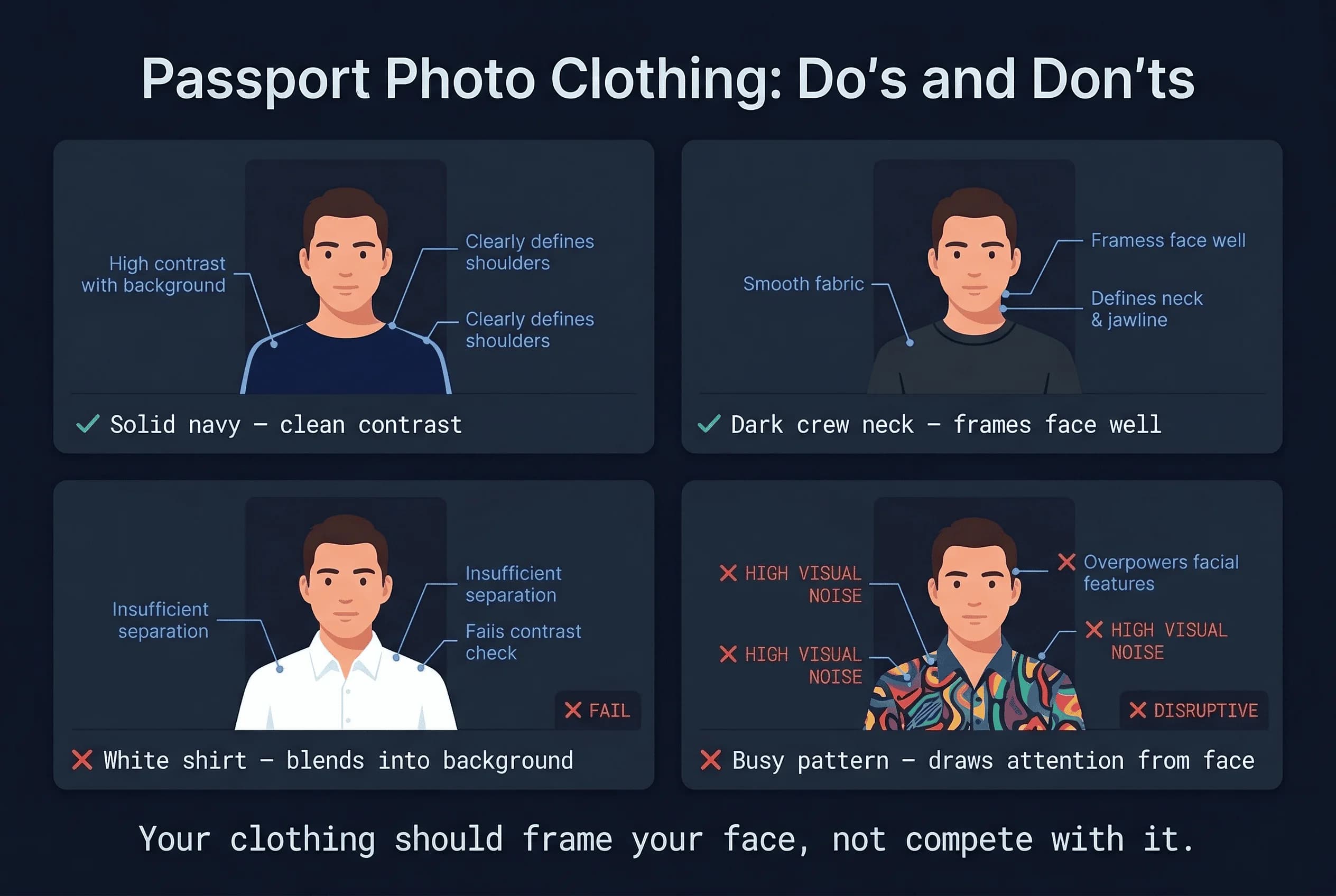
Wear solid, dark-colored clothing that contrasts with your background. Dark navy, black, forest green, and deep burgundy all work well. The key is avoiding anything that blends into the white background or draws attention away from your face.
Passport officials need to see your face clearly. Your clothing should frame your face, not compete with it. The right outfit makes your photo more likely to pass; the wrong outfit is an easy mistake to avoid.
This is one area where a little preparation goes a long way. You don't need special clothes or expensive outfits — just an understanding of what works and what doesn't.
Best Colors to Wear for a Passport Photo
Navy blue is the safest choice. It contrasts well with white backgrounds, looks professional, and works for every skin tone. Navy is the default recommendation for a reason: it's nearly foolproof.
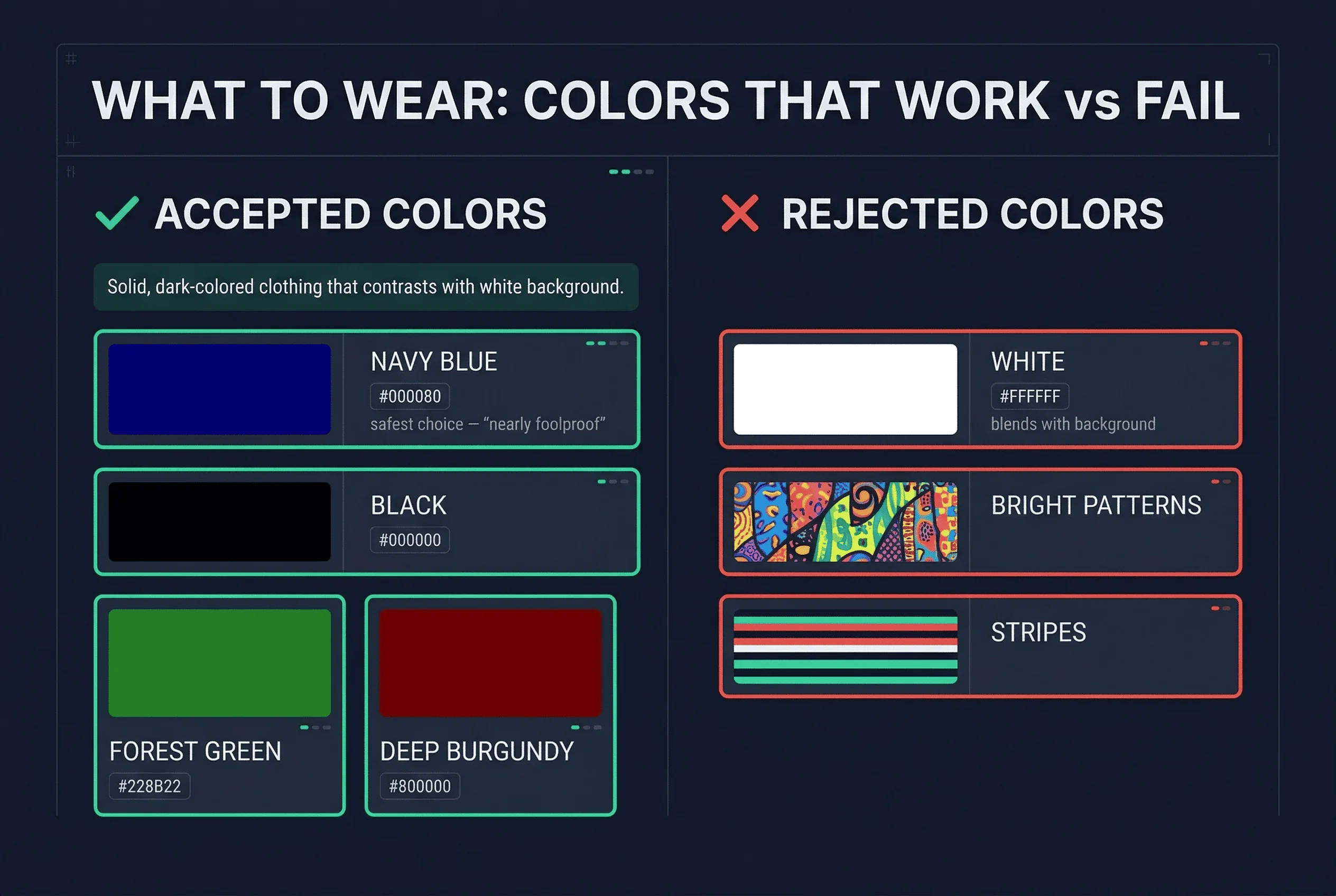
Black is acceptable but can look severe. If you choose black, ensure the lighting is even so your features don't appear too harsh. Black can sometimes make faces look washed out in photos.
Dark green, burgundy, and other deep tones work well. Avoid anything with shine or sparkle — those catch light and create problems.
Gray works if it's a dark, solid gray. Light gray or heather gray blends into white backgrounds and should be avoided.
Get a compliant passport photo online
What Not to Wear in a Passport Photo
White tops are the most common mistake. A white shirt against a white background makes it impossible to distinguish where your neck ends and your clothing begins. The automated system will reject this. It's the number one clothing-related reason for passport photo rejection.
Light colors in general are risky. Cream, beige, light gray, and pastels can all blend into a white background. If you must wear light colors, ensure your photo has excellent contrast — but why take the risk?
Busy patterns are problematic. Stripes, plaids, polka dots, floral prints, and anything with a pattern distract from your face. Some countries specifically ban "busy" patterns. The goal is a clean, simple image.
Low necklines that show bare shoulders can cause issues. The photo should show from your shoulders up, but your shoulders should be covered. V-necks and scoop necks that reveal collarbone are generally fine; wide necklines that show significant shoulder skin are not.
Uniforms are discouraged. Military, police, medical, or any professional uniforms are not appropriate for passport photos. The passport should represent you as a private citizen, not in your professional capacity. This is a general rule, not a strict ban — but avoiding uniforms is wise.
Passport Photo Glasses Rules by Country
This is where rules vary significantly. Glasses are one of the most complex aspects of passport photo requirements:
United States: You cannot wear glasses in passport photos. This includes prescription glasses, sunglasses, and tinted lenses. If you wear glasses daily, you'll need to remove them for the photo — even if you have a medical need. There's no exception for prescription glasses.
United Kingdom: Glasses are allowed as long as there is no glare. This means no flash reflection on the lenses. Photochromic lenses that darken in sunlight can be problematic — bring a backup pair of clear lenses if you need them.
Canada: Prescription glasses are allowed as long as the lenses are clear and free of glare. Sunglasses and tinted lenses are not permitted. Unlike the US, Canada does not ban prescription eyewear from passport photos.
Australia: Glasses are not allowed in Australian passport photos. This matches the US policy — remove all eyewear before taking the photo.
Schengen countries: Generally allow glasses but check the specific country. Flash glare is the main issue everywhere. Italy and France tend to be stricter than other EU countries.
If you wear glasses daily, check the rules for your specific country before your photo appointment. The US and Australia prohibit all glasses; the UK and Canada allow prescription eyewear with clear lenses. If your country prohibits glasses, consider wearing contact lenses for the photo. If you can't wear contacts, you'll need to remove your glasses — the photo is a biometric tool, and looking slightly different without glasses won't affect your travel.
Jewelry Guidelines for Passport Photos
Simple jewelry is usually fine. Small earrings, wedding rings, and modest necklaces that don't dangle or catch light are acceptable. The key word is "modest" — if it draws attention to itself, remove it.
Large, flashy jewelry can be distracting and may cause issues. Hoop earrings that extend past your ears, chandelier earrings, and statement necklaces should be removed. These can create shadows or catch light.
Facial jewelry like nose rings, lip rings, and eyebrow rings are generally acceptable but can cause issues if they reflect light or draw attention away from your face. Remove anything that changes your appearance significantly or creates glare.
Body jewelry (like visible belly button rings) shouldn't be an issue since the photo shows from the shoulders up. But avoid anything flashy or unusual.
Country-Specific Passport Photo Dress Codes
Some countries have explicit dress requirements for passport photos. These are less common than they used to be but still exist:
The UAE requires modest clothing that covers shoulders and knees. This applies to both men and women. The UAE has strict cultural standards that extend to passport photos.
Some Muslim-majority countries expect conservative dress. If you're applying for a visa to a country with specific dress expectations, research the requirements.
Some countries ban clothing with political symbols or inappropriate imagery. Generally, keep your clothing neutral and non-controversial.
Always check specific country requirements before applying. Different countries have different standards, and what's acceptable for one passport might not work for another.
How Clothing Affects Passport Photo Compliance
Your clothing choice doesn't just affect appearance — it influences how automated systems process the photo.
Shoulder detection is used by compliance software to confirm the photo is framed correctly. If your top is white or very light, the system may not detect where your shoulders end and the background begins. This can trigger a framing error even if the photo is correctly composed.
Colour bleeding from bright or heavily saturated clothing can tint the background in photos taken with consumer cameras. A bright red shirt, for example, can reflect red light onto a white wall behind you, creating a subtle pink cast on the background. Dark, non-reflective colours minimize this effect.
Wrinkled or bunched fabric around the neckline can create shadows that extend upward toward the chin. A clean neckline with smooth fabric gives the face a cleaner frame.
Practical Tips for Choosing Passport Photo Clothing
Plan your outfit in advance. Don't wait until you're at the photo counter to think about what to wear. If going to a retail location, bring a dark top in your bag as a backup.
Check your clothes for lint, wrinkles, or stains before the photo. The photo should look presentable — visible lint or collar stains are unprofessional at best and distracting at worst.
Make sure your clothes fit properly around the neckline. Ill-fitting clothing can bunch up and create shadows or look sloppy.
Consider the overall look: hair, makeup (if applicable), and accessories should all work together. A simple, cohesive look is more likely to pass than a mismatched outfit.
Use a passport photo checker to verify your photo before submitting. For more on passport photo accessories, see our guide to wearing makeup in passport photos or headwear rules.
The key is simplicity: solid dark colours, proper fit, nothing that distracts from your face. That's all you need for a passport photo that passes.