No — hats, caps, berets, bandanas, and most head coverings are not allowed in passport photos. There's one major exception: religious or medical headwear that cannot be removed for the photo. This is the standard rule across most countries, though details vary.
This rule exists because your face must be fully visible from chin to the top of your head. Immigration officers need to verify your identity against the photo, and anything covering your hair or forehead compromises that verification. The rule is strict but reasonable.
Understanding the exceptions is important if you wear headwear for religious or medical reasons. The rules are designed to balance security needs with religious freedom.
The General Rule: No Hats Allowed in Passport Photos
Standard headwear is prohibited in passport photos. This includes:
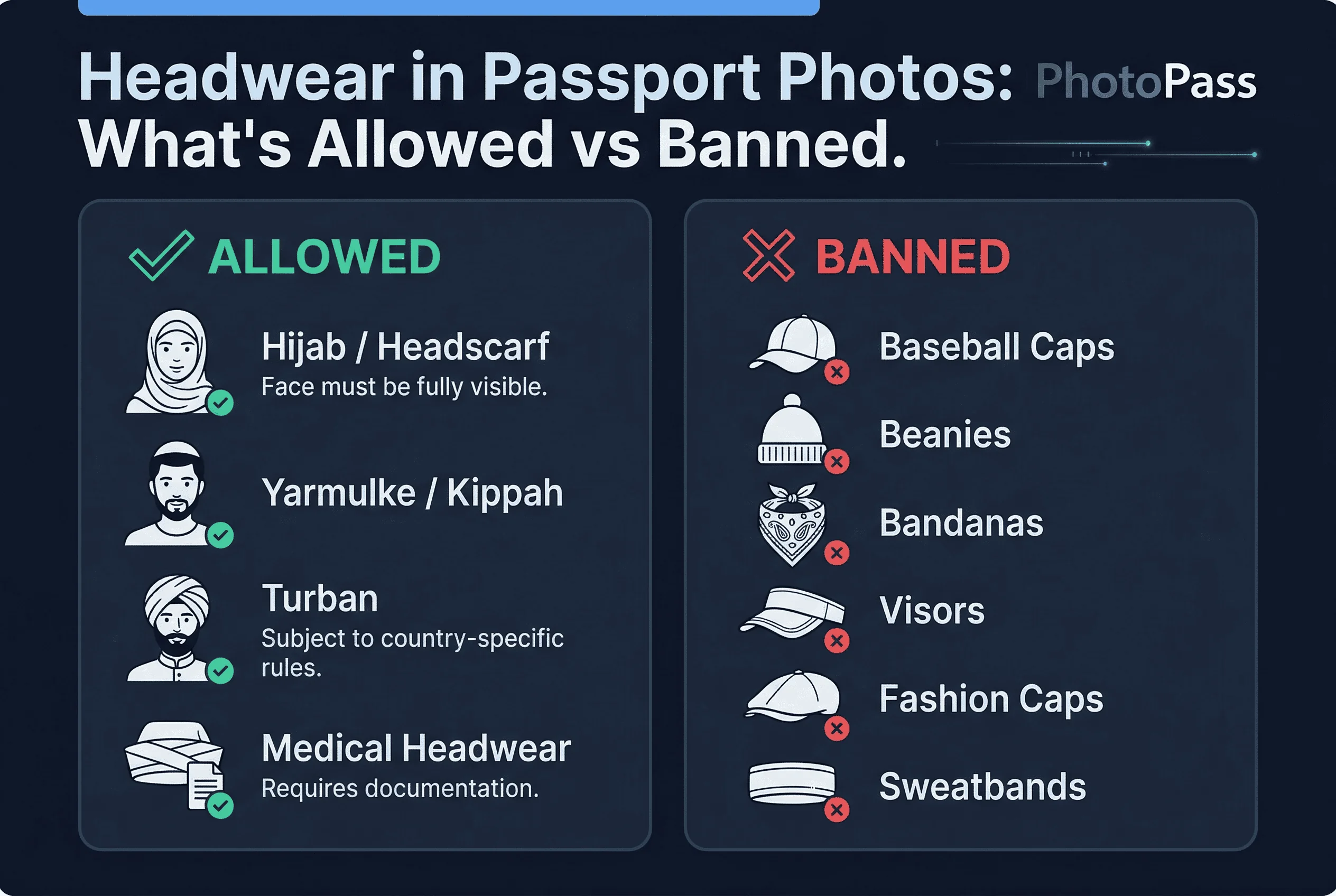
Baseball caps, visors, and any casual headwear Berets and fashion caps Bandanas and headwraps (non-religious) Sweatbands and athletic headwear Beanies and winter caps
The rule applies to anything worn on your head that isn't hair itself. Even if you normally wear a hat every day, you'll need to remove it for your passport photo.
Get a compliant passport photo online
Religious Headwear Exemptions for Passport Photos
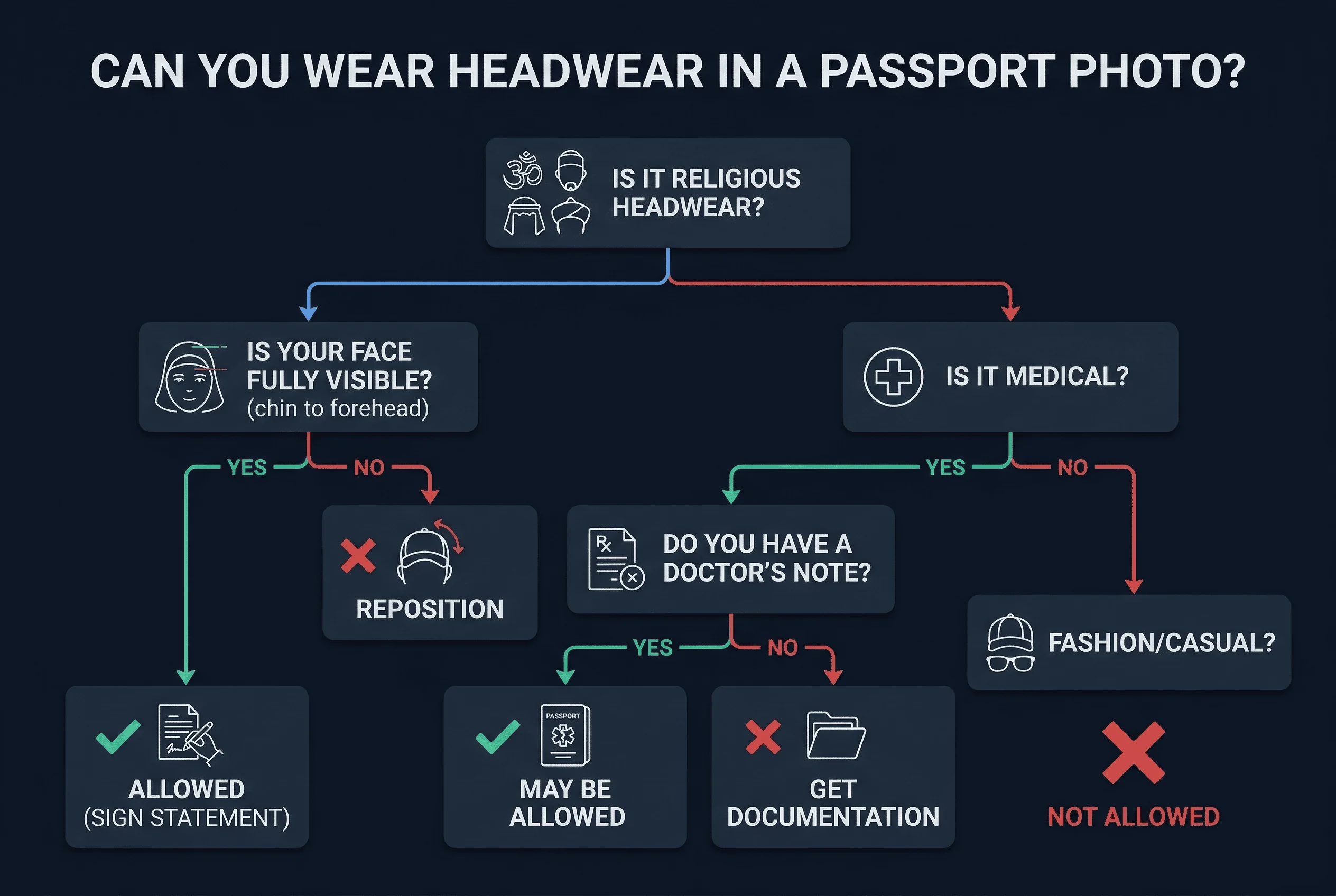
If you wear religious headwear as part of your faith, you're allowed to keep it on for your passport photo. This applies to sincere religious belief, not fashion choices or cultural trends. The exemption covers:
Hijabs and headscarves (Islam) — The face must be fully visible, but the hair and neck can be covered. The scarf should not obscure any part of the face.
Yarmulkes and kippahs (Judaism) — These small head coverings sit on top of the head and don't obscure the face at all. They're generally acceptable.
Sikhs wearing turbans or patkas — The rules are more complex here. In some countries, the turban can stay; in others, it must be removed. The key is that the face must be completely visible.
Habits or veils (Christianity) — Some religious orders require veils or habits. These may be allowed if the face is clearly visible.
Any other religious headwear that is part of consistent religious practice. The key is sincerity — this isn't a loophole for fashion headwear.
To qualify for the exemption, the headwear must sit naturally on your head — not obscuring your face, not tilted at an unusual angle, not covering any part of your forehead or eyebrows. The oval of your face must be completely visible.
The US State Department provides a checkbox on the form for those who need the religious exemption. You'll typically need to sign a statement confirming that the headwear is worn due to religious beliefs.
Some countries are more strict than others about how the religious headwear can be positioned. For example, the UK requires that the face be clearly visible from chin to top of head, but the scarf can be draped over the shoulders. The US allows religious headwear but requires a note explaining the religious basis if the headwear covers the ears.
Medical Headwear Exemptions for Passport Photos
Medical headwear is sometimes allowed with documentation. This is rare and typically applies only to:
Head coverings required immediately after surgery Medical devices worn on the head Bandages for head injuries Prosthetic headwear used for medical reasons
You'll need a doctor's note explaining why the headwear cannot be removed for the photo. The note should be on official letterhead and explain the medical necessity.
Medical exemptions are evaluated on a case-by-case basis. Don't assume you'll automatically qualify — get documentation in advance.
Are Hair Accessories Allowed in Passport Photos?
This is a gray area. Small hair clips, bobby pins, and regular hair ties are generally acceptable if they're not visible or don't alter your head shape significantly.
Headbands, bandanas, and wraps are more problematic. These are technically not hats, but they're also not everyday hair accessories for everyone. If a headband significantly changes your hairline appearance or sits on your forehead, it can cause issues.
The safest approach is to remove all headwear and hair accessories unless you qualify for a religious exemption. If you wear a headband daily as part of your hairstyle, bring proof (like a social media photo) in case you're questioned.
Hair ties that are visible in the photo may be flagged. Clear or flesh-colored elastic is less likely to cause issues than colored or decorated ties.
Passport Photo Headwear Rules by Country
The US State Department has a clear religious exemption policy and provides a checkbox on the form for those who need it. The policy is well-established and consistently applied.
The UK is similarly accommodating but requires the religious headwear to not obscure any facial features. The British passport system is generally flexible with religious exemptions while maintaining security standards.
Some countries are more strict. Check the specific requirements for India if that's your destination, as some countries have specific guidelines about how religious headwear should be positioned. India's rules can vary depending on whether you're applying for an Indian passport or an Indian visa.
Australia and Canada follow similar policies to the US and UK. The general international standard is: religious headwear is allowed if it doesn't obscure the face.
Some countries don't have clear religious exemption policies or may not honor them in practice. If you're applying for a passport from a country you're unfamiliar with, research the requirements carefully using our passport photo requirements tool.
How to Take a Passport Photo with Religious Headwear
If you're wearing approved religious headwear, the photo still needs to meet all other compliance requirements — and the headwear can make some of them harder to achieve.
Shadows are the biggest risk. A hijab, turban, or kippah can cast shadows on the face, particularly under overhead lighting. The shadow from a hijab's edge can fall across the forehead or cheeks, which triggers the same rejection as any other facial shadow. Use frontal lighting — face a large window directly, or use two light sources from either side of the camera — to minimise shadows from the headwear's edges.
Head positioning measurements still apply. Government systems measure the face from chin to the crown of the head (or the top of the headwear if it covers the crown). A turban or tall headwrap may affect how much of the frame your head occupies. If the headwear adds significant height, step slightly further from the camera so your head still falls within the required proportion of the frame.
Colour contrast matters. A white hijab against a white background can make it difficult for automated systems to distinguish the boundary of your headwear from the background. If possible, choose a headwear colour that contrasts slightly with the required background colour. For US photos (white background), a non-white head covering photographs more cleanly.
Practical Advice for Headwear in Passport Photos
If you're considering wearing any type of headwear, check the requirements for your specific country before your photo appointment. Don't assume that what's accepted in one country works in another.
When in doubt, remove the headwear — you can always put it back on immediately after the photo is taken. The photo takes seconds; the passport lasts years.
If you qualify for a religious exemption, bring documentation. A letter from your religious leader or proof of membership in a religious organisation can help smooth the process. Having paperwork ready prevents delays at the acceptance facility.
If you're unsure whether your specific headwear qualifies, contact the passport authority in advance and ask. It's better to clarify beforehand than to have your application rejected and lose weeks to reprocessing.
For more on passport photo rules, see our guide to makeup in passport photos or what to wear.