Schengen Visa Photo Size and Dimension Requirements
The Schengen Area encompasses 27 European countries that share a unified visa photo standard based on the ICAO 9303 biometric specification. The requirements are:
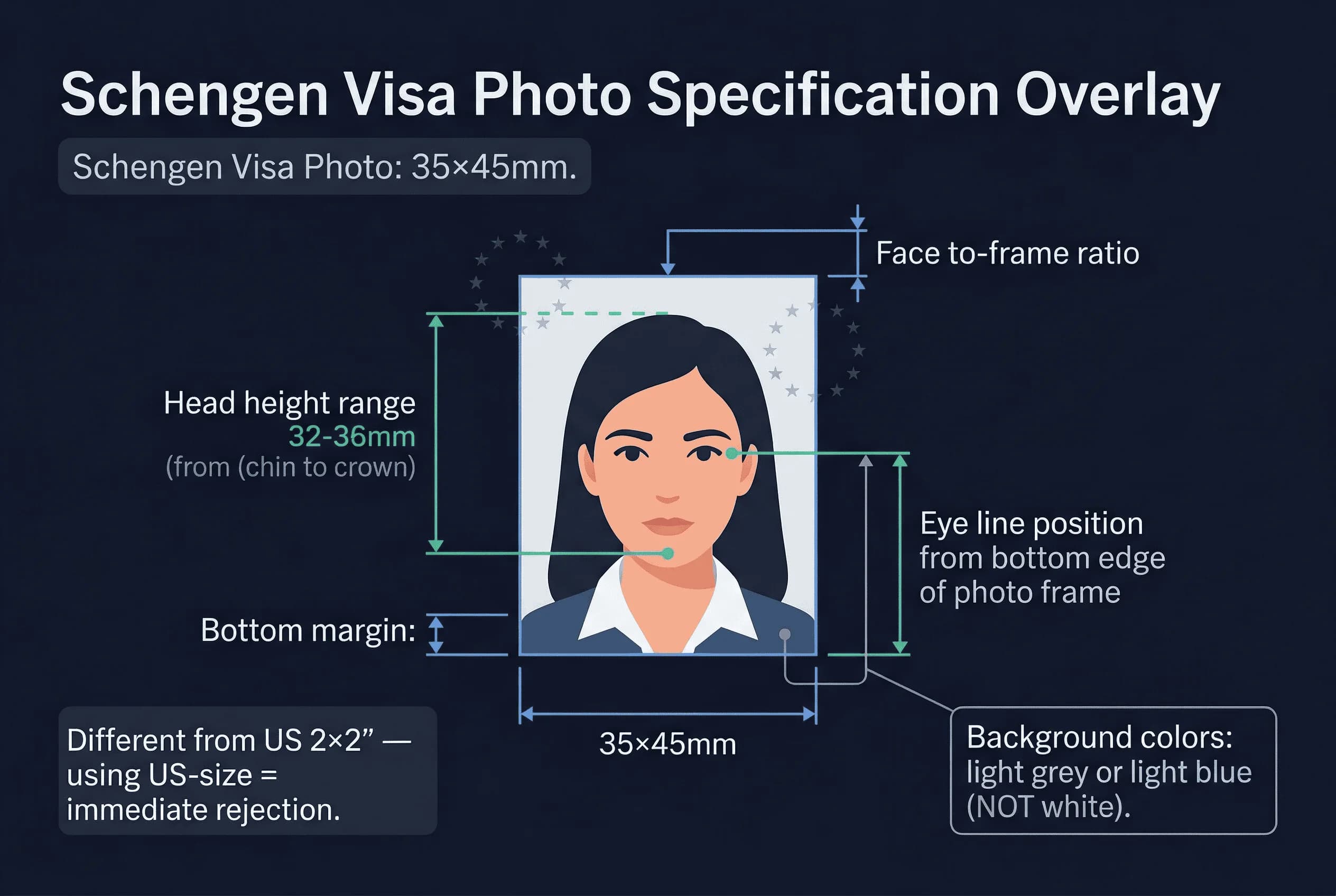
- Size: 35 × 45 mm (approximately 1.38 × 1.77 inches) in portrait orientation
- Digital equivalent: 413 × 531 pixels at 300 DPI
- Head height: Your face from chin to the top of your head must fill 60 to 80 percent of the frame height — this translates to roughly 27 to 36 mm in a 45 mm photo. For optimal biometric quality, aim for 32 to 36 mm.
- Eye line: Approximately 56 percent from the bottom of the image, or about 25 mm from the bottom edge
- Head position: Centered, facing directly forward with both eyes open
- Resolution: Minimum 300 DPI for printed submissions
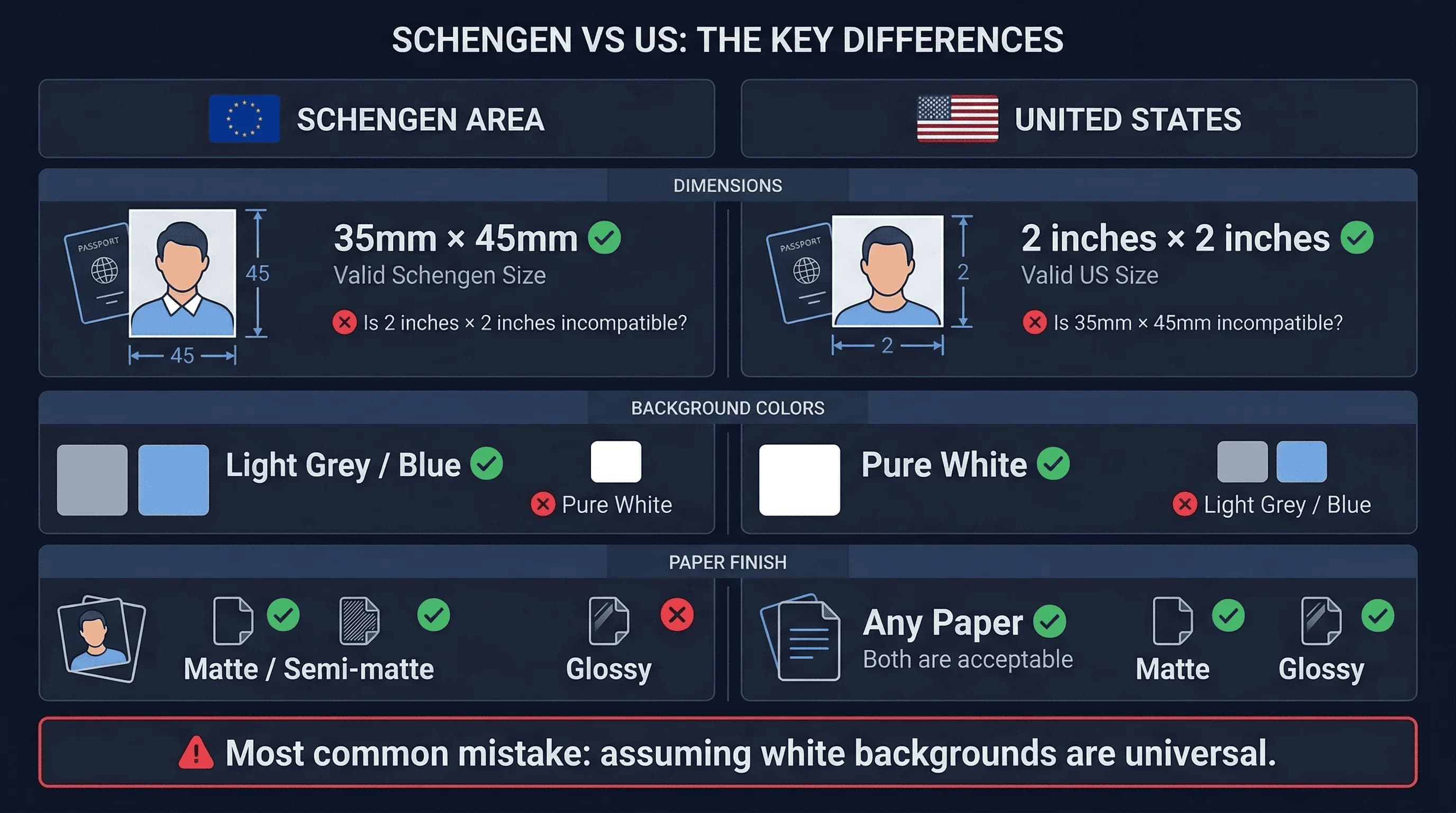
This format is notably different from US passport photos, which use a 51 × 51 mm square. A US-size photo submitted for a Schengen visa will be rejected immediately. It is also different from the Indian passport format (35 × 35 mm square).
Get a compliant passport photo online
Schengen Visa Photo Background and Lighting Rules
The background must be plain white or light grey — both are accepted under the ICAO standard. The background must be uniform with no patterns, shadows, gradients, or visible objects.
Some individual consulates have a preference. For example, some German consulates specifically request light grey, while some Spanish consulates accept plain white. When in doubt, light grey is the safer choice across the Schengen area, but white is not wrong.
What does NOT work
- Cream, off-white, or beige tones
- Blue, green, or any colored background
- Textured walls or patterned wallpaper
- A background with your shadow visible on it
Lighting guidance
Even, front-facing lighting is essential. The ICAO standard is strict about shadows:
- Use two light sources at eye level on either side of the camera to eliminate shadows on the face and background.
- Avoid overhead lighting, which casts shadows under the nose and chin.
- Avoid direct flash, which can create glare, hot spots, or red-eye.
- Natural daylight from a large window you are facing (not standing in front of) gives the most even result at home.
Stand at least half a meter in front of the background to prevent your body from casting shadows onto it.
Expression and Appearance Rules for Schengen Visa Photos
The ICAO biometric standard is strict:
- Expression: Neutral expression with mouth closed. No smile — not even a slight one. The US allows a closed-mouth smile, but Schengen does not.
- Glasses: Not allowed. This includes prescription glasses, sunglasses, and tinted lenses. Remove all eyewear before taking the photo. Clear prescription contact lenses are fine, but colored or cosmetic lenses that alter your eye appearance should be avoided.
- Eyes: Both eyes must be clearly visible and open. No hair, accessories, or shadow should obstruct either eye.
- Head coverings: Only permitted for documented religious reasons. The full face must remain visible from the bottom of the chin to the top of the forehead, and the covering must not cast shadows on the face.
- Hair: Must not obscure the face. Pull hair back from the forehead and behind the ears where possible.
Schengen Visa Photo Recency and Color Requirements
The photo must have been taken within the last six months. If your appearance has changed significantly — through weight change, surgery, facial hair, or aging — the photo may be rejected even if it is recent. Consulates compare your visa photo to the one in your passport during processing.
Photos must be in full color with natural skin tones. No black-and-white images, no filters, and no digital retouching that alters your appearance.
Digital Photo Requirements for Schengen Visa Applications
If you are applying through an online visa portal (such as the EU's upcoming EES/ETIAS system or national consulate portals), your digital photo should meet:
- Format: JPEG
- Dimensions: 413 × 531 pixels (35 × 45 mm at 300 DPI)
- Resolution: 300 DPI minimum
- Color space: sRGB
- File size: Varies by portal, but typically under 500KB
For in-person submissions, bring two printed 35 × 45 mm photos on photo-quality paper with a matte or semi-matte finish.
How Schengen Visa Photos Differ from US and Indian Standards
If you are accustomed to US or Indian passport photo rules, these are the critical differences:
| Feature | Schengen | US | India |
|---|---|---|---|
| Size | 35 × 45 mm (portrait) | 51 × 51 mm (square) | 35 × 35 mm (square) |
| Face coverage | 60–80% | 50–69% | 60–80% |
| Expression | Neutral only, no smile | Neutral or slight smile | Neutral only |
| Glasses | Not allowed | Not allowed | Not allowed |
| Background | White or light grey | White or off-white | Pure white only |
The most common mistake is using a US-size photo. The 51 × 51 mm square format is the wrong size and the wrong shape for Schengen — it must be 35 × 45 mm portrait orientation.
Country-Specific Schengen Visa Photo Variations
While the base ICAO specification is shared across the Schengen area, individual consulates may enforce additional requirements:
- Germany: Particularly strict about head positioning — centered within a tight tolerance. Biometric photo booths at German consulates enforce this automatically.
- France: Accepts photos from automated photo booths, which many countries are more cautious about.
- Netherlands: Requires both ears to be visible in the photo.
- Italy: Standard ICAO rules, but some consulates prefer white background over grey.
Always check your destination country's consulate website for any country-specific guidance in addition to the base Schengen standard.
Common Schengen Visa Photo Mistakes That Cause Rejections
Wrong photo size: Using a US-format 51 × 51 mm photo or an Indian 35 × 35 mm photo instead of the required 35 × 45 mm portrait format. This is the fastest way to get rejected.
Background issues: Using a colored background, having visible shadows, or using a textured wall. Both white and light grey are acceptable — but they must be uniform and clean.
Glasses in the photo: Glasses are not permitted. This includes clear prescription frames with no tinting.
Wrong expression: Any smile or change from a neutral expression. The ICAO standard is strict — no exceptions.
Face not properly framed: Head too small in the frame (under 60% of the photo height) or too large (over 80%). The face must be centered with the eyes at approximately 56% from the bottom.
Old photo: Photos older than six months are rejected. If your appearance has changed, even a recent photo may be questioned.
How to Get Your Schengen Visa Photo Right
A Schengen visa application already involves extensive paperwork, appointment scheduling, and processing times of 15 to 45 calendar days. A photo rejection adds unnecessary delay to an already lengthy process. Use the passportsize-photo.online compliance checker to validate your photo against ICAO Schengen standards before submitting.
For the full specification, see our Schengen Area photo requirements guide.