Indian Passport Photo Dimensions: 35×35mm Square
Indian passport photos use a 35 × 35 mm square format — a size unique to India. This is smaller than the US format (2×2 inches / 51×51mm) and different from the European rectangular 35×45mm standard. Neither a US nor a UK passport photo can be reused for an Indian passport application.
- Print size: 35 × 35 mm (3.5 × 3.5 cm)
- Digital equivalent: 413 × 413 pixels at 300 DPI
- Face coverage: Your face must fill 60 to 80 percent of the frame vertically
- Head position: Centered, looking directly at the camera with both eyes open
- Resolution: Minimum 300 DPI for printed submissions
The face coverage requirement of 60–80% is higher than most countries (the US requires only 50–69%). If your head is too small in the frame (common with photos taken from too far away) or too large (cropped too aggressively), the photo will be rejected.
Get a compliant passport photo online
Passport Seva Digital Upload Requirements for Indian Photos
If you are applying online through the Passport Seva portal, your digital photo must meet specific technical requirements:
- Format: JPEG only
- File size: Between 10KB and 300KB
- Pixel dimensions: Minimum 350 × 350 pixels
- Color space: sRGB
The portal validates these requirements automatically on upload. Photos that do not meet the specifications are rejected immediately, and you will need to re-upload before your application can proceed. Re-submissions typically add 5 to 7 business days to the processing timeline.
For applicants submitting at a Passport Seva Kendra (PSK) in person, bring two printed 35×35mm photos on photo-quality paper. Most PSKs also have on-site photo services where you can get photos taken for around ₹100–₹200 if your prints are rejected.
Indian Passport Photo Background Requirements
The background must be plain white. The Ministry of External Affairs requires pure white — not cream, not light grey, not off-white. This is stricter than some people expect, and the Passport Seva automated screening system will reject backgrounds that appear white to the eye but register as slightly grey or tinted.
The background must be free of patterns, shadows, textures, and visible objects. If you are taking the photo at home, a clean white wall with no shadows works well. A white poster board or foam core from any stationery store is a reliable alternative. Stand about two feet in front of the background so your body does not cast shadows onto it.
Expression and Appearance Rules for Indian Passport Photos
India follows the strict ICAO international standard for facial expression. This is more restrictive than the US rules:
- Expression: Neutral expression with mouth closed. No smile — not even a slight one. Unlike the US, which permits a slight natural smile, India rejects any deviation from neutral. The automated system flags "expression not as per specifications" for any non-neutral face.
- Glasses: Not allowed since 2020. The Ministry of External Affairs banned all glasses including prescription eyewear. Medical exemptions exist but require a certificate and prior approval from the Regional Passport Office — for most people, switching to contact lenses is far easier.
- Contact lenses: Clear prescription contacts are fine. Colored or cosmetic lenses that change your eye color may trigger additional verification.
- Ears: Both ears should be visible. This is strongly recommended, not an absolute rule, but photos with both ears visible have a significantly lower rejection rate.
- Hair: Must not obscure the face. Pull hair back from the forehead and keep it behind the ears where possible.
- Head coverings: Permitted for religious reasons, but the full face from chin to forehead must be clearly visible with no shadows from the covering.
Photo Recency and Color Rules for Indian Passports
The photo must be recent — taken within the last six months. If your appearance has changed significantly, the photo may be rejected even if it was taken recently. This is compared against your existing passport photo during renewal applications.
Photos must be in full color with natural skin tones. No black-and-white images, no filters, and no heavy digital editing.
Lighting Tips for Indian Passport Photos
Even, front-facing lighting is essential. Avoid:
- Overhead lights that cast shadows under the nose and chin
- Flash that creates glare or red-eye
- Side lighting that illuminates one half of the face more than the other
Natural daylight from a window you are facing (not standing in front of) gives the most even result. If using artificial light, two lamps at eye level on either side of the camera reduce shadows effectively.
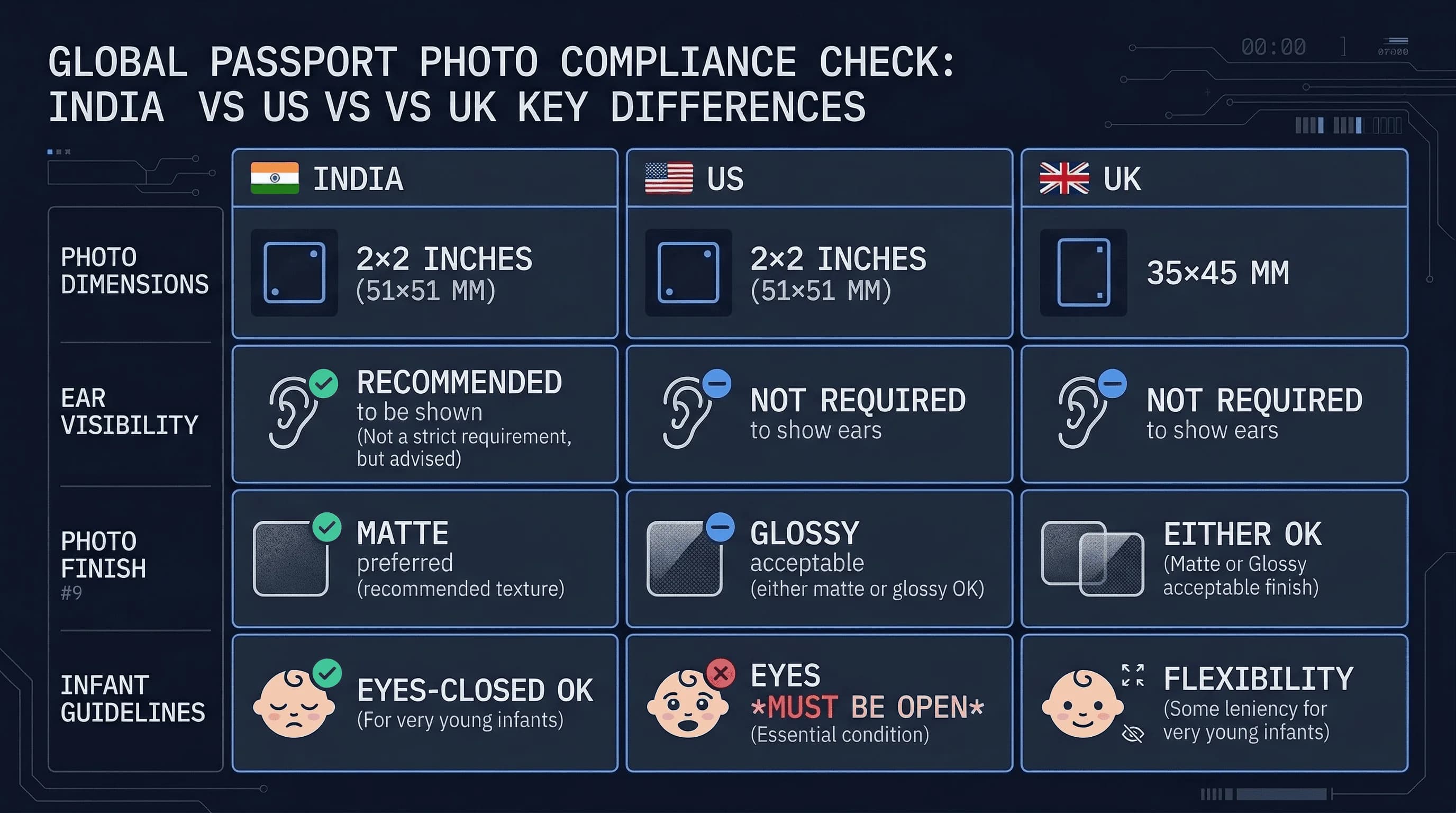
Indian Passport Photo vs US and UK Standards
If you are accustomed to US or UK passport photo rules, be aware of these important differences:
| Feature | India | US | UK |
|---|---|---|---|
| Size | 35×35mm | 51×51mm (2×2 in) | 35×45mm |
| Face coverage | 60–80% | 50–69% | 70–80% |
| Expression | Neutral only, no smile | Neutral or slight smile | Neutral only |
| Glasses | Banned (2020) | Banned (2016) | Banned (2018) |
| Background | Pure white only | White or off-white | Light grey allowed |
| Print finish | Matte preferred | Matte or glossy | Matte or glossy |
No border: Unlike some European countries, Indian passport photos should not have a white border around the image.
Matte finish preferred: Glossy prints are accepted, but matte finish scans more clearly at the Passport Seva Kendra and is the safer choice.
OCI Card Photo Size and Specifications
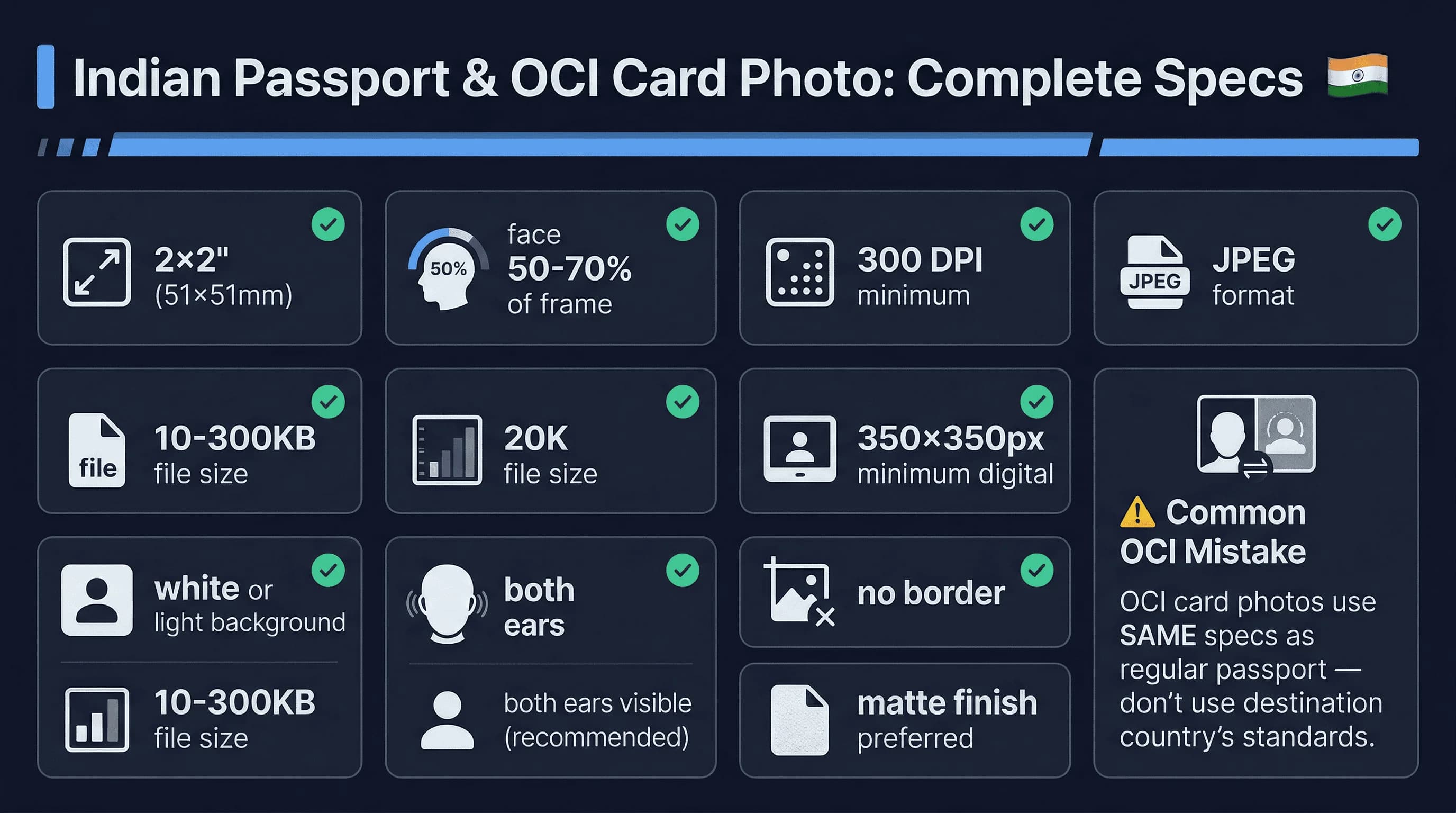
Overseas Citizenship of India (OCI) card applications use a different photo size than regular Indian passports. OCI photos require the 2 × 2 inch (51 × 51 mm) format — the same as the US passport standard — rather than the 35×35mm format used for Indian passports. Some consulates may also accept the 35×35mm variant, but the primary requirement listed on the OCI application form is 2×2 inches.
Other rules remain the same — white background, neutral expression, no glasses — but the face coverage requirement is different: OCI requires 49 to 69 percent (similar to the US standard) rather than the passport's stricter 60 to 80 percent. The common mistake for applicants living abroad is using the photo standards of their resident country instead of the OCI-specific requirements.
Common Indian Passport Photo Mistakes That Cause Rejection
Wrong expression: Any hint of a smile triggers rejection in the automated system. This is the most common issue for applicants who are accustomed to US photo rules where a slight smile is allowed.
Background not pure white: Light grey and off-white backgrounds that pass in other countries are rejected in India. Use pure white.
Wrong photo size: Applicants living abroad often submit photos in their resident country's format — 2×2 inches if in the US, or 35×45mm if in Europe. India requires 35×35mm for passports, which is neither of those sizes.
Glasses in the photo: Since the ban is relatively recent (2020), some applicants still submit photos with glasses. The photo will be rejected at upload or at the PSK counter.
Face too small or too large in frame: The 60–80 percent face coverage rule is stricter than most countries and is enforced rigorously. Use a compliance tool to verify positioning before printing.
How to Get Your Indian Passport Photo Right the First Time
The safest approach for Indian passport and OCI applications is to use an AI compliance checker that validates against the exact Indian government specifications. This catches dimension errors, background issues, expression flags, and positioning problems before you submit — avoiding costly delays in an already lengthy process.
For the full list of India passport photo requirements, see our country-specific guide.