The US State Department accepts both matte and glossy passport photos. Most other countries follow the same rule. The paper finish rarely causes rejection — but there are specific situations where one type works better than the other, and knowing the differences helps you make the right choice.
Matte vs Glossy vs Semi-Gloss for Passport Photos
Understanding the practical differences between finishes matters more than understanding the technical details.
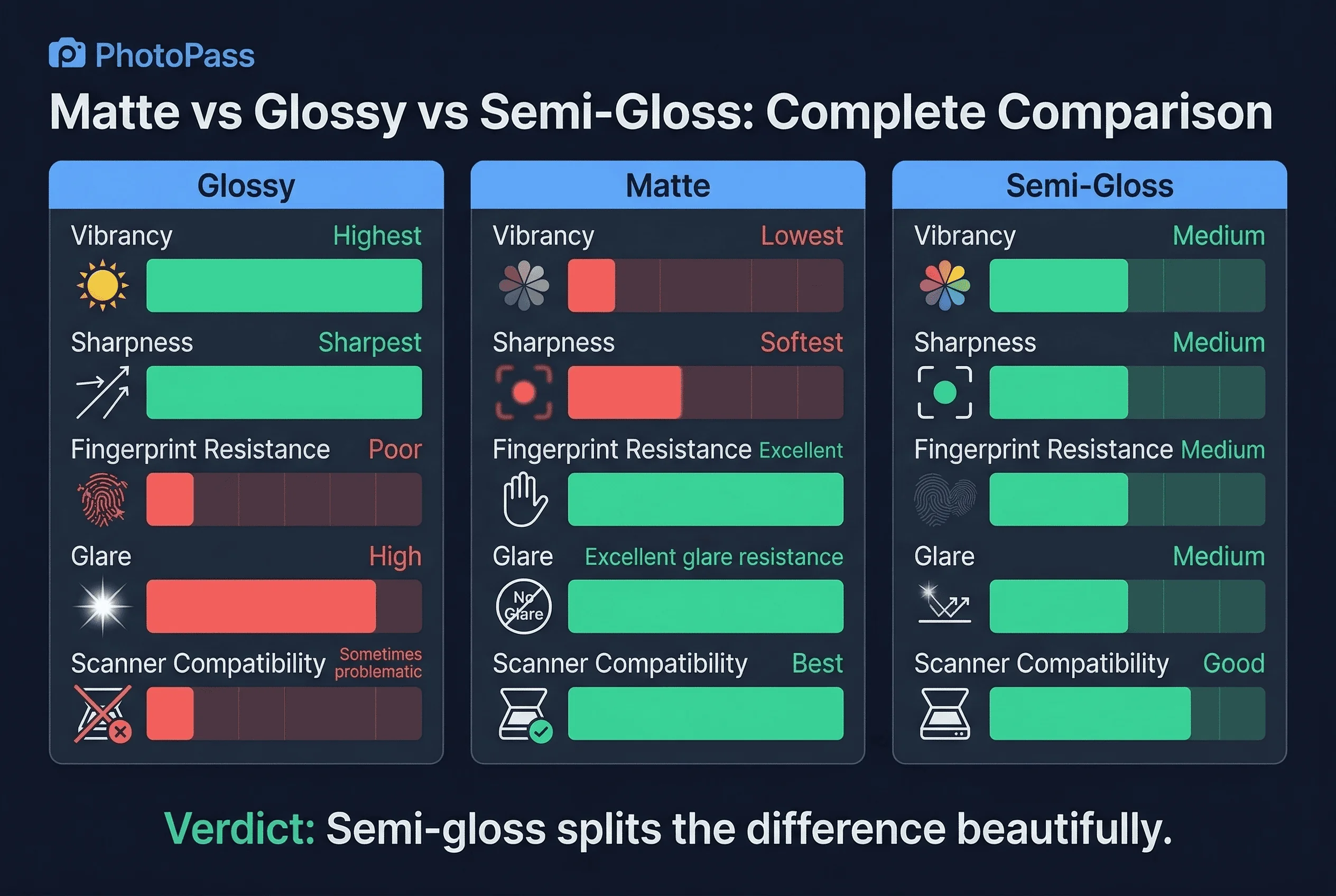
Glossy paper has a shiny, reflective surface that makes colors pop. Photos appear sharper and more vibrant. The downside: fingerprints show easily, and the glare can interfere with facial recognition scanners in some countries. If you've ever tried to photograph a glossy print with your phone, you know exactly what happens — the light reflects off the surface and obscures the image. That same principle applies when embassy scanners try to read your photo.
Matte paper absorbs light rather than reflecting it. There's no glare, fingerprints don't show, and the surface feels more substantial and professional. Colors appear slightly less vivid than on glossy, and images have a softer, more muted look that some people actually prefer for formal documents. Matte photos also age better — they're less likely to stick together if they get humid.
Semi-gloss (also called luster or satin) splits the difference beautifully. You get some shine without the full reflection of glossy, better color vibrancy than matte, and moderate fingerprint resistance. It's the safest all-around choice if you're unsure which to pick. Many professional passport photo services use semi-gloss specifically because it works well across the widest range of scenarios.
| Feature | Glossy | Matte | Semi-Gloss |
|---|---|---|---|
| Color vibrancy | Highest | Lowest | Medium |
| Sharpness | Sharpest | Softest | Medium |
| Fingerprint resistance | Poor | Excellent | Good |
| Glare potential | High | None | Low |
| Scanner compatibility | Sometimes problematic | Excellent | Good |
| Aging/durability | Good | Excellent | Very good |
Get a compliant passport photo online
Which Paper Finish Does Each Country Prefer for Passport Photos?
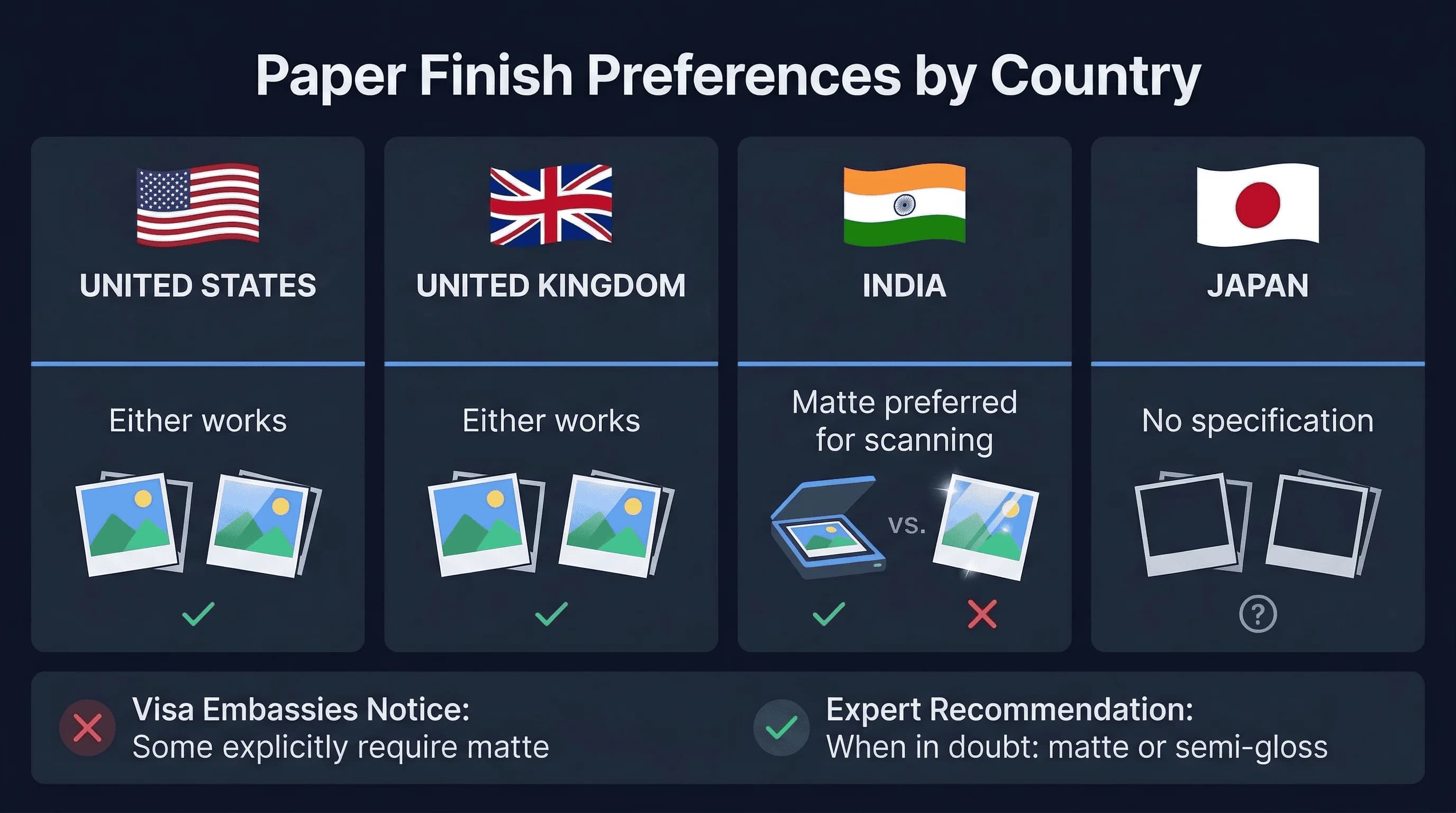
Most countries accept all finishes without restriction, but some have documented preferences or documented issues that are worth knowing before you print.
United States: Either matte or glossy works perfectly fine. The State Department specifies only that photos must be "printed on photo-quality paper." There's no finish requirement in the official guidelines. Your photo will be accepted either way.
United Kingdom: Same as the US — either finish passes without issue. The UK Passport Agency accepts both without expressing any preference. Your application won't be flagged regardless of which you choose.
India: Both finishes are technically accepted. However, the Indian passport portal recommends avoiding extremely shiny finishes because their centralized printing system works better with less reflective surfaces. If you're applying for an Indian passport, lean toward matte or semi-gloss.
Germany: Matte is preferred. German biometric passport scanners sometimes struggle with glossy finishes because the reflective surface interferes with infrared scanning. While glossy photos aren't automatically rejected, using matte for German applications eliminates unnecessary risk. Germany takes biometric accuracy seriously.
Canada: Either finish works without issue. Passport Canada accepts both without specifying a preference. Choose based on personal convenience rather than technical requirements.
Japan: Glossy is traditionally preferred. Japanese passport photos have historically used glossy finishes, and the printing technology at Japanese consulates expects glossy paper. This isn't a strict requirement, but going with glossy aligns with their standard process.
Australia: Either finish is acceptable. The Australian Passport Office specifies photo-quality paper but doesn't mandate or recommend a particular finish.
France: Semi-gloss is the safest choice. The French passport system works well with all finishes, but the slightly reflective surface helps their scanning equipment read the photo accurately.
Best Passport Photo Paper for Home Printing
If you're printing at home, your choice narrows based on your printer type.
Inkjet printers work significantly better with glossy photo paper. The glossy coating prevents ink from feathering or bleeding, producing sharper edges and more accurate colors. Inkjet printers and matte paper don't mix well — the matte coating lets ink spread slightly, creating soft images that look blurry when examined closely. If you have an inkjet, glossy is the path of least resistance.
Laser printers handle both finishes equally well since toner bonds to the surface rather than soaking in like ink. If you have a laser printer, choose based on personal preference rather than technical limitations.
Semi-gloss works reasonably well with most home printers. It's not as perfectly optimized as glossy for inkjet, but it produces acceptable results without the fingerprint and glare issues of full glossy. If you don't want to buy multiple paper types, semi-gloss is the sensible single choice.
Whatever you choose, avoid regular copy paper at all costs. Standard 80gsm printer paper absorbs ink unpredictably, produces muddy colors, and looks obviously amateur. Government officials see hundreds of photos daily — they notice when something looks homemade. The difference between photo paper and copy paper is immediately visible. Use photo paper (typically 180-260 gsm) for professional results.
When Passport Photo Paper Doesn't Matter: Digital-Only Applications
An increasing number of countries accept digital-only passport applications. If you're submitting your photo online, paper type is irrelevant — you're uploading a JPEG file, not a physical print.
Countries with digital-only or digital-preferred options
- New Zealand — Fully digital passport applications; paper photos are essentially obsolete
- UK — Online passport applications accept digital photo uploads
- US — The online renewal pilot programme accepts digital uploads (limited eligibility)
- Japan — Online passport applications via My Number Card accept digital photos
- Singapore — ICA accepts smartphone-taken digital photos
For these applications, focus on pixel dimensions, file format (JPEG), and file size limits instead of paper finish. Paper type only matters when you physically print the photo for a mail-in or in-person application.
If you're submitting both digitally and in person (common for some visa applications where you upload to the DS-160 AND bring a printed copy to the interview), then paper type matters for the printed version only.
Does Paper Weight Matter for Passport Photos?
Paper weight, measured in grams per square meter (gsm), affects how substantial the paper feels more than how well it prints. But that feel matters.
Photo paper typically ranges from 180gsm to 350gsm. For passport photos, anything above 200gsm works well. The heavier weight prevents curling, feels more professional, and handles better during the application process. A 250gsm photo feels like a proper document — not flimsy or cheap.
Lower weights (below 150gsm) feel flimsy and can cause feeding problems in printers. They also crease more easily during mailing, which could damage your carefully prepared photos. We've all seen what happens when a thin photo gets bent — the image itself doesn't repair itself.
Heavier weights (300gsm and above) can be too thick for some home printers, especially older inkjet models. Check your printer's specifications if you're using heavy cardstock. Most modern printers handle 250gsm without issue.
For most situations, semi-gloss hits the sweet spot — professional appearance, good compatibility with all country systems, and minimal hassle. Check your target country's specific requirements on our country requirements page to confirm before printing. For German applications specifically, use our Germany passport photo guide for detailed recommendations.