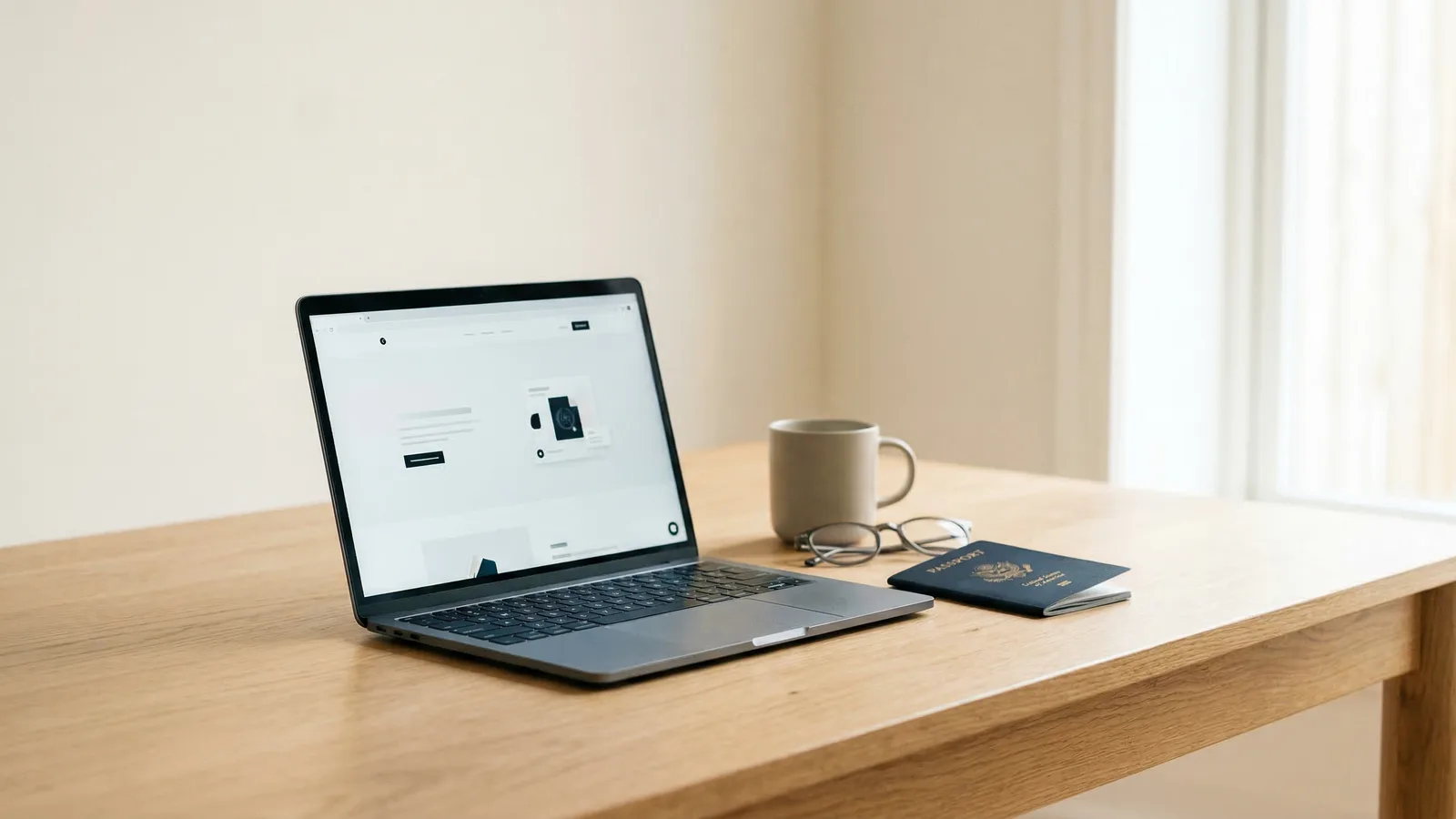
A professional photographer charges $25–$75 for passport photos. Your phone camera costs nothing. Both can produce a compliant 2×2 inch (or 45×35mm, depending on your country) passport photo that passes government review. The difference is in the experience, the consistency, and whether you trust yourself or a professional to get the details right.
Here's an honest comparison of taking your passport photo at home versus going to a studio — with the specific scenarios where each option makes more sense.
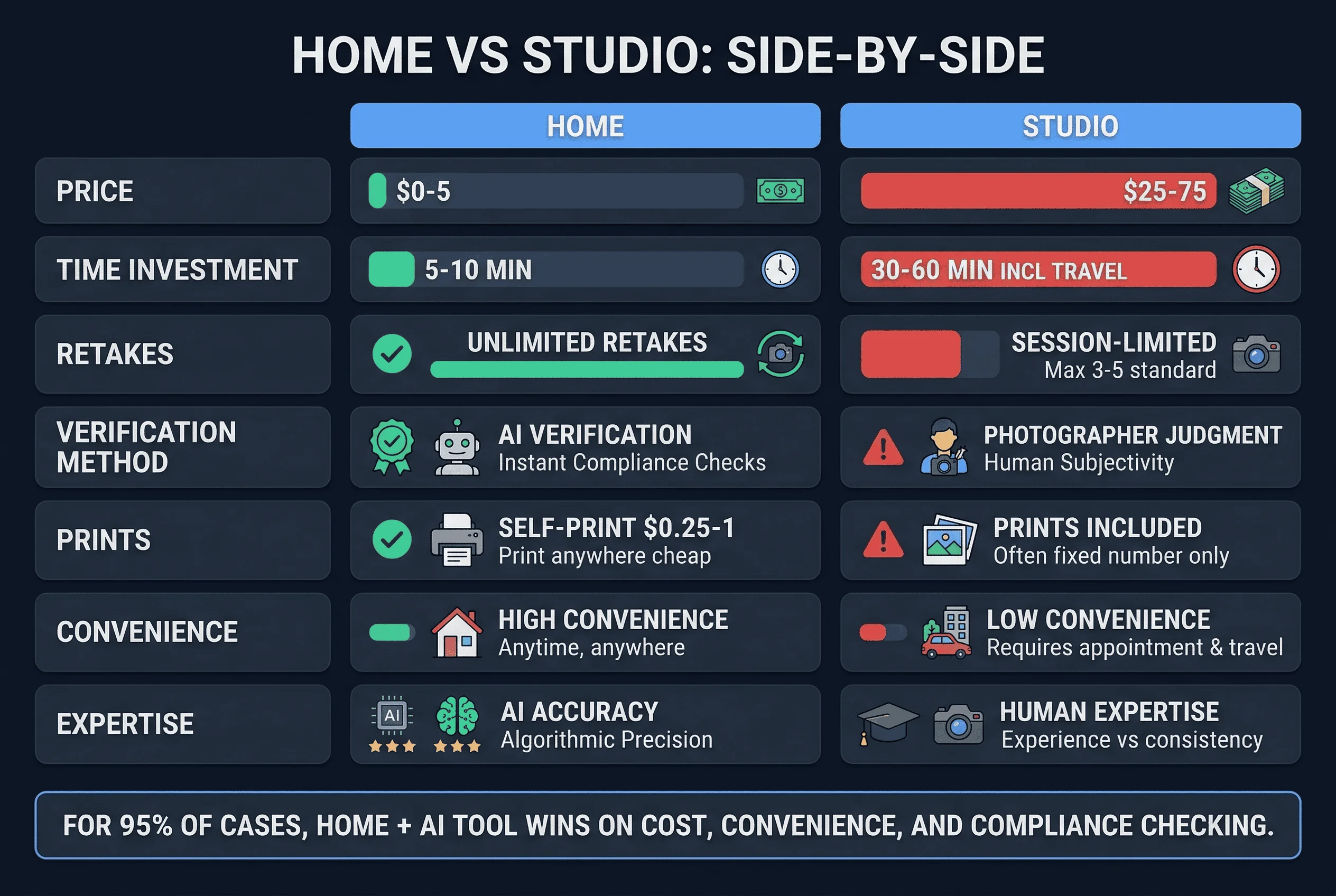
Home vs Studio Passport Photo: Quick Comparison
| Factor | Home (DIY) | Professional Studio |
|---|---|---|
| Cost | $0–$5 (phone + online tool) | $25–$75 |
| Time | 5–10 minutes | 30–60 minutes (including travel) |
| Equipment | Smartphone + white wall | Professional camera + lighting + backdrop |
| Compliance check | AI verification (if using online tool) | Photographer's experience |
| Retakes | Unlimited, immediate | Usually included, but session is fixed |
| Digital copy | Yes (if using online tool) | Often, but may cost extra |
| Prints | Self-print for $0.25–$1 | Usually included in the session fee |
Get a compliant passport photo online
How to Set Up a DIY Passport Photo at Home
Taking a passport photo at home requires three things: a smartphone, a plain white wall (for US photos) or appropriate background for your country, and decent lighting.
The wall. Find the whitest, smoothest wall in your home. Avoid walls with visible texture, nail holes, or off-white paint. Stand about 12–18 inches in front of the wall to prevent your shadow from falling on it.
The lighting. Natural daylight is the best free lighting available. Position yourself facing a large window with indirect sunlight. Avoid direct sunlight — it creates harsh shadows. If you're shooting at night, use two lamps positioned at 45-degree angles to your face to minimize shadows.
The camera. Any smartphone from the last five years has a camera good enough for passport photos. Use the rear camera, not the selfie camera — it produces sharper, higher-resolution images. Have someone else take the photo, or prop the phone on a stable surface and use the timer.
The shot. Frame yourself from the chest up. Look directly at the camera. Keep a neutral expression or a natural, relaxed smile — the US State Department accepts both. Remove glasses (required for US photos since November 2016). Make sure your entire head, from chin to the top of your hair, is visible with space above.
That gives you a raw photo. Upload it to an online compliance tool like passportsize-photo.online for verification against your country's exact specifications — head size, eye position, background uniformity, and lighting. If anything fails, retake it on the spot.
Total cost: $4.99 for verification plus $0.25–$1 for printing. Under $6.
What to Expect from a Professional Passport Photo Studio
A professional photographer's studio is designed for this. Proper backdrop material (not a painted wall). Calibrated studio lights that eliminate shadows. A high-resolution camera that captures more detail than any phone. And a human who has taken thousands of passport photos and knows the exact requirements.
You walk in, the photographer positions you, takes several shots, selects the best one, and delivers prints (and usually a digital file). Some studios specialise in passport and ID photos; others offer it as one of many services.
Cost: $25–$75 depending on your location and the studio. Urban studios charge more. Studios that advertise passport photo specialisation charge a premium. Some photography chains (like those inside malls) offer passport photos for $15–$25.
Time: 15–20 minutes for the actual session. Add travel time — 15–30 minutes each way depending on distance. Total time investment: 45–75 minutes.
What you get: Typically two or four prints and a digital file. Some studios include reshoots if the first batch isn't satisfactory. Others charge for a second session.
When Is a Home Passport Photo the Better Choice?
For most people, most of the time. If you have a smartphone and a white wall, you can produce a passport photo that's indistinguishable from a studio shot — especially after AI compliance verification catches any issues.
The math is heavily in your favour. Home costs $5–6 total. A studio costs $25–$75 plus travel time. The quality difference for a 2×2 inch photo (600×600 pixels at 300 DPI) is negligible. Modern smartphone cameras produce more than enough resolution and sharpness for a passport photo. You're not printing an 8×10 portrait — you're producing a tiny photo that will be reviewed by a government clerk.
Home also wins on retakes. At a studio, you get one session. If the photos look off when you see them later, returning for a reshoot means another trip and possibly another fee. At home, you retake in seconds. Upload again. Free verification. Zero friction.
Home is especially better for
- Budget-conscious applicants
- Parents photographing children (babies and toddlers are unpredictable — having unlimited attempts at home is invaluable)
- People with limited mobility or transportation
- Renewals and routine applications with no urgency
When Is a Professional Studio Better for Passport Photos?
Professional studios have legitimate advantages in specific situations.
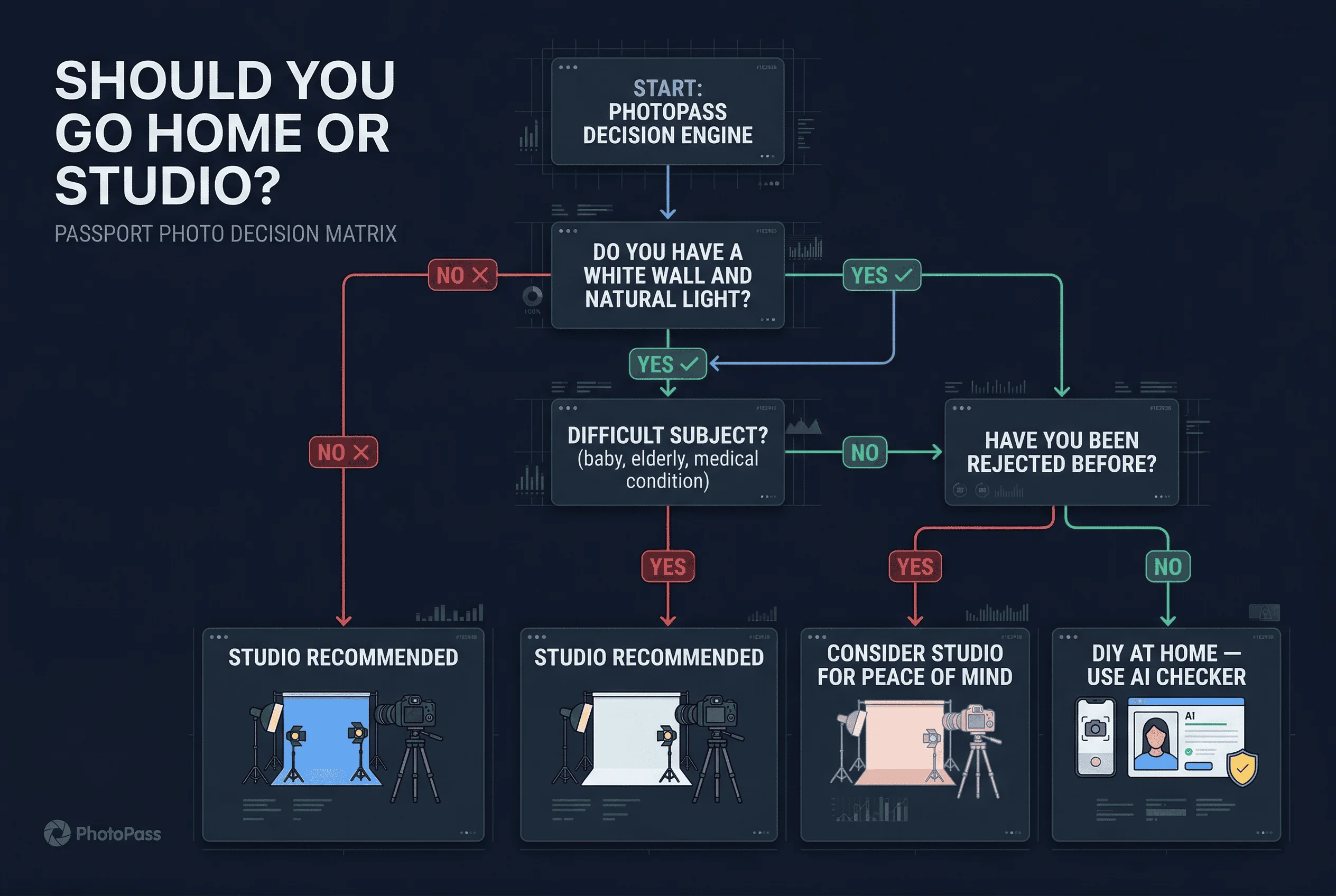
Complex document requirements. Some visa photos require a specific background colour that's hard to reproduce at home (e.g., light blue or red). Studios have the exact backdrop materials and know the specifications.
Meticulous appearance standards. For professional headshots that double as passport photos, a studio provides better lighting, posing guidance, and post-processing. If you want to look your best in the photo you'll carry for the next ten years, a professional touch helps.
Physical limitations. If you can't hold a phone steady, can't stand against a wall, or have a disability that makes DIY photography impractical, a studio photographer can accommodate your needs with adaptive equipment and techniques.
Cultural or religious considerations. Some head coverings require precise framing to meet government requirements while respecting religious practice. A photographer experienced with these requirements can ensure compliance without compromising dignity.
No suitable background at home. If every wall in your home is a bold colour, covered in wallpaper, or otherwise unsuitable, and you don't have access to a portable white backdrop, a studio eliminates the background problem entirely.
Home vs Studio Passport Photo Quality: Does It Matter?
Does a studio photo actually look better? In a controlled comparison, yes — studio lighting produces more even illumination, fewer shadows, and more accurate colour reproduction. A professional camera captures marginally more detail.
But does it matter for a passport photo?
Passport photos are printed at 2×2 inches (US) or 35×45mm (UK). At that size, the difference between a smartphone shot in good natural light and a studio shot with professional lighting is almost invisible. Government reviewers aren't judging aesthetics — they're checking compliance. Both a well-taken home photo and a studio photo will pass if they meet the specifications.
Where studio quality does matter: the photo itself. You'll look at this image every time you open your passport for the next decade. If looking your best matters to you, a professional photographer's ability to find your good angles, manage lighting across your face, and choose the most flattering frame is worth the premium.
Does a Studio Guarantee Passport Photo Compliance?
Here's the uncomfortable truth about studios: a professional photographer is not a compliance guarantee.
Most photographers know the general rules. White background. Look at the camera. No glasses. But specific measurements — head must occupy 50–69% of frame height, eyes at 56% from bottom — are rarely checked with precision. Photographers frame by instinct and experience, which is usually close enough but not always exact.
An AI compliance tool measures against exact specifications every time. It doesn't have good days and bad days. It doesn't estimate percentages by eye.
The safest approach combines the best of both: take the photo at home (or at a studio if you prefer), then verify it with an AI tool before submitting.
Home vs Studio Passport Photos: Our Verdict
Home wins for most people. The cost savings are dramatic ($5 vs $25–$75), the quality difference is negligible at passport photo size, and AI verification provides more reliable compliance checking than a photographer's visual assessment.
A studio wins when you can't control your home environment, need a specific unusual background, or simply want a professional-looking photo. No shame in that — it's your face for the next ten years.
The smartest move regardless: verify the photo before you submit it. Upload to passportsize-photo.online for a 30-second compliance check against your country's exact requirements. Whether you shot it at home or in a $75 studio, verification eliminates the guesswork.
Read about digital vs printed passport photos or see our comparison of iPhone vs professional camera for passport photos for more on DIY quality.