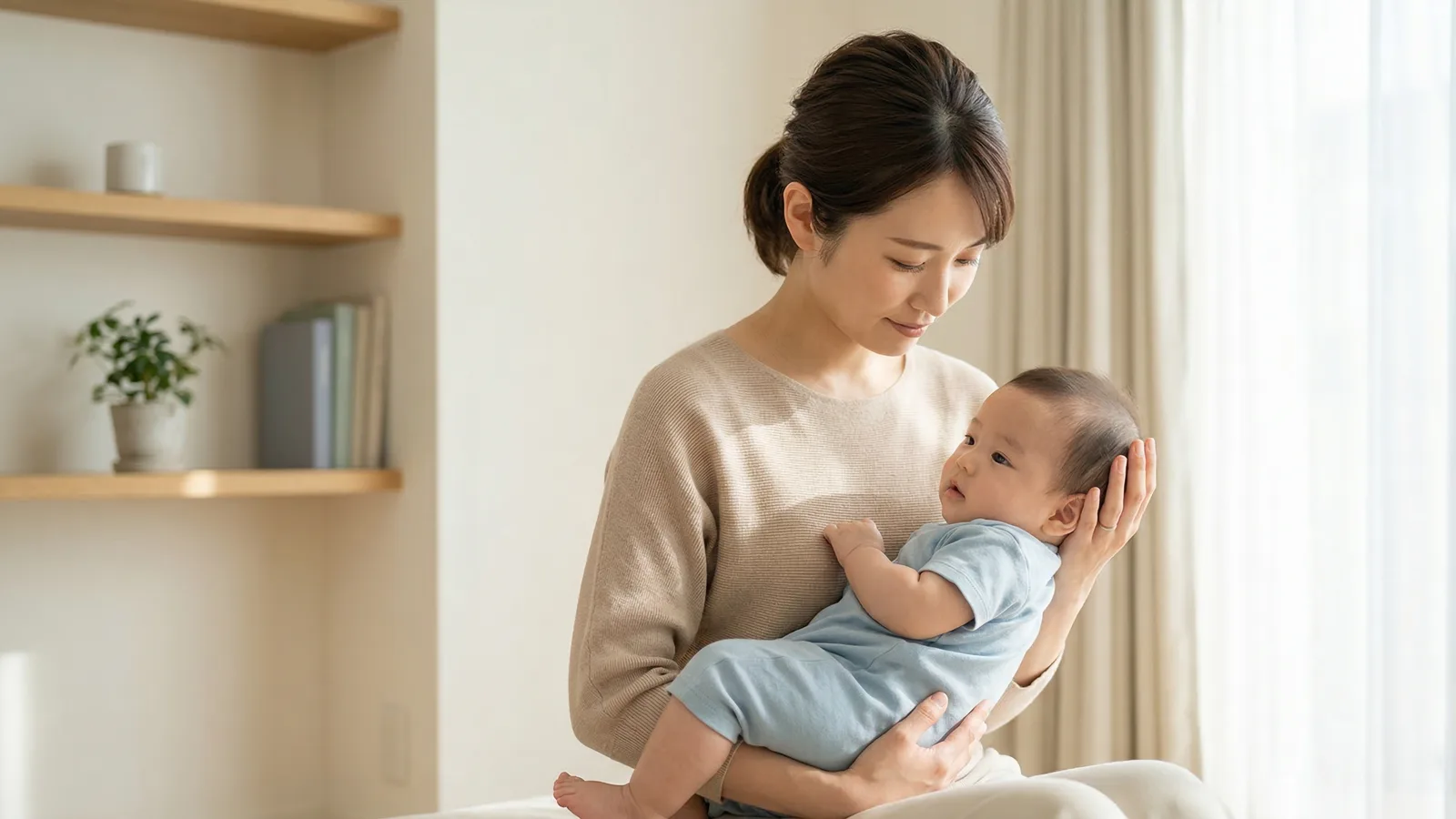
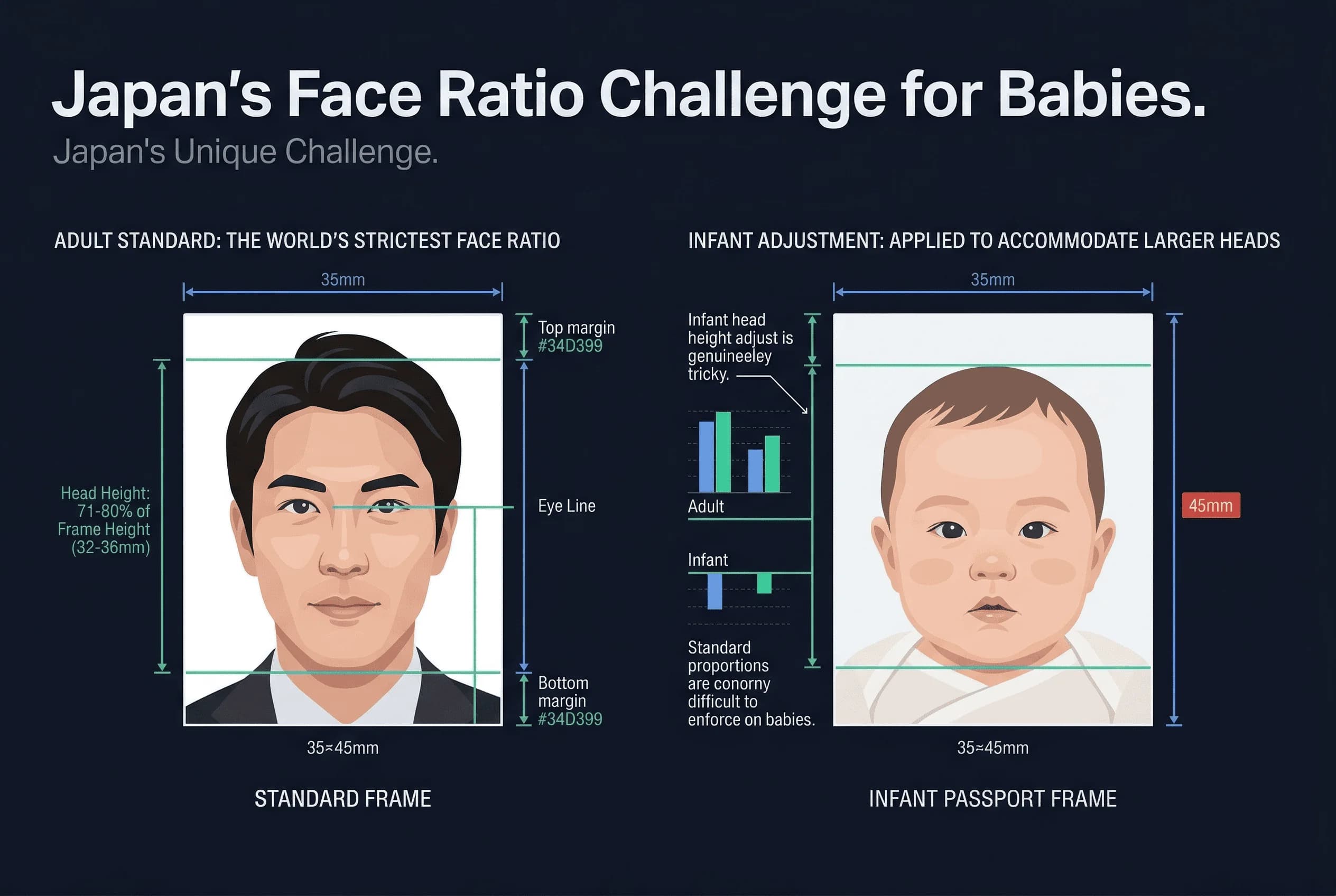
Japan permits baby passport photos with some flexibility, but the country's strict face-to-frame ratio creates unique challenges. Infants can't position themselves to meet the 71-80% face requirement that adult Japanese passport photos demand. Understanding these nuances prevents rejection.
This guide covers what makes Japanese baby photos different and how to successfully capture a compliant image.
Japanese Baby Passport Photo Size Requirements
Standard Japanese passport dimensions apply: 35×45mm at 300 DPI (413×531 pixels).
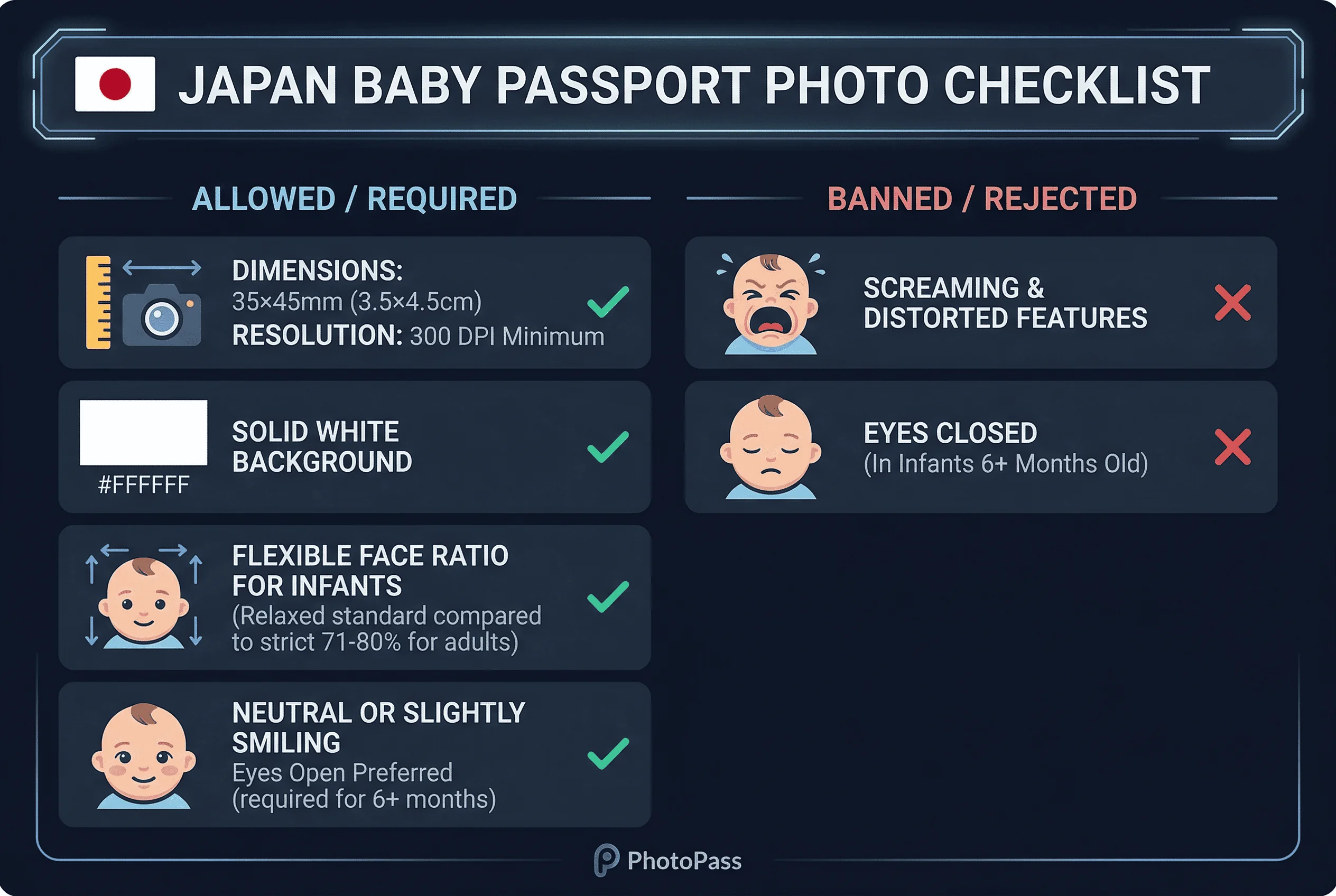
However, the face-to-frame ratio differs for infants. Japanese authorities understand that babies can't position themselves like adults. The strict 71-80% rule has more flexibility for young children.
That said, the face must still be clearly visible and prominent in the frame. A tiny baby face in a large frame gets rejected.
Get a compliant passport photo online
White Background Rules for Japanese Baby Passport Photos
Japan's white background rule applies to everyone — including babies. The photo must have a pure white (#FFFFFF) background.
This catches many parents who assume baby photos have more flexibility. They don't. The background color is non-negotiable.
Use a white blanket or background. Ensure even lighting with no shadows. The same rules that apply to adults apply to infants.
Expression Rules for Japanese Baby Passport Photos
Japan enforces strict neutral expression for adults. For babies, the rules relax somewhat, but not as much as some countries.
What passes for Japanese baby passports:
- Eyes open preferred, but closed eyes sometimes accepted for newborns
- Neutral or slightly smiling acceptable
- Mouth open or closed
What fails:
- Screaming with distorted features
- Eyes closed in older infants (6+ months)
- Extreme expressions that obscure facial features
The key is natural. A calm baby with relaxed features passes. A baby mid-tantrum fails.
Japan's 71–80% Face Ratio Challenge for Baby Photos
This is where Japanese baby photos become difficult. Adults must have faces filling 71-80% of the frame. Babies have smaller heads, making this ratio challenging.
Position the baby as close to the camera as safely possible. Use a tight crop. The goal is maximum face coverage without cutting off features.
If your baby has a small face in the frame, adjust and retake. This is the most common rejection reason for Japanese baby photos.
Photography Setup Tips for Japanese Baby Passport Photos
Photographing a baby for Japanese passports requires planning:
Timing Your Japanese Baby Passport Photo Session
Schedule during your baby's happy window. After feeding, before nap. You need 15-20 minutes of cooperation.
Have everything ready before waking the baby. Equipment positioned. Lighting adjusted. Camera settings confirmed.
Setting Up White Background for Japanese Baby Photos
Lay your baby on a white blanket or foam board. Ensure the white is pure, not off-white.
Position lighting to eliminate shadows. Soft, even illumination works best. Harsh light creates shadows that fail.
Capturing Rapid Shots for Japanese Baby Photos
Babies move. Take many shots quickly. Review each immediately. Delete obvious failures.
Plan for 20-30 attempts minimum. Digital storage is free. Embarrassment costs nothing.
Common Japanese Baby Passport Photo Rejection Reasons
Face too small — Japan's strict ratio catches many baby photos. Get closer. Crop tighter.
Wrong background — White backgrounds are mandatory. Grey or cream fails.
Shadows — Poor lighting creates shadows on the face or background. Fix your setup.
Blurriness — Baby movement causes blur. Use fast shutter speed. Take multiple shots.
Eyes closed — While sometimes accepted, open eyes are strongly preferred for older infants.
Are Glasses Allowed in Japanese Baby Passport Photos?
Japan bans all glasses in passport photos, including for babies. If your infant wears prescription glasses, remove them before taking the photo. This applies to all types of eyewear.
Clothing Recommendations for Japanese Baby Passport Photos
Dress baby in contrasting colours to white. Dark reds, blues, and browns photograph well against white backgrounds.
Avoid white or very light clothing. It blends into the background, creating processing issues.
Keep clothing simple. Bows, headbands, and elaborate outfits distract from the face. The photo should show facial features clearly.
Age-Specific Tips for Japanese Baby Passport Photos
Newborns (0–3 months). Easiest to photograph. Lay them on a white surface. Closed eyes sometimes accepted at this age, but eyes open is always preferred. A calm, sleeping newborn can work in a pinch.
Infants (6–12 months). The hardest age. Babies can move but can't follow directions. They resist positioning but are too young to cooperate. Have a helper hold their attention with a colourful toy above the camera. Use burst mode.
Toddlers (1–3 years). Can sit independently, which helps. But they may smile reflexively or refuse to look forward. Use a favourite toy held just above the camera lens. Take as many shots as needed.
Where to Get Baby Passport Photos in Japan
Photo studios (フォトスタジオ / 写真館). Studios near passport centres (パスポートセンター) in every prefecture. Staff understand Japanese requirements. Cost: ¥800–1,500.
Photo booths (証明写真機). Ki-Re-i and DNP photo booths are everywhere — train stations, convenience stores, shopping centres. Not recommended for babies — the enclosed space and fixed timing don't work for infants.
DIY at home. The most practical option for babies:
- Lay baby on white blanket or white foam board
- Use natural window light supplemented with a desk lamp
- Position camera directly above, lens pointing down at baby's face
- Get close enough that face fills 70%+ of the frame
- Take 20–30 rapid shots in burst mode
Camera Settings for DIY Japanese Baby Passport Photos
Use burst mode (continuous shooting). A shutter speed of 1/200 or faster prevents motion blur. ISO 400–800 is acceptable indoors. Focus on the baby's nearest eye. If shooting from above (baby lying down), ensure the camera is perpendicular to the baby's face to avoid perspective distortion.
Applying for a Japanese Baby Passport at the Passport Centre
Baby passport applications are submitted at the prefectural passport centre (旅券事務所 / パスポートセンター). Both parents' consent is typically required. You'll need the child's 戸籍謄本 (family register copy) and both parents' identification. The same 35×45mm white-background photo is needed regardless of the child's age. Applications take approximately one week to process.
Japanese Baby Passport Photos for Families Abroad
If you're applying for your baby's Japanese passport from abroad, the same photo rules apply. Japanese embassies and consulates in major cities worldwide follow the same requirements. Studios abroad may be unfamiliar with Japanese passport requirements — specify "Japanese passport photo, 35×45mm, white background, no glasses."
Do Not Digitally Edit Japanese Baby Passport Photos
Do not digitally edit or composite the baby's photo. Do not remove glasses digitally, add a white background, or alter the baby's expression. Always take the photo correctly from the start.
Japanese Passport Renewal and Photo Requirements for Children
Japanese passports for children under 12 are valid for 5 years. Each renewal requires a new photo. Babies' faces change dramatically — budget for multiple photo sessions over the early years.
Quick Checklist for Japanese Baby Passport Photos
Before submitting your baby's Japanese passport photo:
- Photo is 35×45mm
- Background is pure white
- No glasses or eyewear
- Face fills as much of the frame as possible (71–80% for adults; some flexibility for babies)
- Eyes preferably open
- Neutral or calm expression
- No shadows on face or background
- Photo is sharp and not blurry
- 300 DPI minimum resolution
Verify your baby's photo meets all Japanese passport requirements with the passportsize-photo.online checker. For size details, see Japanese passport photo size guide. View all Japanese passport photo rules on the Japan hub.