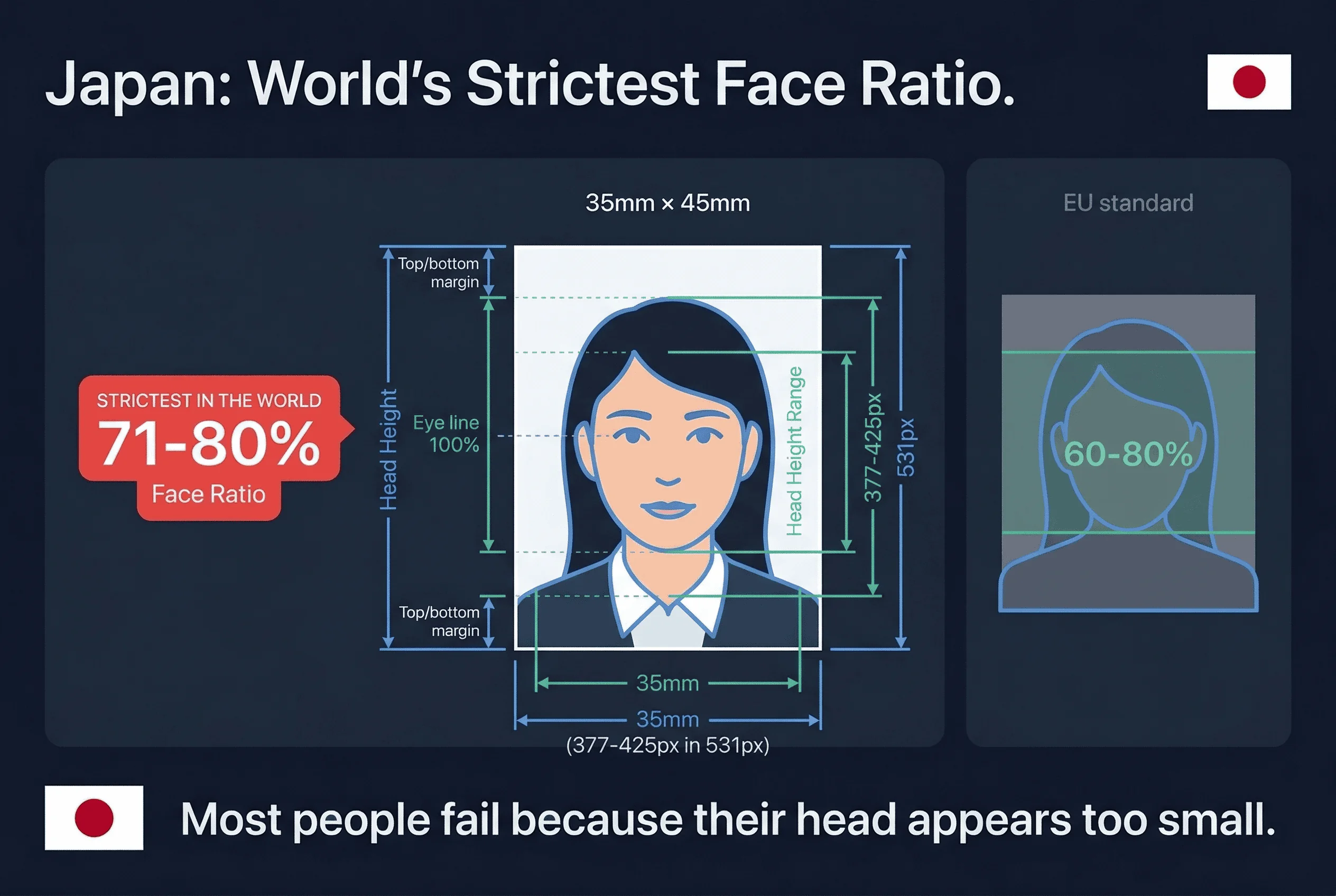
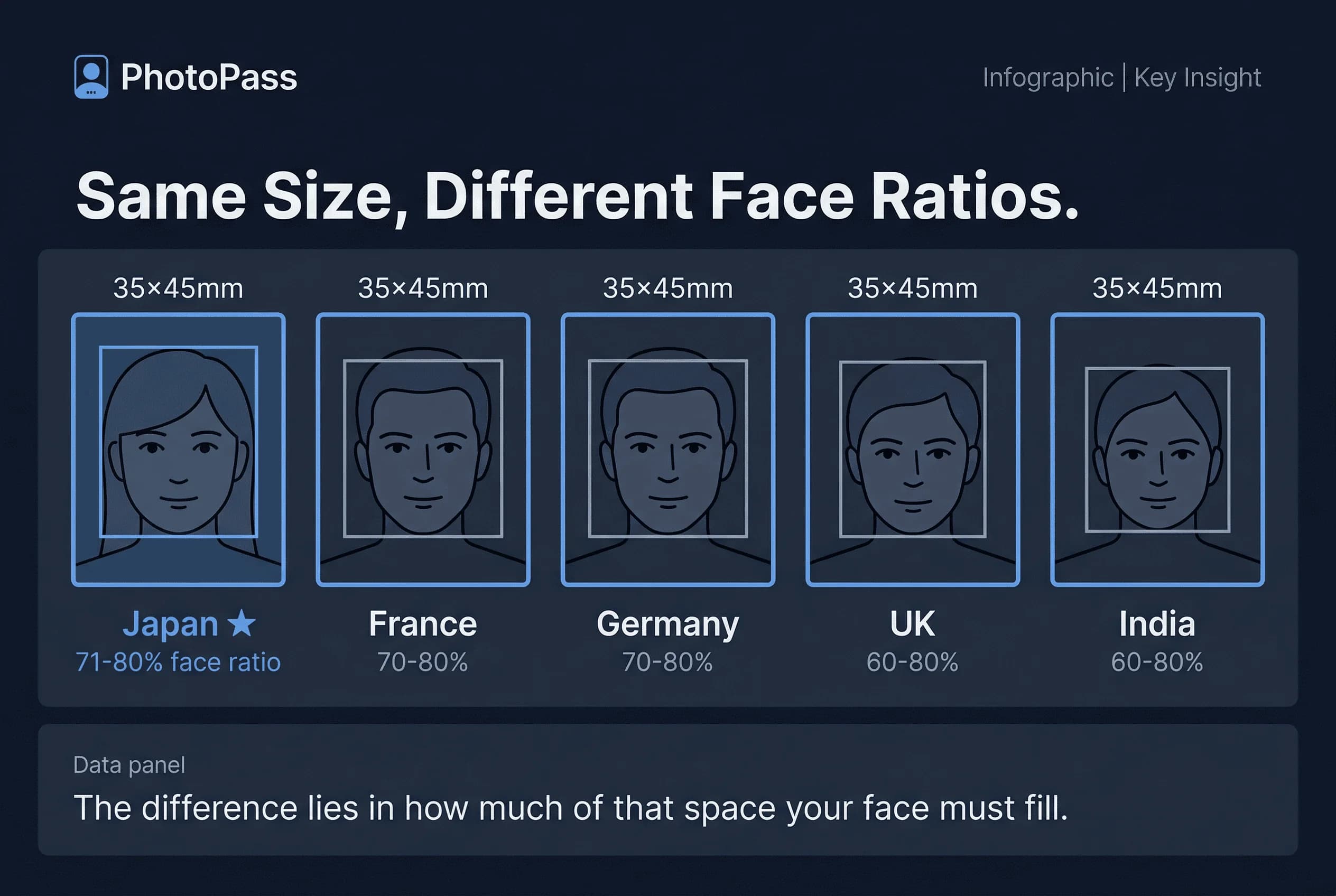
Japan requires passport photos measuring 35×45 millimeters — standard for most countries. But Japan's face-to-frame ratio is the strictest anywhere: 71-80% of the frame height must be your face. Many applicants fail because their head appears too small.
This makes Japan unique. While other countries allow 60-80% face coverage, Japan demands the face occupy nearly the entire photo.
Exact Japanese Passport Photo Size Dimensions
| Measurement Unit | Width | Height |
|---|---|---|
| Millimeters | 35mm | 45mm |
| Inches | 1.38" | 1.77" |
| Pixels (300 DPI) | 413px | 531px |
| The millimeter dimensions match France and most EU countries. The difference lies entirely in how much of that space your face must fill. |
Get a compliant passport photo online
Why Does Japan Require Such a Large Face in Passport Photos?
Japan's Ministry of Foreign Affairs enforces the 71-80% ratio for biometric accuracy. Their facial recognition system was designed for faces filling most of the frame. Smaller faces produce lower-resolution biometric data, increasing matching errors.
This requirement emerged from Japan's early adoption of biometric passports. The technology required higher resolution facial data than other countries mandated. Japan chose strict standards rather than compromise accuracy.
Japanese Passport Photo Face Measurement Formula
To pass, your face height (chin to top of head) must equal 71-80% of the frame height.
For a 45mm frame, your face must be 32-36mm tall. For a 531-pixel digital image, your face should be 377-425 pixels tall.
This is deceptively difficult. Most people position themselves too far from the camera, creating small faces in the frame.
How to Get the Right Face Ratio for Japanese Passport Photos
Step closer to the camera. This is the most common fix. If your face fills 60% of the frame (typical for most other countries), move 30-45cm closer. On a 45mm frame, you need to gain roughly 5mm of face height — the difference between 27mm (60%) and 32mm (71%).
Use a longer lens. Smartphone wide-angle lenses distort facial proportions at close range — your nose appears larger, your ears appear smaller. If using a phone, stand at normal distance and zoom in to 2x rather than physically moving closer. A dedicated camera with a 50-85mm lens produces the most natural proportions.
Crop carefully. You can crop after shooting, but only if you captured enough resolution. Start with the highest resolution your camera offers. Cropping a 12-megapixel image to 413×531 pixels leaves plenty of room. Cropping a 2-megapixel image does not.
Measure before submitting. Open the image in a photo editor. Measure the pixel height from chin to crown and divide by total image height. If the result is between 0.71 and 0.80, you pass. If it's 0.65-0.70, you're close but will be rejected — crop tighter or reshoot.
Common Japanese Passport Photo Sizing Rejection Reasons
The most frequent rejection cause is face too small. The 71% minimum trips up applicants who assume standard passport photo framing works.
Face too large is equally problematic. Above 80%, the system can't capture full facial features. Both ears must be visible.
Off-center faces also fail. Your nose should align with the frame's centre vertical axis. Even slight tilting — which might pass in Australia or France — can trigger rejection in Japan.
Wearing glasses: Glasses are not permitted. If you arrive at the passport centre wearing glasses in your photo, it will be rejected outright. Remove them before the photo is taken.
Japanese Passport Photo Size vs Other Countries
Here is how Japan's face coverage compares to other major countries:
| Country | Face coverage | Notes |
|---|---|---|
| Japan | 71–80% | Strictest in the world |
| United Kingdom | 64–76% | Narrower than ICAO default |
| France / Germany | 60–80% | Standard ICAO range |
| Australia | 60–80% | Standard ICAO range |
| United States | 50–69% | Most permissive major country |
| Canada | 44–51% | Tall frame, lower percentage |
| Brazil | 44–51% | Same as Canada |
A photo that passes in the US or Canada will almost certainly fail in Japan. Even UK and Australian photos may have faces that are too small. Always reframe specifically for Japan's 71–80% requirement.
Glasses and Appearance Rules for Japanese Passport Photos
- Glasses: Not permitted. Remove all eyewear, including prescription glasses and sunglasses. Japan's strict face coverage rule means any frame obstruction is particularly problematic.
- Expression: Neutral, mouth closed. No smiling.
- Background: White, evenly lit with no shadows behind the head.
- Hair: Must not cover the face or forehead. Both ears must be visible — this is checked more strictly in Japan than in many countries.
- Head coverings: Only for religious reasons. The full face from forehead to chin must remain visible.
Where to Get a Correctly Sized Japanese Passport Photo
Shashin-ya (写真屋) — photo studios. Professional photo studios throughout Japan understand the strict 71-80% requirement and produce compliant photos reliably. Ask for "パスポート写真" (passport shashin). Prices range from ¥800-1,500. Studios near passport centres in Tokyo (Shinjuku, Ikebukuro), Osaka, and other major cities handle passport photos daily.
Ki-Tech and Speed photo booths (証明写真機). Automated photo booths are available in convenience stores, train stations, and shopping centres across Japan. Machines by Fujifilm, DNP, and others are pre-programmed with correct Japanese specifications. Cost is ¥700-1,000. These machines produce high-quality photos but the face-ratio compliance depends on how you position yourself.
Convenience stores (コンビニ). Some apps (e.g., Pikuri) allow you to take a photo at home and print at a convenience store (Lawson, FamilyMart, 7-Eleven). Cost is only ¥30-200 for prints. This is the cheapest option, but you must ensure the 71-80% face coverage yourself.
Outside Japan: Specify "Japanese passport photo, 35×45mm, face must fill 71-80% of the frame." Most international studios are unfamiliar with this stricter requirement and will produce photos with 60-65% coverage — not enough for Japan.
Digital Submission Requirements for Japanese Passport Photos
Japan's passport application system accepts digital photo uploads:
- JPEG format, 413×531 pixels minimum at 300 DPI
- White background, no shadows
- Face must fill 71-80% of the frame height
- Taken within the last six months
- The automated system checks dimensions and face detection before accepting
Because Japan's strict coverage rule requires the face to be large in the frame, starting with a high-resolution source image gives you more room to crop precisely without losing quality.
Japanese Passport Photo Size Rules for Babies and Children
Children's Japanese passport photos follow the same 35×45mm size and 71-80% head height requirements. The strict face coverage makes children's photos particularly challenging.
Infants (under 1 year): Lay the baby on a white sheet and photograph from directly above. Both eyes should be open. The 71-80% requirement means the baby's face must measure 32-36mm from chin to crown — very precise positioning. Photo studios near passport centres handle infant photos regularly.
Children (1-5 years): Same rules as adults — neutral expression, eyes open, face centered. The strict coverage means children must be positioned closer to the camera. Studios in Japan have experience managing the unique challenge of getting children to sit still at close range.
Verifying Your Japanese Passport Photo Before Submission
Use our passport photo checker to measure your face ratio against Japan's 71-80% requirement. For complete Japan passport details, see our Japan requirements guide.