Japan requires a pure white background for passport photos. The Ministry of Foreign Affairs (MoFA) specifies a plain white background with no patterns, objects, or shadows. Japan is among the stricter countries on this — the automated systems at passport offices measure actual RGB values, not visual appearance, and anything short of pure white risks rejection.
Exact Background Rules for Japanese Passport Photos
The background must be:
- White (#FFFFFF) — pure white, not off-white, cream, ivory, or light grey
- Uniform — the same shade from edge to edge
- Smooth — no visible texture, grain, or pattern
- Shadow-free — no shadows from your head, body, or hair
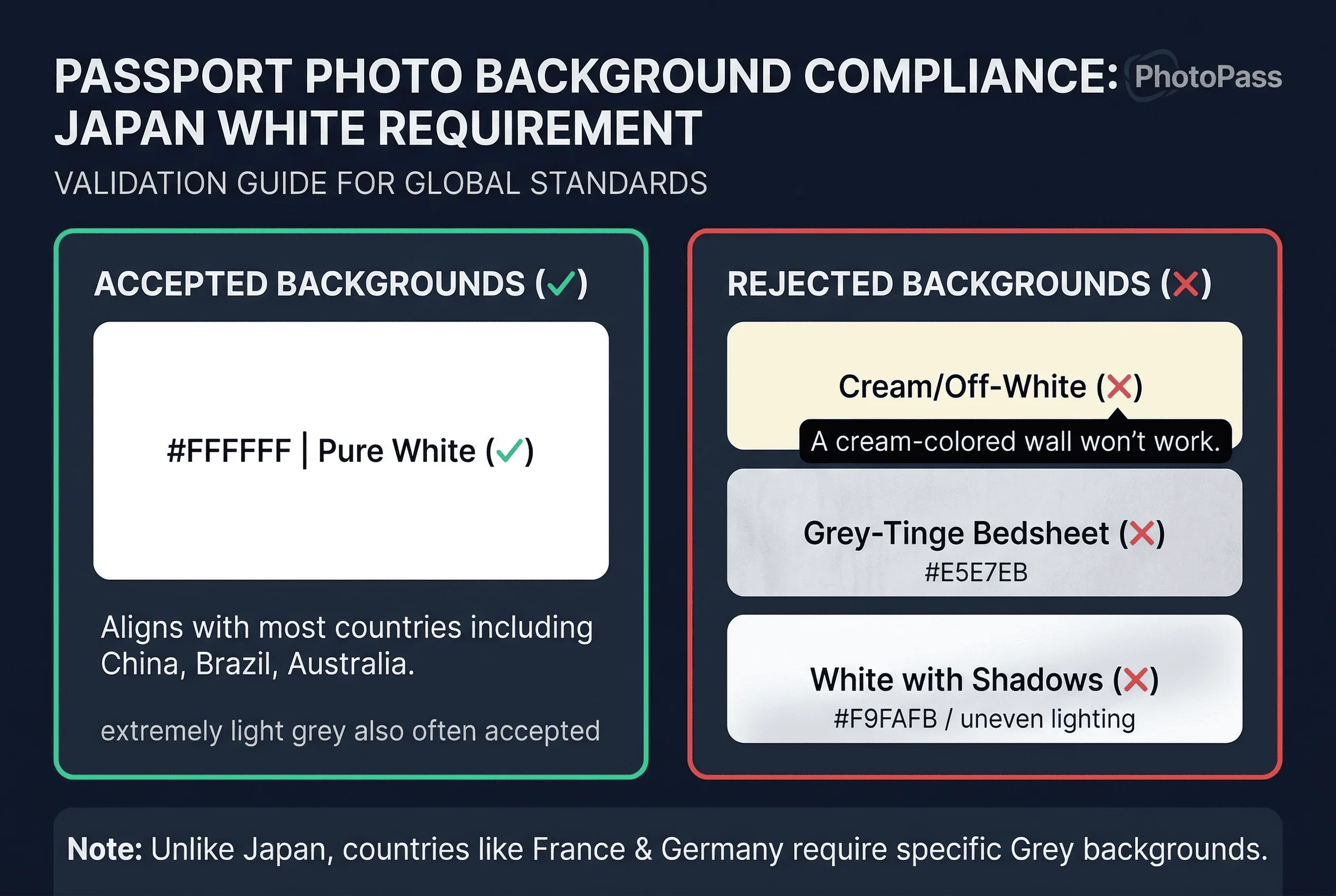
In RGB terms, your background should read 255, 255, 255 — or very close to it. Values below 240 in any channel risk rejection. The automated system uses a numerical threshold, not human judgment. A background that looks white to your eye but measures at RGB 230, 230, 230 will fail.
Get a compliant passport photo online
What Background Colors Fail for Japanese Passport Photos?
Off-white and cream. Japanese walls (especially in older apartments) often have a slightly yellowish tone. Under warm indoor lighting, even white walls photograph as cream. The system detects this.
Shadows. Standing too close to the wall casts a body shadow behind you. Your head shadow is especially problematic — it creates a dark halo the system reads as non-uniform.
Gradients. A single ceiling light makes the background brighter at the top and darker at the bottom. The system expects uniform white everywhere.
Textured surfaces. Traditional Japanese wall textures (聚楽壁, sand-finish, or textured wallpaper) create visible patterns. Smooth surfaces only.
Light grey. What passes in Germany (light grey 230,230,230) fails in Japan. Japan requires pure white, not grey.
Fabric wrinkles. Bedsheets and curtains sag and wrinkle, creating shadows and uneven colour. Paper or foam board is better.
Japanese Passport Photo Background vs Other Countries
| Country | Background | Notes |
|---|---|---|
| Japan | White | Strict — pure white only |
| United States | White | Same as Japan |
| China | White | Same as Japan |
| France | White | Same as Japan |
| Australia | White | Same as Japan |
| India | White | Same as Japan |
| Germany | Light grey | Different — will fail in Japan |
| United Kingdom | Light grey | Different — will fail in Japan |
| South Korea | White | Same as Japan |
Japan shares its white background rule with most countries. If you have a compliant white-background photo for the US, China, France, or South Korea, the background colour will also work for Japan (verify size and other rules separately). Photos taken for Germany or the UK (light grey) will not pass Japanese requirements.
How to Create a White Background at Home for Japanese Photos
The White Wall Method for Japanese Passport Photos
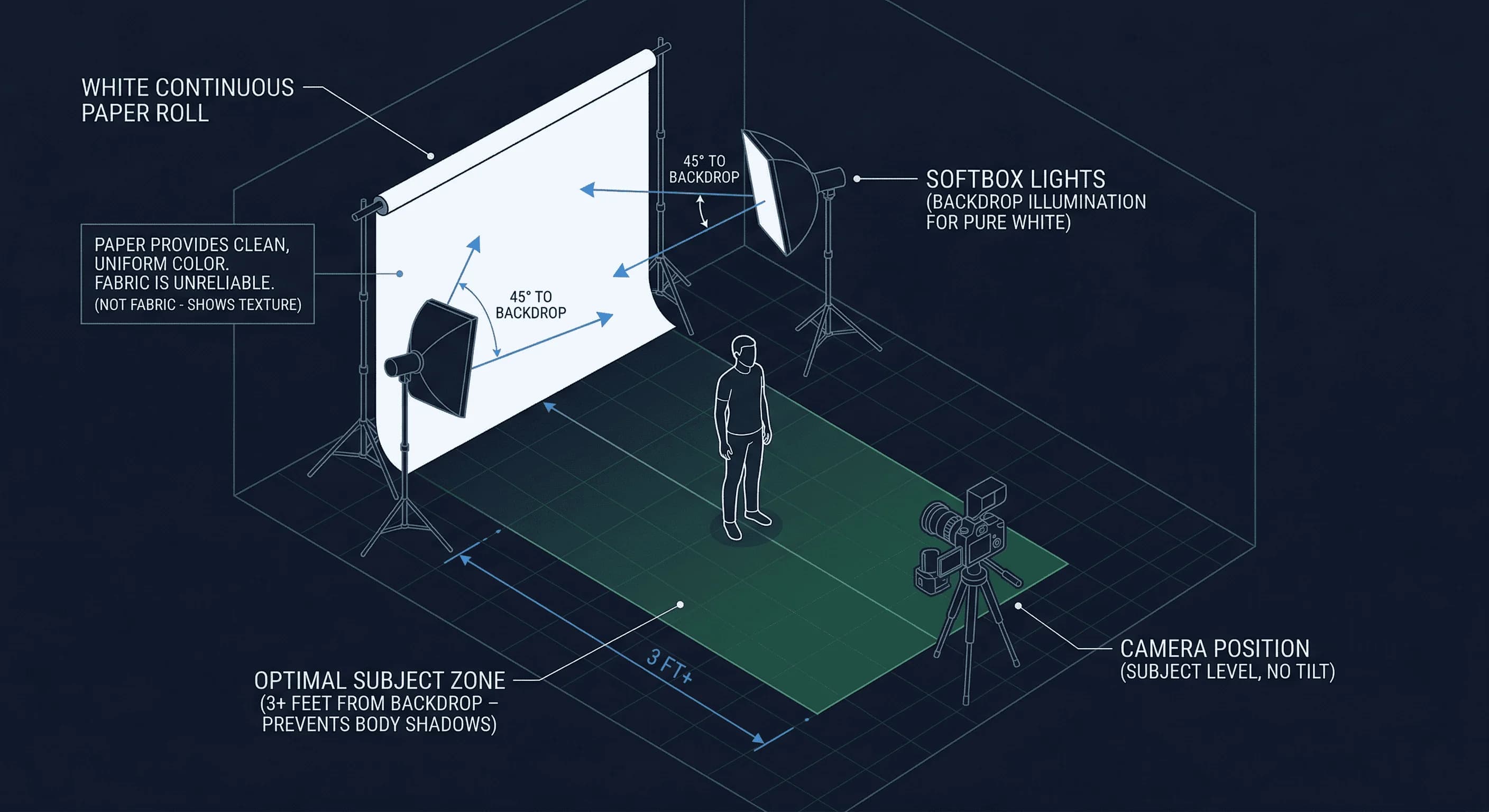
- Find a smooth white wall. Flat or matte white paint works best. Avoid glossy finishes — they reflect light unevenly.
- Stand 40–60cm (1–2 feet) away from the wall. This gap eliminates your body shadow.
- Use two light sources at 45 degrees. Place one lamp on each side of the camera. This cross-lighting cancels shadows on both sides.
- Use daylight bulbs (5000K–5500K). Standard warm Japanese lighting (電球色, 2700K) casts yellow tones that make white walls photograph as cream. Switch to 昼光色 (daylight colour) bulbs.
- Check the result on a computer screen. Phone screens can be misleading. Open the photo on a PC and zoom into the background. It should look uniformly white with no grey patches, cream tones, or shadows.
The Paper Backdrop Method for Japanese Passport Photos
White seamless paper (背景紙) provides the cleanest background. A roll of 1.35m-wide white paper from a photography supply shop (ヨドバシ, ビックカメラ) costs around ¥1,500–3,000. Hang it behind you and let it curve down. Paper produces a perfectly smooth, matte white surface with no texture.
The Foam Board Method for Japanese Passport Photos
White foam board (スチレンボード) from a craft store or 100-yen shop works well for seated portraits. Position it behind you and light evenly. Sizes of 60cm × 90cm or larger are sufficient.
Where to Get Japanese Passport Photos with White Background
証明写真機 (Shōmei shashin-ki / ID photo booths). Ki-Re-i (DNP) and Speed (Fuji) booths are found in train stations, convenience stores, and shopping centres across Japan. They produce compliant white backgrounds automatically. Prices: ¥700–1,000 per session. The booths are calibrated for Japanese requirements — this is the easiest option.
写真館 (Shashin-kan / Photo studios). Professional studios near city halls (市役所) and passport offices handle high volumes. Prices: ¥1,500–3,000 for a set of prints plus digital file. They use professional lighting and white backgrounds.
Convenience store printing. Services like ピクリ (Pikuri) let you take your own photo and print it at a Lawson, FamilyMart, or 7-Eleven multi-function printer. You control the background at home; the printer handles the output. Cost: ¥200–300. Verify the background is pure white before printing.
Japanese citizens abroad. At Japanese embassies and consulates, staff know the background requirement. In cities with large Japanese communities, local photo studios may be familiar with the spec. Always specify "白い背景" (white background) and check the result before accepting.
The Shadow Problem in Japanese Passport Photo Backgrounds
Shadows are the most common background issue in DIY photos. The physics: any light source creates a shadow on the opposite side. When you stand against a wall, that shadow falls on the background.
The fix: distance. Stand 40–60cm from the wall. The gap gives the shadow space to fall below the frame or diffuse to near-invisibility.
Phone flash makes it worse. The built-in flash is a single hard light directly in front of you. It casts a sharp shadow right behind your head. Disable the flash and use room lighting or natural light.
Third light (optional). If you still see a faint shadow after distance adjustment, add a third light aimed at the background from below or the side.
Common Japanese Passport Photo Background Mistakes
Yellow lighting. Japanese homes often use warm (電球色) lighting. This makes white walls photograph as cream. Switch to daylight (昼光色) bulbs or shoot near a window during the day.
Using a bedsheet. Fabric wrinkles and sags, creating shadows and texture. If you must use fabric, stretch it completely taut across a frame and iron it first.
Overexposing the background. While bright is better than dark, extreme overexposure creates a glow around your head. The background should be white, not blindingly bright.
Editing the background digitally. Minor brightness adjustments are fine. Aggressive background replacement or masking creates artefacts that automated systems detect.
Using a coloured wall. Pale blue, pale green, or pale yellow fails even if it looks white in your room.
Verifying Your Japanese Passport Photo Background
Before submitting, check:
- Background is pure white across the entire frame
- No visible shadows anywhere behind you
- No texture, pattern, or seam visible
- Background extends beyond all edges of the photo
- Lighting is even from top to bottom, left to right
Open the photo in image editing software and use the colour picker tool on multiple background areas. All readings should be at or near RGB 255, 255, 255.
Use our passport photo checker to validate your background. For complete Japanese passport photo requirements, see the Japan passport photo hub.