Indian driving licence photos require passport-size dimensions of 35×45mm with a white background. For online applications through the Parivahan or Sarathi portals, digital photos must be under 200KB with 300 DPI resolution. These specifications align with other Indian government ID documents but have unique online submission requirements.
The driving licence serves as primary identity proof throughout India. Whether applying for a new licence, renewal, or international driving permit, understanding photo requirements prevents application delays.
For Indian passport photo requirements, understanding driving licence specifications provides useful context as both use similar 35×45mm standards.
Indian Driving Licence Physical Photo Specifications
All Indian driving licence photos must meet these requirements:
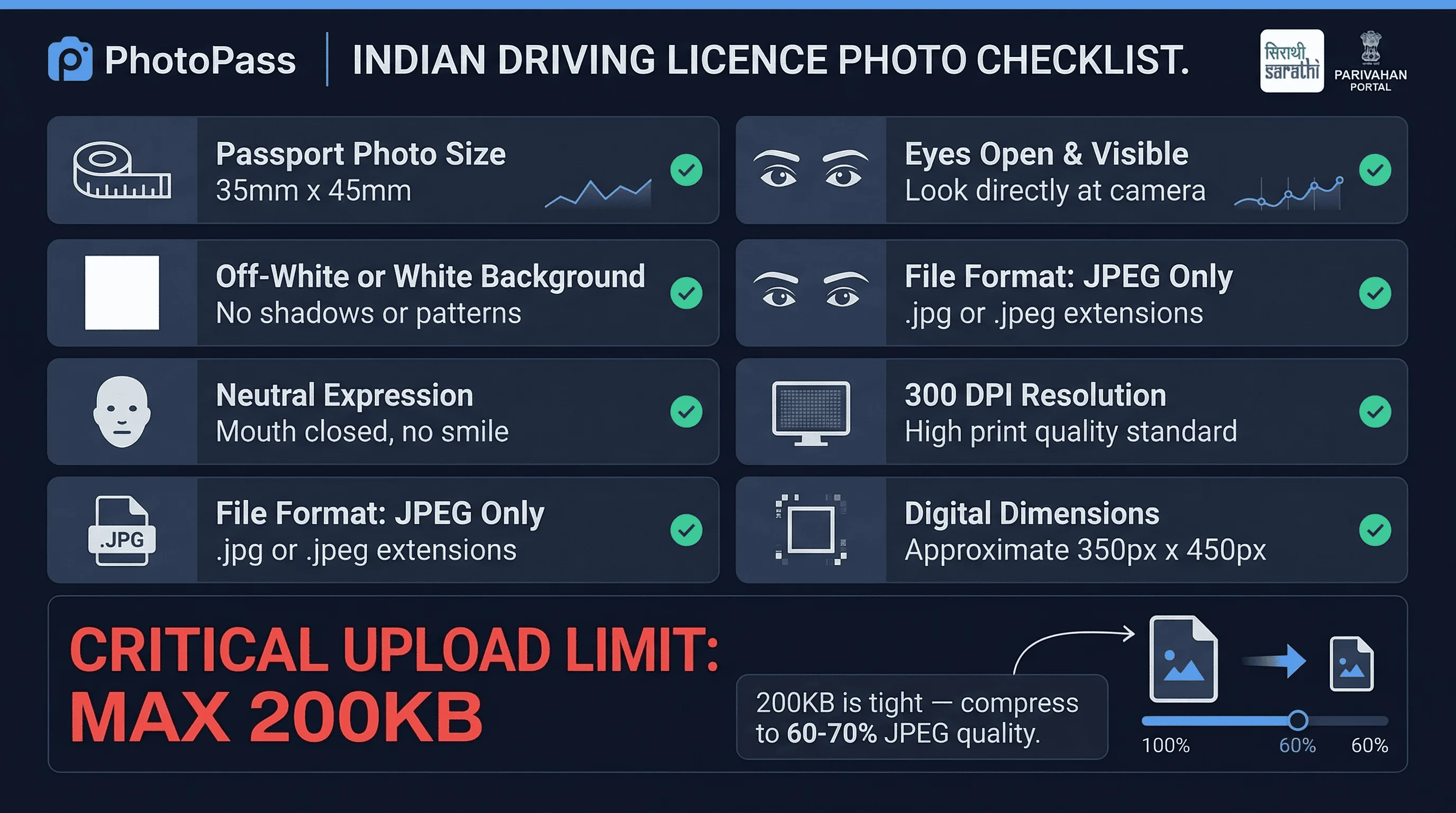
Dimensions: 35×45mm (passport size) Background: Plain white (#FFFFFF) Appearance: Full face, front view Expression: Neutral, mouth closed Eyes: Open, clearly visible Format: Color photograph Quality: Clear, sharp, well-lit
These specifications match the Indian passport (also 35×45mm). Note: the PAN card uses a smaller 25×35mm format — do not substitute photos between documents without checking sizes.
Get a compliant passport photo online
Digital Upload Requirements for the Sarathi Portal
Online applications through government portals have specific digital requirements:
File format: JPEG only File size: Maximum 200KB Resolution: 300 DPI recommended Dimensions: Approximately 350×450 pixels (depends on portal) Aspect ratio: Matches physical 35×45mm
The 200KB limit causes the most issues. High-resolution photos easily exceed this threshold and require compression.
The Parivahan Portal for Indian Driving Licences
The Parivahan portal (parivahan.gov.in) handles driving licence services across India:
Services available
- New licence application
- Renewal application
- Duplicate licence request
- Address change
- International driving permit
The portal accepts digital photo uploads during application. The system validates file size and format automatically. Incorrect photos get rejected before submission.
The Sarathi Portal for Driving Licence Applications
Sarathi (sarathi.nic.in) is the Transport Ministry's primary driving licence portal:
State-specific services: Each state may have variations Online application: Available in most states Appointment scheduling: Book test appointments online Status tracking: Monitor application progress
Photo requirements remain consistent across states, though some regional RTO offices have additional informal requirements.
Online vs In-Person Applications
Different application methods have different photo handling:
Online applications
- Upload digital JPEG photo
- Must meet file size limits
- System validates automatically
- Pay fees online
In-person applications
- Submit printed photos
- Two copies typically required
- RTO may photograph you directly
- More flexibility on file size
Both methods require the same physical specifications. The difference is only in submission format.
State RTO Variations for Driving Licence Photos
While the central government sets baseline requirements, state RTO offices sometimes have additional expectations:
Maharashtra: Prefers digital applications through M-Parivahan Delhi: Standard Parivahan requirements Karnataka: Uses Parivahan but may request additional copies Tamil Nadu: Standard requirements with possible interview West Bengal: Standard Parivahan process
When applying, check your specific RTO's requirements. Minor variations exist between states.
Common Indian Driving Licence Photo Upload Issues
These problems frequently cause application failures:
File size exceeded: Photos over 200KB get rejected. Use compression to reduce file size while maintaining quality.
Invalid format: Non-JPEG files fail upload. Convert images to JPEG before submission.
Resolution issues: Too-low resolution causes rejection. Maintain 300 DPI or higher.
Background color: Off-white backgrounds cause problems. Ensure pure white background.
Photo too old: While no strict validity period, recent photos work best.
How DL Photos Compare to Other Indian IDs
Indian driving licence photos share specifications with other documents:
Passport photos: Same 35×45mm dimensions, same white background. One photo session covers both documents.
PAN card photos: Different size — PAN uses 25×35mm, not 35×45mm. Do not reuse driving licence photos for PAN applications.
Aadhaar photos: Different requirements. Aadhaar uses specific biometric capture.
The standardization means one photo session can potentially serve multiple document needs.
Tips for Compliant Indian Driving Licence Photos
Follow these recommendations:
Use professional photographers experienced with Indian government requirements. They understand 35×45mm specifications and white background requirements.
For digital submissions, use photo editing software to compress to under 200KB. Save at 60-70% JPEG quality to achieve target file size.
Test uploads before completing applications. Most portals allow test uploads without submission.
Keep original high-resolution files. You can always compress more but cannot recover quality from over-compressed images.
Before submitting, verify your photo using our passport photo checker. This helps ensure compliance before application completion.
When to Get New Driving Licence Photos in India
Driving licence photos should be updated when:
- Previous photo is over 1 year old
- Appearance has changed significantly
- Photo was rejected previously
- Applying for new licence category
- After any facial surgery or significant weight change
For renewals, using existing photos is often acceptable if they meet current specifications.
International Driving Permit Photos vs Licence Photos
IDP applications through Indian RTOs require additional photos:
Requirements: The IDP uses a different size — 35×35mm (square), not the 35×45mm driving licence format. Do not reuse driving licence photos for IDP applications. Application: Through Parivahan or local RTO.
International driving permits require photos meeting the 35×35mm standard. Check specific country requirements where you'll drive.
Photo Specifications Deep Dive
Understanding exact technical requirements helps:
Physical dimensions
- Width: 35mm
- Height: 45mm
Digital equivalents
- At 300 DPI: Approximately 413×531 pixels
- At 72 DPI (screen): Approximately 99×128 pixels
- Recommended upload: 350×450 pixels
File size management
- Target: Under 200KB
- Typical compressed size: 80-150KB
- Avoid aggressive compression below 50KB (quality loss)
Cost of Indian Driving Licence Photos by Provider
Professional driving licence photos cost:
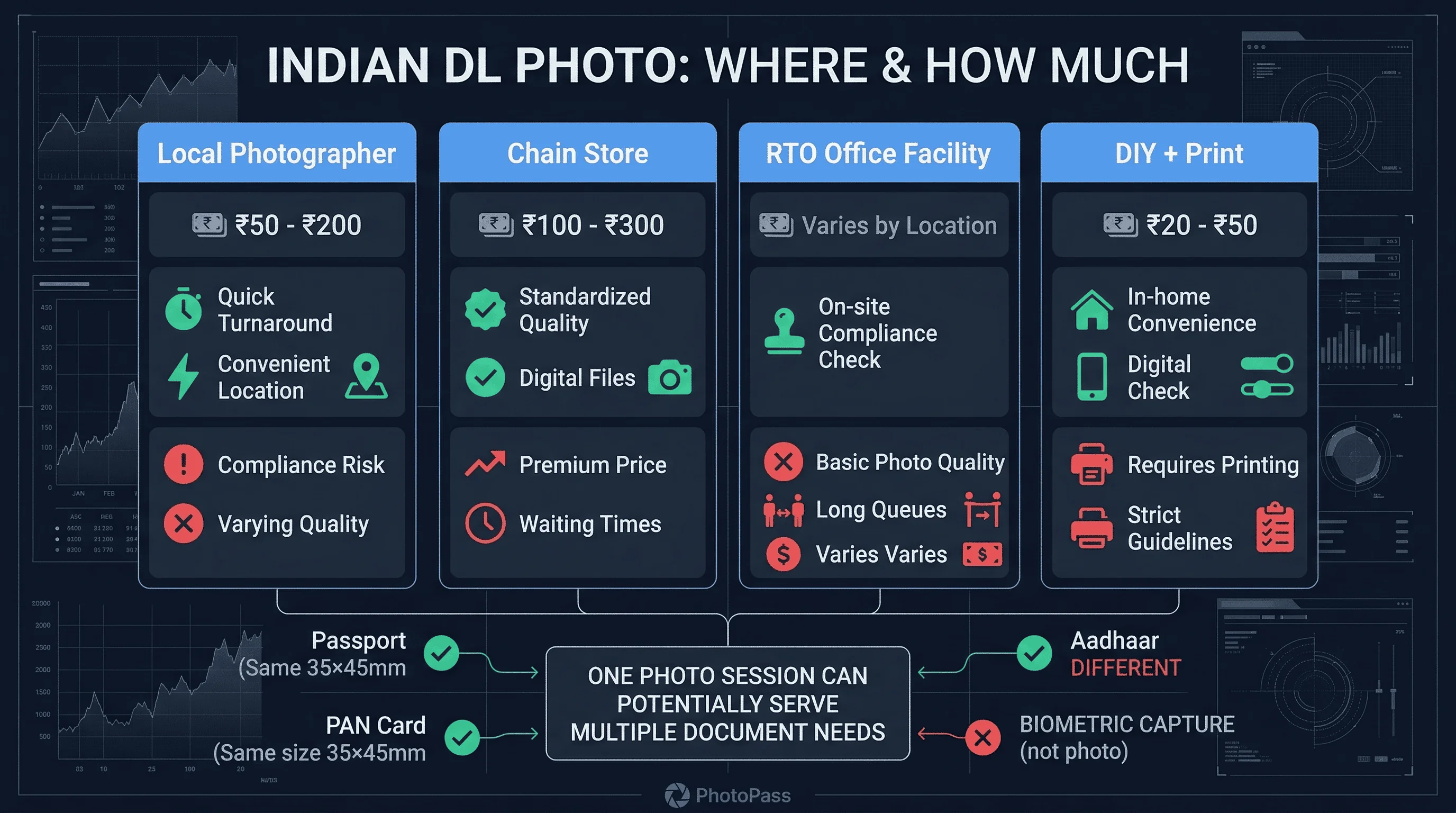
Local photographers: ₹50-200 for prints with digital files Chain stores: ₹100-300 for professional service DIY with printing: ₹20-50 for printing costs
Many RTO offices now have photo facilities. Costs vary by location.
Final Checklist for Indian Driving Licence Photos
Before submitting your driving licence application:
- Photo is 35×45mm
- Background is pure white
- Expression is neutral
- Both eyes visible and open
- Digital file under 200KB
- JPEG format confirmed
- At least 300 DPI resolution
- Photo is recent
Expression and Appearance Rules for Driving Licence Photos
- Neutral expression — mouth closed, no smile, no frown
- Eyes open — both eyes fully visible, looking directly at the camera
- No glasses — all types banned, including clear prescription lenses
- Hair away from face — forehead and both eyes clearly visible
- Head coverings — permitted for religious reasons (turban, hijab, patka); full face from chin to forehead must remain visible
- Clean, even lighting — no shadows on face or background
- Recent photo — taken within the last 6 months
Indian Document Photo Comparison
| Document | Size | Background | Glasses | Smile |
|---|---|---|---|---|
| Driving Licence | 35×45mm | White | Not allowed | Not allowed |
| Indian Passport | 35×45mm | White | Not allowed | Not allowed |
| PAN Card | 25×35mm | White | Not allowed | Not allowed |
| Voter ID (EPIC) | 50.8×50.8mm | White | Not allowed | Not allowed |
| Police Clearance | 35×35mm | White | Not allowed | Not allowed |
| International Driving Permit | 35×35mm | White | Not allowed | Not allowed |
| Ration Card | 35×35mm | White | Not allowed | Not allowed |
India uses five different photo sizes across its government documents. The driving licence and passport share 35×45mm. The PAN card is smaller at 25×35mm. The IDP and police clearance use 35×35mm (square). The voter ID uses 50.8×50.8mm (2×2 inches). Never mix photos between documents without confirming sizes.
Related Articles
- PAN Card Photo Requirements — Related Indian ID photos
- OCI Card Photo Requirements — NRI document requirements