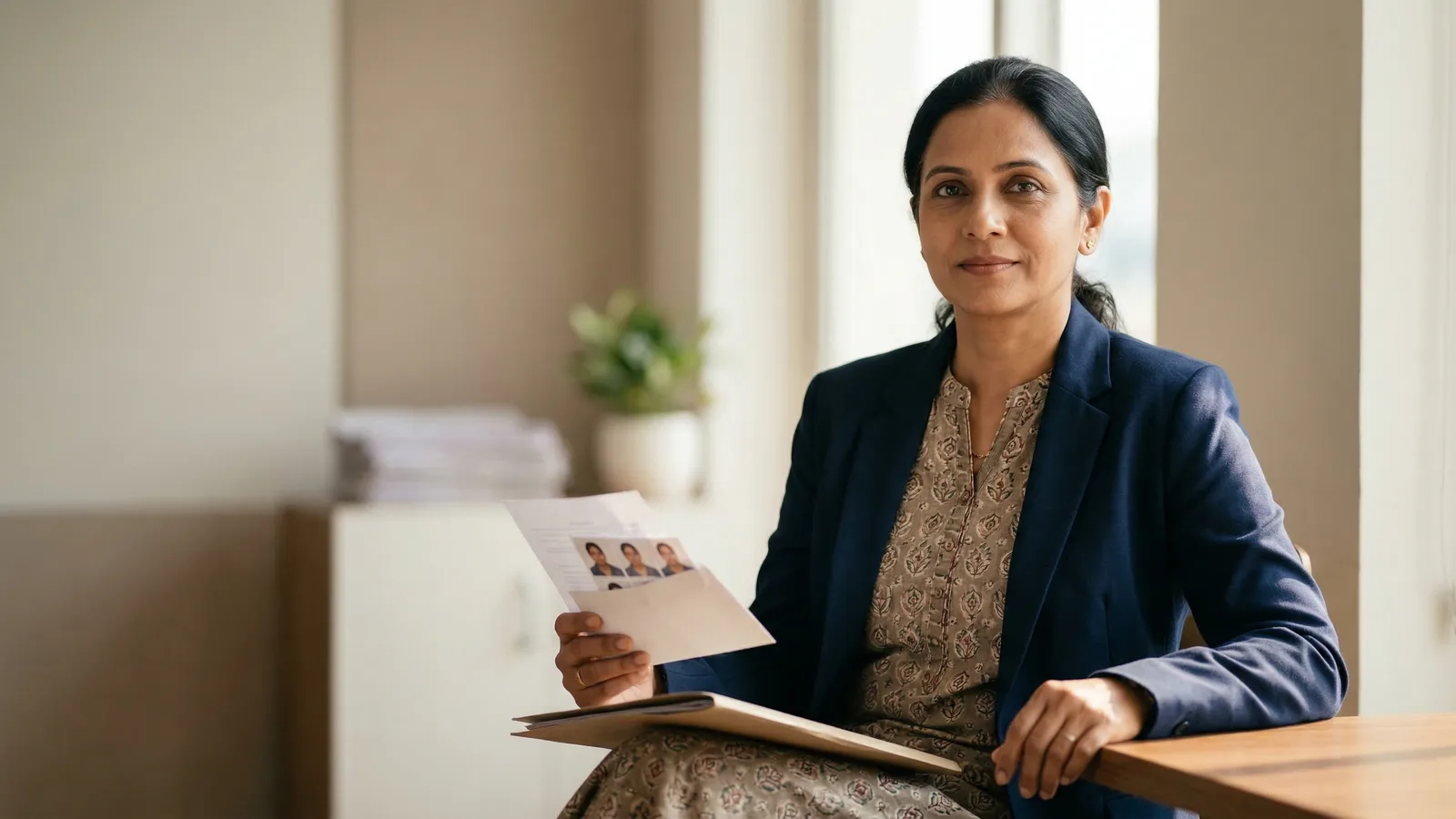
Ration card applications in India require passport-size photos — 35×35mm print, white background. For digital submissions, the standard is 413×413 pixels at 300 DPI. The exact requirements vary by state, and some states now capture photos directly at government offices rather than accepting applicant-submitted photos.
The ration card is issued under India's Public Distribution System (PDS), managed by state Food and Civil Supplies departments. Because administration is state-level, there's no single national photo standard — but passport-size photo specs are accepted across every state that allows self-submitted photos.
Ration Card Photo Specifications
These are the standard specs used across most state portals:
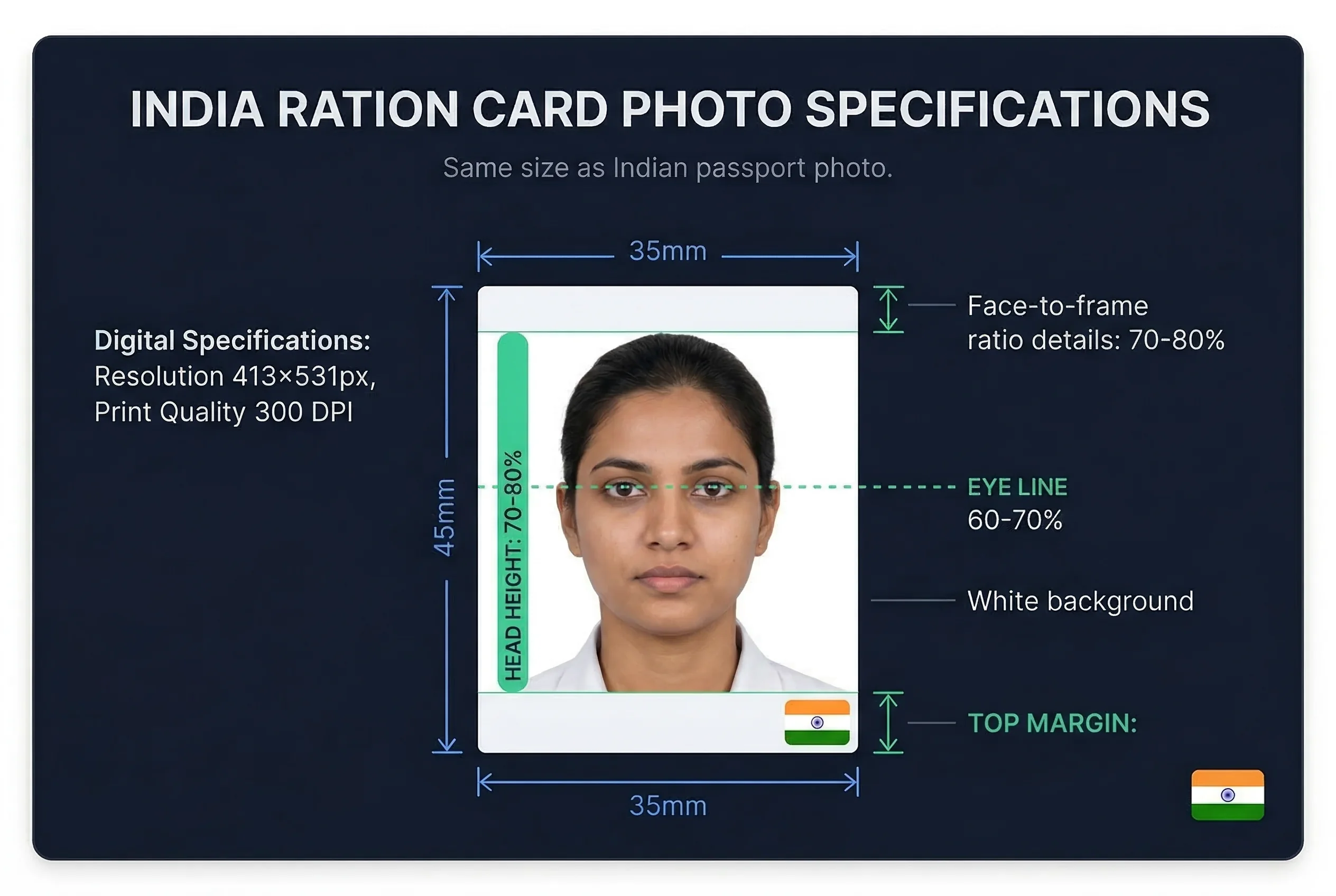
| Requirement | Specification |
|---|---|
| Print size | 35×35mm |
| Digital size | 413×413 pixels |
| Resolution | 300 DPI |
| Background | White (255, 255, 255) |
| Glasses | Not allowed |
| Expression | Neutral |
| File format | JPEG |
| File size | Under 50KB (most portals) |
If you already have passport-size photos on hand, they'll work for most state applications. The 35×35mm spec matches the Indian passport photo standard — the same photos serve both purposes.
Get a compliant passport photo online
Ration Card Photo Rules: State-by-State Variations
India has 28 states and 8 union territories, each running its own PDS portal. While the photo spec is largely consistent, the submission method varies.
Uttar Pradesh runs the UP FCS portal (fcs.up.gov.in). New ration card applications require a passport-size photo of each family member to be uploaded with the application form. File size limit is typically 50KB per image.
Maharashtra manages applications through the Maharashtra Food portal. Photo submission is required for the head of household. Maharashtra also allows walk-in applications at Tehsil offices where a photo may be captured on-site.
Tamil Nadu — one of India's strongest PDS systems — processes most applications through government outlets (ration shops) and district offices. Photos may be captured by the officer rather than submitted by the applicant.
Rajasthan uses the Jan Soochna Portal for ration card applications. Photo upload requirements follow the standard passport-size spec.
West Bengal processes through the WB Food portal and requires passport-size photos for new household registrations.
The pattern: larger states with mature digital portals tend to accept uploaded photos. States with strong on-ground PDS infrastructure often do on-site capture instead. If you're unsure, check your state's Food and Civil Supplies department website or visit the nearest Tehsil/Taluk office.
Types of Indian Ration Cards (AAY, PHH, and APL)
India issues different ration card categories based on household income:
- Antyodaya Anna Yojana (AAY) — for the poorest households
- Priority Household (PHH) — families meeting state-defined criteria
- Non-Priority / Above Poverty Line — reduced subsidy
The photo requirements are the same across all categories. The difference is the entitlement — how much subsidised rice, wheat, sugar, and kerosene the household receives.
How to Apply for an Indian Ration Card Online or Offline
Online: Go to your state's Food and Civil Supplies portal. Search for "[state name] ration card apply online" — every state with digital infrastructure has its own portal. Create an account, fill the application form, upload photos and supporting documents (Aadhaar, address proof, income proof), and submit.
Offline: Visit your local Tehsil office (also called Taluk office in southern states). Collect the application form, attach photos, attach document copies, and submit to the officer. Processing happens through the district office.
Documents typically required alongside photos:
- Aadhaar card (all family members)
- Address proof (electricity bill, bank passbook, rent agreement)
- Income certificate (for PHH/AAY category)
- Existing ration card (for corrections or additions)
Ration Card Processing Time and Fees by State
Processing typically takes 15-30 days after submission. Some states issue a temporary acknowledgement slip that can be used at PDS shops while the physical card is being processed.
Fees range from ₹5 to ₹100 depending on the state and category. In several states (including UP and Tamil Nadu), the ration card is issued free of charge.
Validity depends on the state. Most ration cards are valid until the household composition changes — a marriage, birth, or death in the family typically requires an update.
Photo Tips for Indian Ration Card Applications
Take the photo against a plain white wall or sheet with even lighting. Avoid shadows on the wall behind you. Face the camera squarely. Keep your expression neutral — no smile, no squint.
The file size limit of 50KB (common on state portals) is small. A 600×600px JPEG shot on a modern smartphone will often be 200KB or more. You'll need to compress it before uploading. Most photo editing apps have a "save for web" or quality slider — aim for 70-80% JPEG quality to get under 50KB without visible degradation.
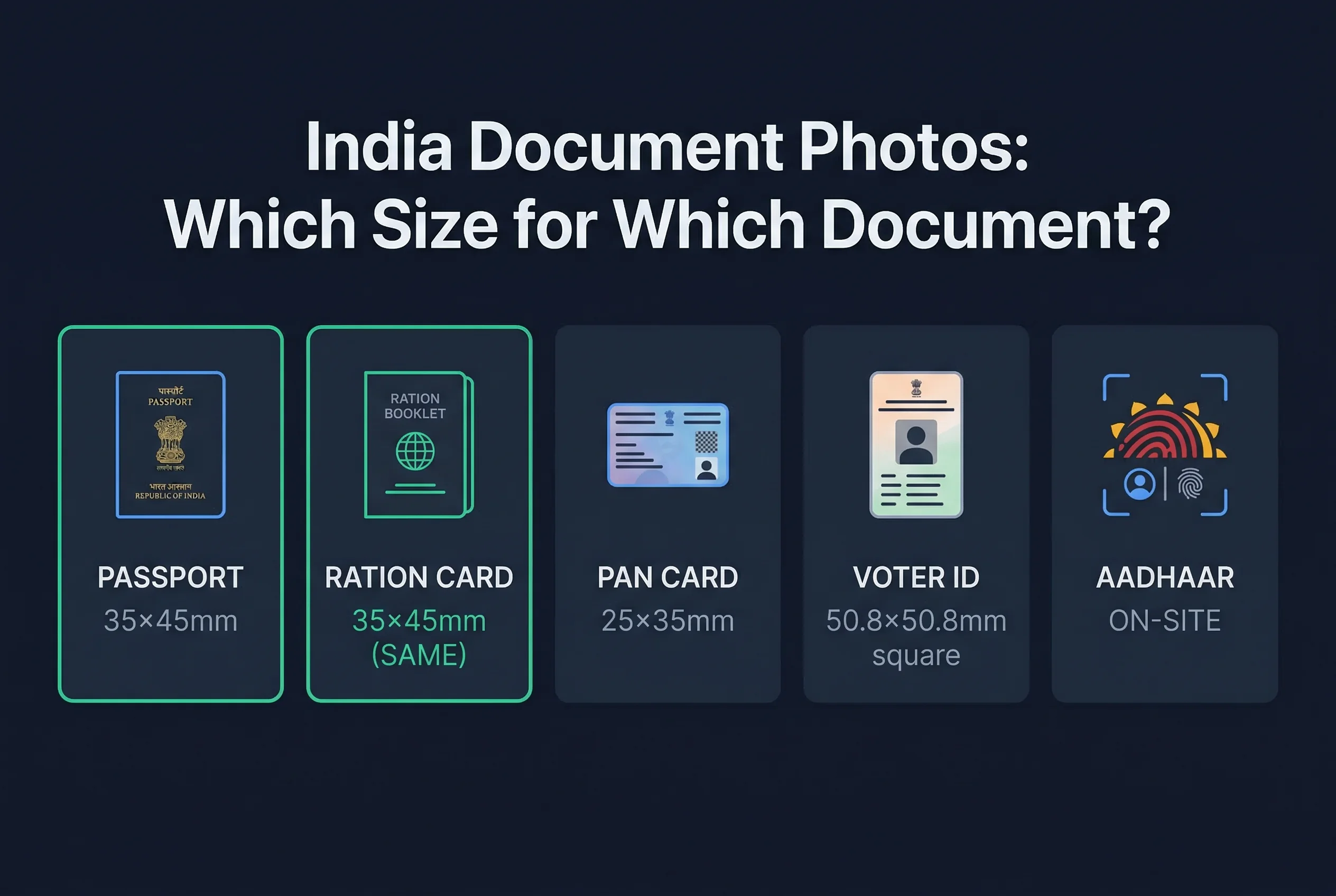
If you're applying for multiple documents at the same time — Indian passport, ration card, voter ID — you can use a single photo session for all of them. The ration card and passport use the same 35×35mm spec. The voter ID is larger (50.8×50.8mm). Shoot at the right dimensions for each, or use the passportsize-photo.online checker to ensure your photo meets each document's spec before you submit.
For other passport-size documents in India like PAN card, the same 35×35mm photo applies across the board. Keep a few digital copies at 413×413px and you'll be set for most Indian government applications.
Expression and Appearance Rules for Ration Card Photos
- Neutral expression — mouth closed, no smile, no frown
- Eyes open — both eyes fully visible, looking directly at the camera
- No glasses — all types banned without exception, including clear prescription lenses
- Hair away from face — forehead and both eyes clearly visible
- Head coverings — permitted for religious reasons (turban, hijab, patka); full face from chin to forehead must remain visible
- Clean, even lighting — no shadows on face or background
- Recent photo — taken within the last 6 months
Indian Document Photo Comparison
| Document | Size | Background | Glasses | Smile |
|---|---|---|---|---|
| Ration Card | 35×35mm | White | Not allowed | Not allowed |
| Indian Passport | 35×35mm | White | Not allowed | Not allowed |
| PAN Card | 25×35mm | White | Not allowed | Not allowed |
| Driving Licence | 35×45mm | White | Not allowed | Not allowed |
| Voter ID (EPIC) | 50.8×50.8mm | White | Not allowed | Not allowed |
| Police Clearance | 35×35mm | White | Not allowed | Not allowed |
| Arms Licence | 35×35mm | White | Not allowed | Not allowed |
The ration card, passport, police clearance, and arms licence all share the 35×35mm format. Note the PAN card (25×35mm), driving licence (35×45mm), and voter ID (50.8×50.8mm) use different sizes.
Common Ration Card Photo Rejection Reasons
- Glasses present — even clear prescription lenses are rejected
- Non-white background — light blue, grey, or patterned backgrounds fail
- File too large — state portals typically cap uploads at 20–50KB; compress before uploading
- Wrong dimensions — submitting driving licence or voter ID photos instead of 35×35mm
- Photo does not match Aadhaar — some states cross-reference ration card photos with your Aadhaar record
Quick Checklist for India Ration Card Photos
- Size: 35×35mm print (413×413px digital)
- Background: plain white
- Expression: neutral, mouth closed
- No glasses (any type)
- File size under 50KB for digital upload
- Family member photos ready (if applying for household card)
- Aadhaar card for all family members
- Address proof ready