Arms licence applications in India require passport-size photos — 35×35mm print, white background, 413×413 pixels for digital copies. Applications are submitted to the District Magistrate's office under the Arms Act, 1959. The photo standard matches the Indian passport spec.
Obtaining an arms licence in India is a lengthy, document-heavy process. The photo requirements are among the simpler parts.
India Arms Licence Photo Specifications (35×35mm)
| Requirement | Specification |
|---|---|
| Print size | 35×35mm |
| Digital size | 413×413 pixels |
| Resolution | 300 DPI |
| Background | White (255, 255, 255) |
| Glasses | Not allowed |
| Expression | Neutral |
| File format | JPEG |
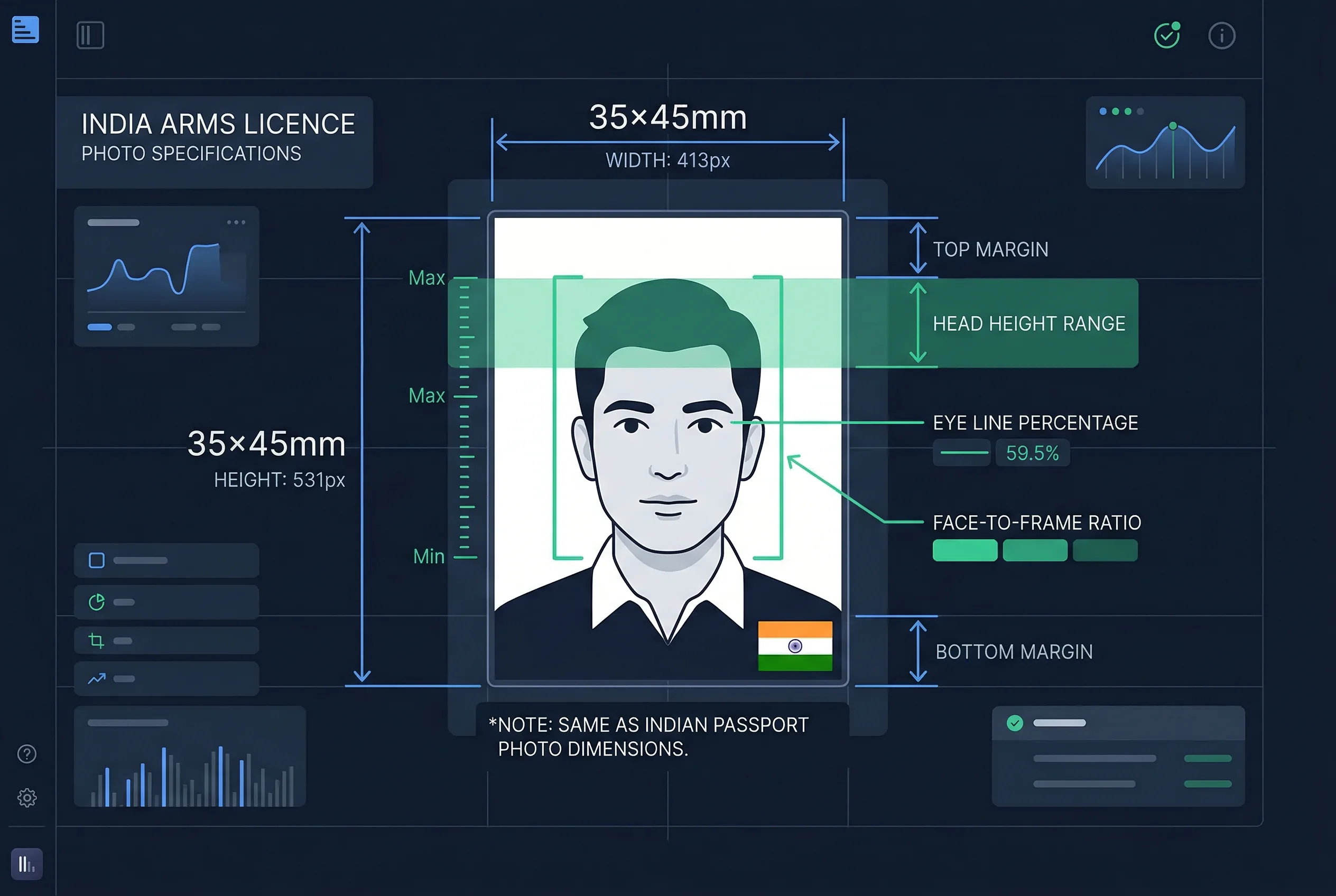
These are the standard passport-size specs used across Indian government applications. If you have compliant photos from a recent passport or PAN card application, they'll work here too.
You'll typically need to submit 4-6 copies of the photo with the application: attached to the Form 1 application, to the supporting documents, and retained by the District Magistrate's office for the police verification file.
Get a compliant passport photo online
Arms Licence Application Process at the District Magistrate
Arms licences in India are issued by the District Magistrate (DM) or District Collector of the district where the applicant is ordinarily resident. The process operates under the Arms Act, 1959, and the Arms Rules, 2016.
Form 1 is the application for a new arms licence (grant). Form 3 is for renewal of an existing licence. Both require photos.
The general sequence:
- Obtain the application form from the District Collector's office or download from your state government's portal
- Fill in personal details, purpose of licence (self-defence, crop protection, sport, etc.), and weapon category
- Attach photographs (passport-size, 35×35mm)
- Attach supporting documents — Aadhaar, address proof, identity proof, no-objection certificates where required
- Submit to the District Magistrate's office
- Background verification is conducted by local police
- DM reviews the file and makes a licensing decision
- Licence issued (or application rejected) with written reasons
The background check is thorough. Police will visit your address, verify employment and financial details, and check for any criminal record or involvement in civil disputes.
Arms Licence Processing Time and Fees by State
| Item | Detail |
|---|---|
| Application fee | ₹100–₹1,000 (varies by state and weapon category) |
| Processing time | 60–90 days (longer if verification is delayed) |
| Validity | 3 years (renewable) |
| Issued by | District Magistrate / District Collector |
Processing time is a function of the police verification cycle. Urban districts with high caseloads tend to be slower. Rural districts with simpler verification sometimes move faster. Practically, applicants should expect 60-90 days from application to decision — sometimes longer.
Documents Required for an Indian Arms Licence Application
Each DM's office has its own checklist, but the standard documents are:
- Completed Form 1 (or Form 3 for renewal)
- Passport-size photos (4-6 copies)
- Aadhaar card (original + copy)
- Address proof (electricity bill, bank statement, etc.)
- Identity proof (PAN card, voter ID, passport)
- Income proof (ITR, salary slip) — required in some states
- Medical certificate (some states require fitness certification)
- Purpose declaration (self-defence, sport, crop protection) with supporting documents
For crop protection and rural self-defence applications, some states require additional certification from the local Tehsildar or Block Development Officer.
Indian Arms Licence Validity and Renewal Process
An arms licence in India is valid for 3 years. Renewal (Form 3) must be filed before expiry. If a licence lapses, you may need to restart the process from scratch — the DM can require a fresh verification cycle for lapsed licences.
Renewal is typically faster than fresh application since the background check is an update rather than a full investigation. Fees for renewal are lower in most states.
The licence specifies: the weapon type and calibre, the number of weapons permitted, the quantity of ammunition, and geographic restrictions (some licences are district-restricted, others are all-India).
Who Can Apply for an Arms Licence in India?
An applicant must be:
- An Indian citizen
- 21 years of age or older
- Ordinarily resident in the district of application
- Without a criminal record or history of civil disputes
Applications can be refused on grounds of public safety, unsuitability of purpose, or at the DM's discretion. Decisions are appealable to the state government under the Arms Act.
Photo Tips for Indian Arms Licence Applications
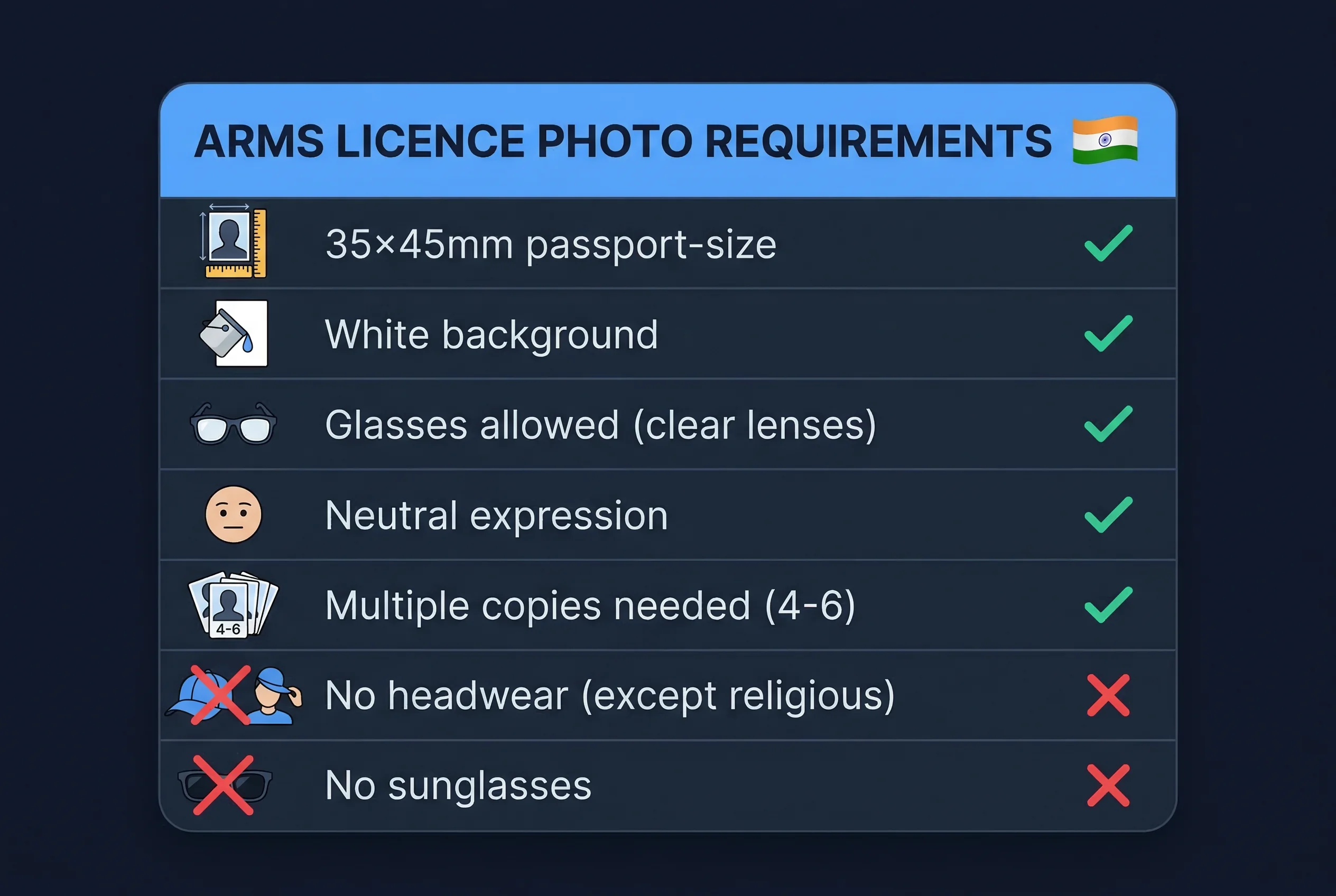
The photo for an arms licence application is the same passport-size photo used across most Indian government applications. Take it against a clean white background with even lighting. No shadows on the wall behind you. Face forward, neutral expression, no glasses.
You'll need multiple printed copies (4-6) for physical submission. Make sure you print at 35×35mm — not the slightly different 45×35mm used in some older passport formats.
For your digital copy, check compliance with passportsize-photo.online before printing. A rejected photo at the DM's office means re-shooting and resubmitting — and the arms licence process is already slow enough.
Expression and Appearance Rules for Arms Licence Photos
- Neutral expression — mouth closed, no smile, no frown
- Eyes open — both eyes fully visible, looking directly at the camera
- No glasses — all types banned without exception, including clear prescription lenses
- Hair away from face — forehead and both eyes clearly visible
- Head coverings — permitted for religious reasons (turban, hijab, patka); full face from chin to forehead must remain visible
- No heavy makeup or accessories — the photo should represent your everyday appearance
- Clean, even lighting — no shadows on face or background
- Recent photo — taken within the last 6 months
Indian Document Photo Comparison
Many Indian government documents share the same 35×35mm passport-size format, but some use different sizes.
| Document | Size | Background | Glasses | Smile |
|---|---|---|---|---|
| Arms Licence | 35×35mm | White | Not allowed | Not allowed |
| Indian Passport | 35×35mm | White | Not allowed | Not allowed |
| PAN Card | 25×35mm | White | Not allowed | Not allowed |
| Driving Licence | 35×45mm | White | Not allowed | Not allowed |
| Voter ID (EPIC) | 50.8×50.8mm | White | Not allowed | Not allowed |
| Police Clearance | 35×35mm | White | Not allowed | Not allowed |
| Ration Card | 35×35mm | White | Not allowed | Not allowed |
The arms licence, passport, police clearance, and ration card all share the 35×35mm format — one photo session covers all four. The PAN card is narrower (25×35mm), the driving licence is taller (35×45mm), and the voter ID uses a square 50.8×50.8mm format. Do not mix sizes across applications.
Common Arms Licence Photo Rejection Reasons in India
- Glasses present — even clear prescription lenses are rejected
- Non-white background — off-white, light blue, or grey backgrounds are rejected
- Shadows on background — uneven studio lighting creates grey patches behind your head
- Wrong dimensions — submitting 35×45mm driving licence photos instead of 35×35mm
- Old photo — photo must resemble your current appearance
- Expression not neutral — smiling, squinting, or closed eyes
Quick Checklist for India Arms Licence Photos
- Size: 35×35mm print (413×413px digital)
- Background: plain white
- Expression: neutral, mouth closed
- No glasses (any type)
- 4–6 printed copies for submission
- Photo taken within 6 months
- Form 1 (new) or Form 3 (renewal) completed
- All supporting documents assembled
For other documents that use the same photo — Indian passport, PAN card, Police Clearance Certificate — one good photo session covers everything. Print a sheet of 35×35mm copies and you'll have enough for multiple applications.