You can take your own German passport photo at home. The Bundesdruckerei accepts DIY photos as long as they meet the exact specifications — and Germany has some of the strictest requirements in the world.
This guide covers what you need, step-by-step instructions, and how to ensure your photo passes.
What You Need for a DIY German Passport Photo
- Smartphone — any modern phone
- Light grey background — grey poster board or grey fabric (#E6E6E6)
- Good lighting — natural daylight is best
- Helper — you cannot take a selfie
- Photo editing app — for resizing to 413×531 pixels at 300 DPI
Get a compliant passport photo online
Step-by-Step German Passport Photo Process at Home
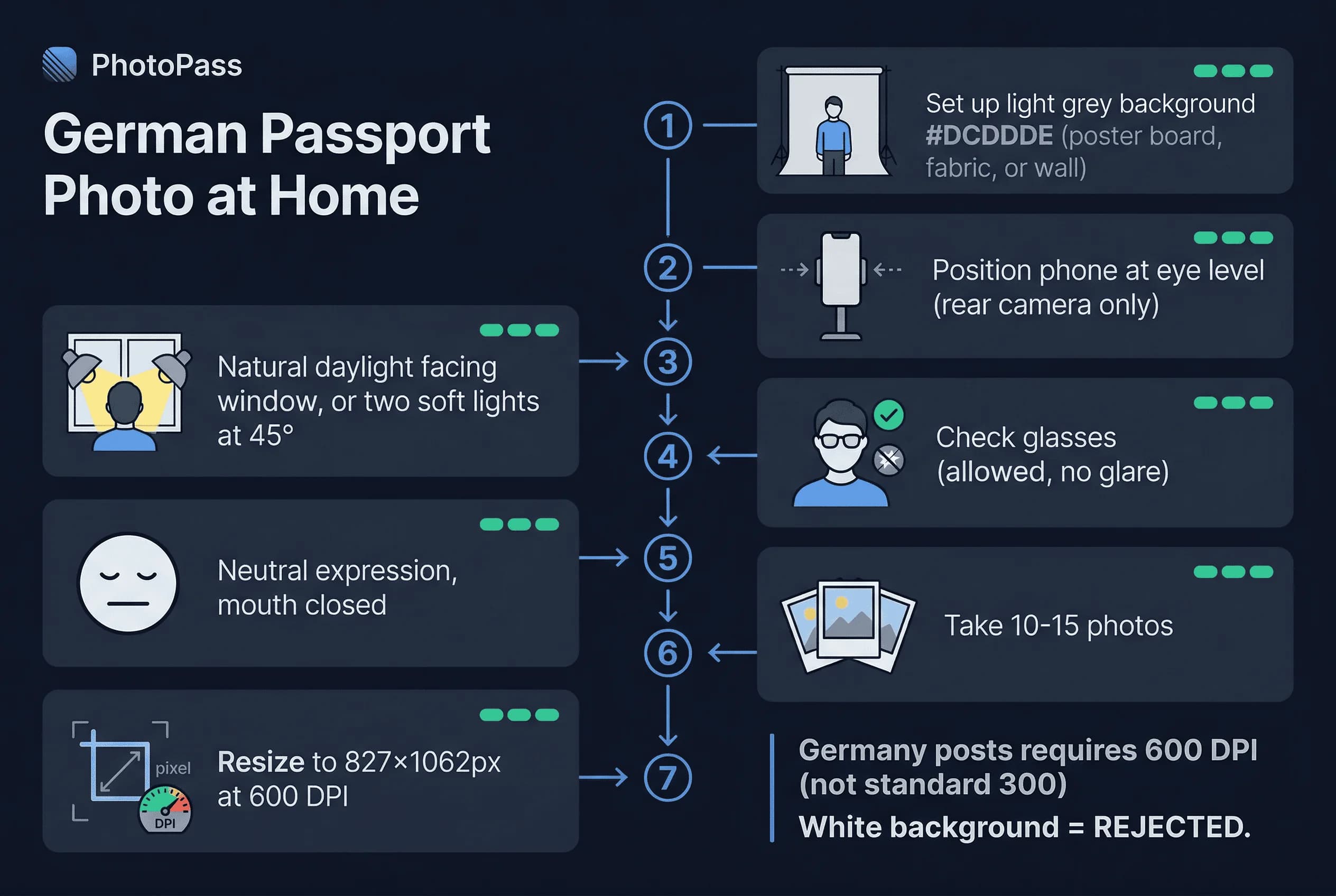
Step 1: Set Up a Grey Background (Not White)
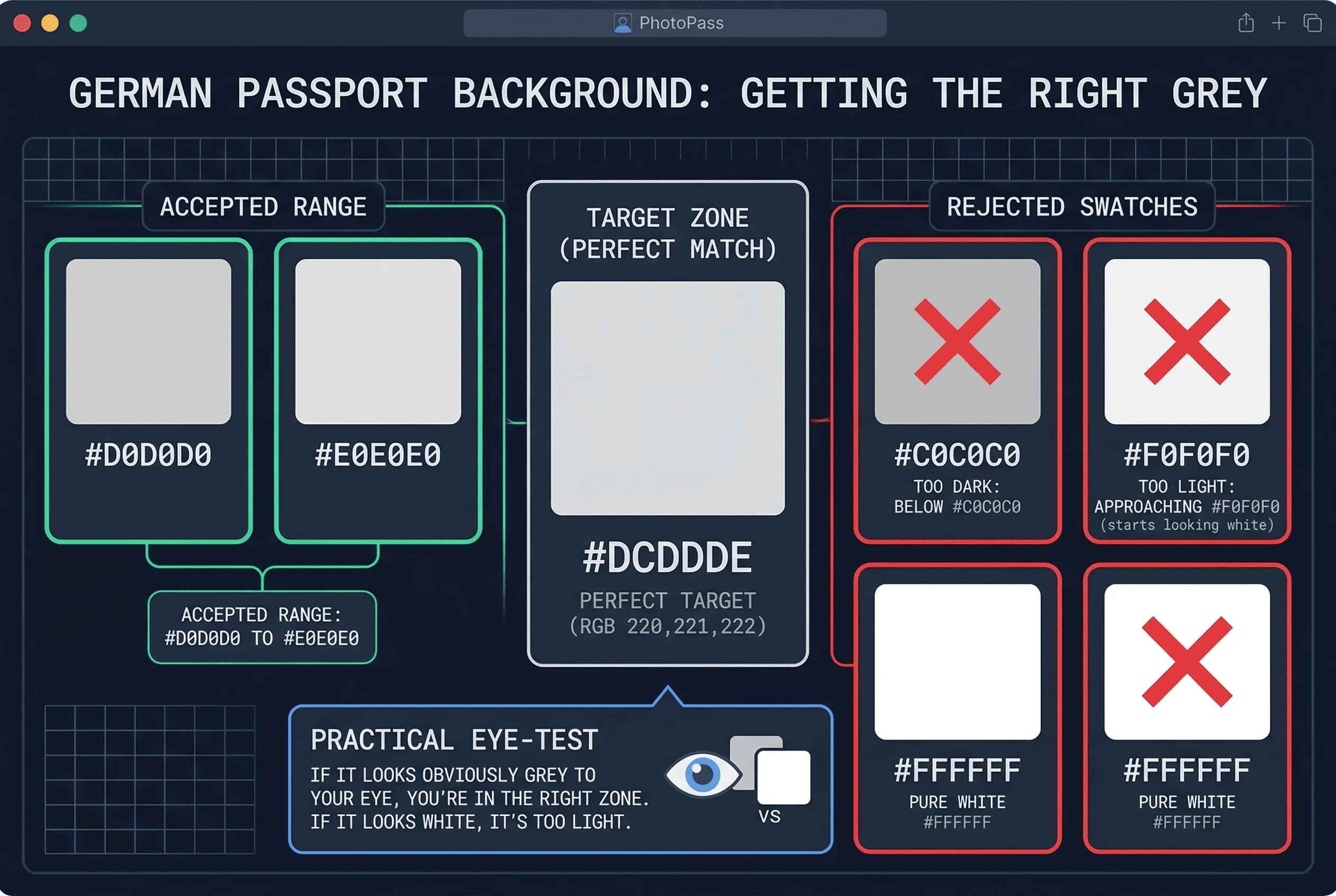
This is the most important step. Germany requires light grey (#E6E6E6) — not white, not dark grey, not medium grey.
Options:
- Grey poster board — available from Bastelbedarf (craft shops), dm, or Müller. Cost: €2–5. The most reliable option.
- Grey fabric or bedsheet — must be a uniform light grey. Iron flat and pin taut. Even minor wrinkles create shadows.
- Grey wall — if you're lucky enough to have one in the correct shade.
White will not work. German authorities reject white backgrounds. The grey requirement is what makes German passport photos uniquely challenging to DIY.
Stand 12–18 inches from the background to prevent your body from casting shadows onto it. The background must fill the entire frame with generous margin for cropping.
Step 2: Position Your Phone for German Photos
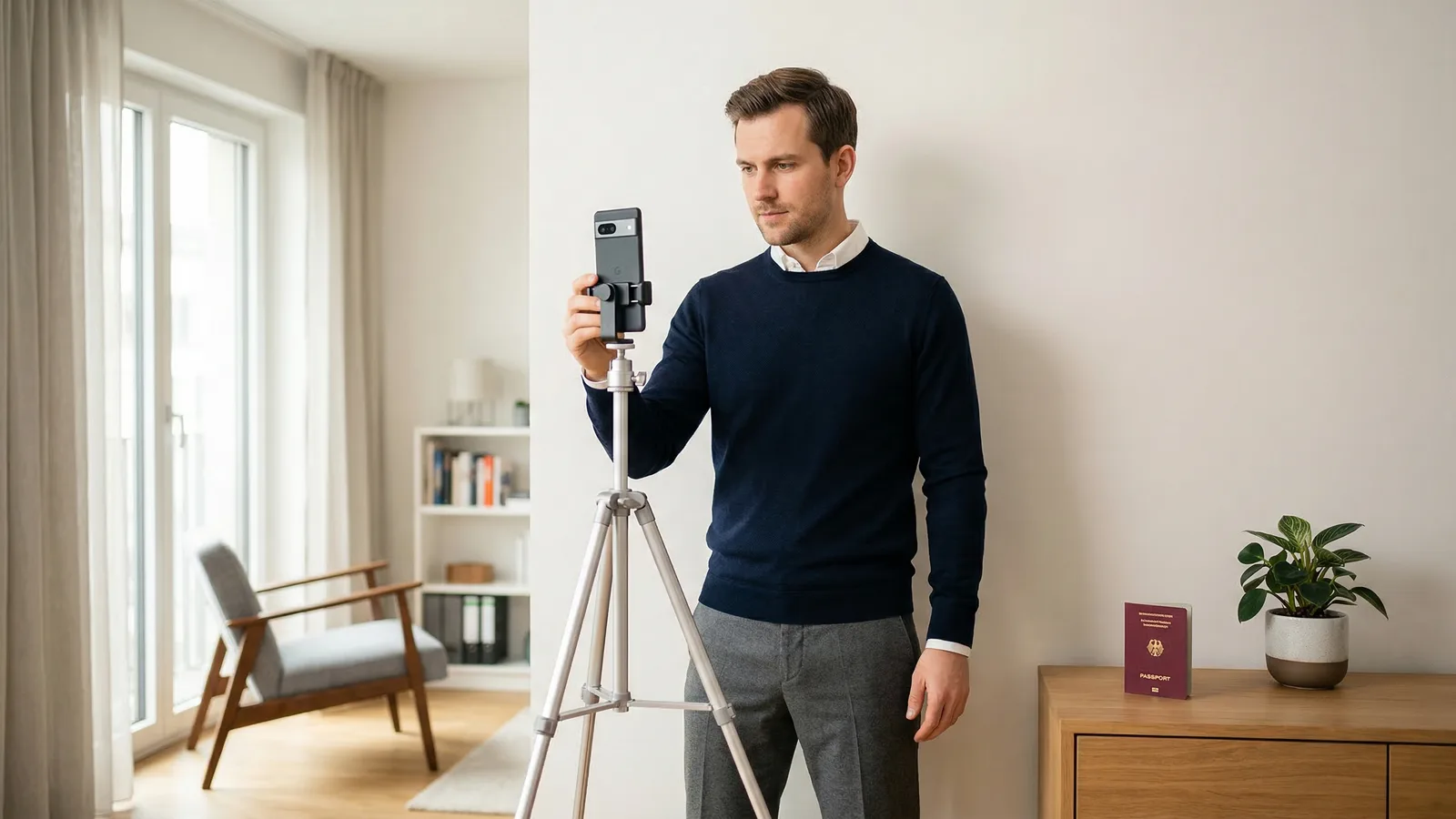
Place your phone on a stable surface at eye level, 4–6 feet (1.2–1.8m) away. Use the rear camera — it produces sharper images with less distortion than the selfie camera.
Set a 3 or 10-second timer, or have someone else take the photo. Never hold the phone in your hand — it causes shake and distortion.
Step 3: Set Up Lighting for the Grey Background
Natural daylight from a window is ideal. Position yourself facing the window with the light in front of you. Overcast days are perfect — the clouds diffuse the light naturally.
If using artificial light, place two identical lamps at 45° angles on either side with daylight-temperature bulbs (5000K–6500K). Match the bulbs — different colour temperatures create uneven tones on the grey background.
Critical for grey backgrounds: Under-lighting makes grey appear darker than intended. Over-lighting washes it towards white. Test by photographing the background alone — on screen, it should appear light grey, not white or dark.
Step 4: Prepare Your Appearance for German Photos
Before the photo:
- Glasses: Germany allows prescription glasses, but ensure no glare on lenses. Position lighting at 45° to minimise reflections. If glare persists, removing them is simpler.
- Remove sunglasses, headphones, and earbuds
- Remove large jewellery that frames your face or creates reflections
- Ensure hair doesn't cover eyes, eyebrows, or forehead
- Wear solid-coloured clothing — avoid grey (you'll blend into the background) and avoid white
Step 5: Take Multiple Photos and Review Each
Take 15–20 photos in quick succession. Use burst mode if available. Review each on a larger screen (computer monitor or tablet).
Eliminate any shot where:
- Background appears too dark, too light, or uneven
- Face is not centred or is tilted
- Eyes are partially closed
- Expression shows any hint of smile
- Glasses have visible glare (if wearing them)
- Shadows appear on background or face
- Hair covers the forehead or eyes
Select your best 3–4 for cropping. The grey background makes shadows more visible than white — be extra critical.
Step 6: Crop and Resize to 413×531 Pixels at 300 DPI
Open your best photo in any editor:
- Crop to the 7:9 aspect ratio (35×45mm)
- Resize to exactly 413×531 pixels at 300 DPI
- Save as high-quality JPEG
- File size should be between 60KB and 6MB
Country-Specific Tips for German Passport Photos
Light Grey Background Is Mandatory for Germany
Germany requires light grey (#E6E6E6). This is NOT white. White backgrounds are rejected by German authorities.
Head Size Must Be 70–80% of the Frame
German photos require head height of 70-80% of frame. Your face should fill more of the photo than in other countries.
Glasses Are Allowed in German Passport Photos
Germany allows prescription glasses provided there's no glare on the lenses. The US, Australia, France, and Japan ban glasses entirely, making Germany more flexible for glasses wearers.
Neutral Expression Required for German Photos
No smiling. This is stricter than the US.
Common Mistakes to Avoid in German Passport Photos
Mistake 1: Using a White Background Instead of Grey
Germany uses light grey (#E6E6E6), not white. White backgrounds are rejected.
Mistake 2: Using Wrong Photo Dimensions
Germany uses 35×45mm (413×531 pixels at 300 DPI), not the US square format.
Mistake 4: Smiling in Your German Passport Photo
Neutral expression is required. No smiling.
Mistake 5: File Size Outside Acceptable Range
Keep between 60KB and 6MB.
How to Check Your German Passport Photo Compliance
Before submitting, verify:
- Background is light grey (#E6E6E6)
- DPI is 300
- Dimensions are 413×531 pixels
- File size is 60KB-6MB
- Head occupies 70-80% of frame
- Eyes are open and visible
- Expression is neutral
- No glare on glasses (if wearing)
- No shadows
Check your German passport photo →
Alternative: Use a German Photo Service Instead
If DIY feels complicated, use a professional service:
- Photostudios: ~€10-15
- Drogeriemärkte (dm, Rossmann): ~€8-12
- Online services: €5-10
These guarantee compliant backgrounds, dimensions, and DPI. Worth it to avoid rejection.
Lighting Tips for German Passport Photos at Home
Natural light. Face a large window with indirect light. Overcast German days produce excellent diffused light.
Artificial light. Two identical lamps at 45° angles with daylight bulbs (5000K–6500K). The grey background requires careful lighting — under-lit grey appears darker than intended, which can push it outside the acceptable range.
Test your setup. Photograph the grey background alone. On your computer screen, it should appear light grey — not white, not medium grey, not dark.
How to Print Your German Passport Photo at Home
After cropping to 413×531 pixels at 300 DPI:
- Print on photo paper at 300 DPI.
- Verify printed background colour matches the light grey requirement.
- Check the printed size with a ruler — it must measure exactly 35mm × 45mm.
- In Germany, print at dm, Rossmann, or a Fotostudio.
Submitting Your Passport Photo to the Bürgeramt
German passport applications are processed at the Bürgeramt (citizens' office) or Einwohnermeldeamt. Bring printed photos. Staff will visually inspect them — the grey background is the most common rejection point for DIY photos.
Photos taken at home are accepted if they meet all specifications. Some Bürgeramt locations offer photo services on-site or nearby for approximately €8–15.
German Passport Photo DIY Rules for Citizens Abroad
If renewing a German passport from abroad, the same light grey background requirement applies at German embassies and consulates worldwide. This is the requirement most often failed abroad — photo studios in other countries default to white backgrounds. Always specify "German passport photo, 35×45mm, light grey background, NOT white."
Verify your photo meets all German requirements with the passportsize-photo.online checker. For size details, see the Germany passport photo size guide. For full German passport rules, visit the Germany hub.