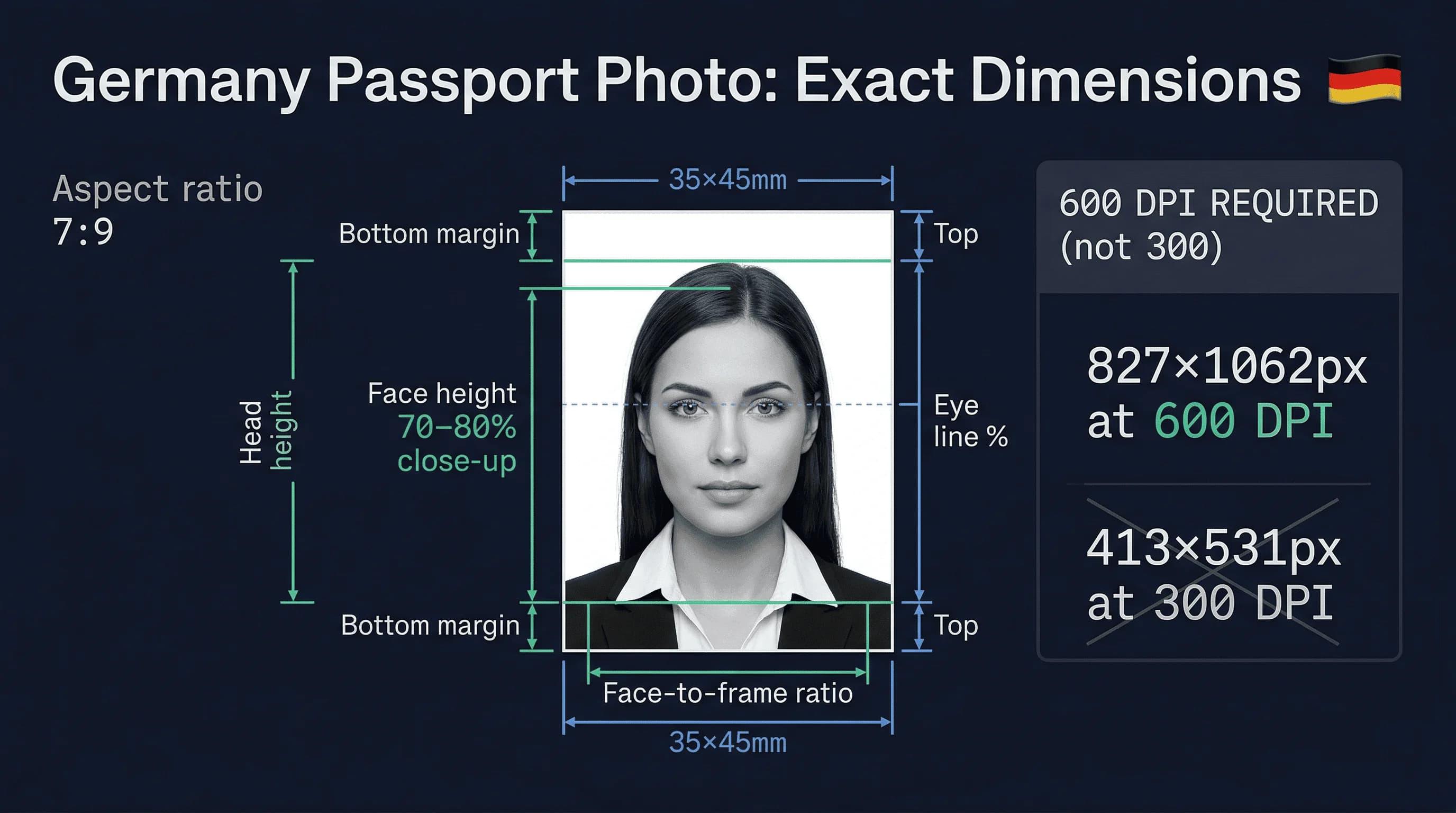
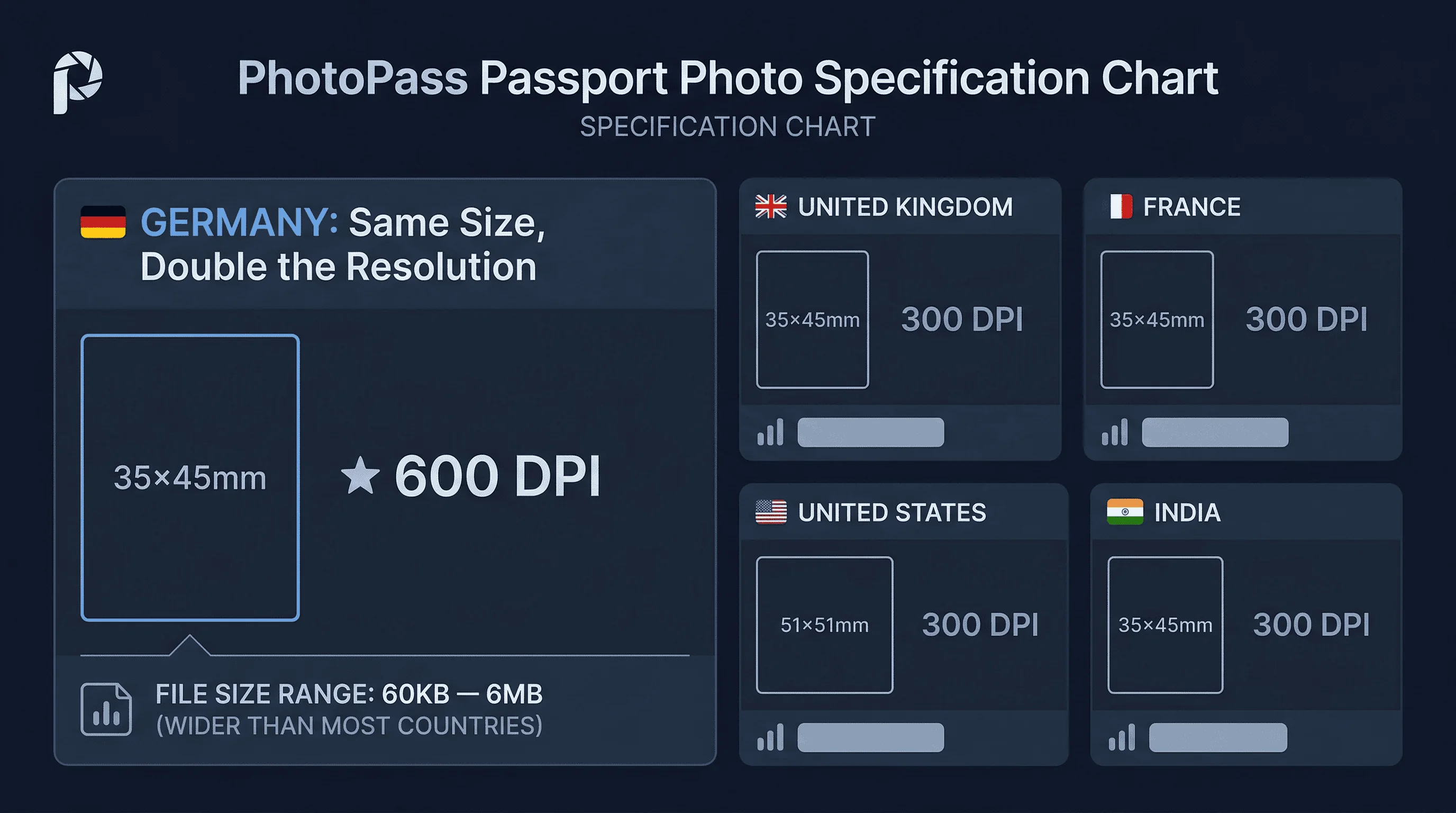
German passport photos are 35 × 45 mm (approximately 1.38×1.77 inches) or 413 × 531 pixels at 300 DPI. Germany shares this ICAO-standard size with the UK, France, and most of Europe. However, Germany is distinctive in requiring a light grey background and conditionally allowing glasses.
Important change since November 2024: For new passport applications within Germany, photos must now be taken digitally at the registration office (Bürgeramt). You can no longer bring your own printed photos for new passport applications.
Exact German Passport Photo Size Specifications
| Specification | Value |
|---|---|
| Width | 35mm / 1.38″ / 413px |
| Height | 45mm / 1.77″ / 531px |
| Aspect ratio | 7:9 |
| DPI | 300 |
| File format | JPEG or PNG |
| Background | Light grey (230,230,230) |
| Glasses | Conditionally allowed |
| Expression | Neutral, mouth closed |
Get a compliant passport photo online
The November 2024 German Passport Photo Change
Since November 2024, Germany requires that passport photos for new applications be taken as live digital captures at the Bürgeramt (registration office). The policy was introduced to prevent digitally altered or AI-manipulated photos.
This means:
- Within Germany: Your photo is taken at the registration office when you apply. You cannot bring your own photo.
- Germans abroad: If applying through a German embassy or consulate, you may still need to provide your own photos. Check with your specific embassy.
- Renewals and other documents: The rules vary. Some applications still accept brought-in photos. Verify with your local Bürgeramt before your appointment.
German Passport Photo Head Height: The 60–80% Rule
Your head — measured from the bottom of the chin to the top of the skull — must occupy 60-80% of the photo's 45mm vertical space.
In concrete terms:
- Minimum (60%): 27mm from chin to crown
- Maximum (80%): 36mm from chin to crown
- Target (70%): approximately 31.5mm — the safest position
- Eye line: Approximately 56% from the bottom of the image
The German BSI (Federal Office for Information Security) biometric standard is strict about centering — your face must be aligned within a tight tolerance. The biometric photo systems at registration offices enforce this automatically. If taking your own photo for embassy applications, aim for 70% head height to stay safely within bounds.
Glasses and Appearance Rules for German Passport Photos
Germany is one of the few countries that conditionally allows glasses in passport photos — a notable distinction shared with the UK and Canada.
- Glasses: Allowed if your eyes are clearly visible with no reflections or glare on the lenses. The frames must not cover any part of your eyes. Tinted glasses and sunglasses are not permitted. Anti-reflective lenses are strongly recommended. Most applicants remove glasses to avoid rejection risk.
- Expression: Neutral, mouth closed. No smiling.
- Background: Light grey — not white. This is a distinctive German requirement that differs from France, the US, and most other countries.
- Hair: Must not cover the face or forehead. Both ears should be visible.
- Head coverings: Only for religious or medical reasons. The full face from forehead to chin must remain visible.
German Passport Photo Size vs Other Countries
| Country | Size | Head height | Background | Glasses |
|---|---|---|---|---|
| Germany | 35×45mm | 60–80% | Light grey | ✅ Conditional |
| United Kingdom | 35×45mm | 64–76% | Light grey | ✅ Conditional |
| France | 35×45mm | 60–80% | White | ❌ Banned |
| United States | 51×51mm | 50–69% | White | ❌ Banned |
| Canada | 50×70mm | 44–51% | White | ✅ Conditional |
| India | 35×35mm | 60–80% | White | ❌ Banned |
| Spain | 26×32mm | 63–78% | White | ❌ Banned |
Germany and the UK are the most similar pair — both 35×45mm with light grey backgrounds and conditional glasses permission. The head height ranges differ slightly (Germany 60-80% vs UK 64-76%), but a photo compliant for one usually works for the other. France uses the same dimensions but requires white background and bans glasses.
Where to Get a Correctly Sized German Passport Photo
Bürgeramt (within Germany, new passports). Your photo is taken at the registration office during your appointment. Arrive with a clean appearance — neutral expression, no head coverings (unless religious), and glasses only if you can avoid lens glare. The system captures the photo and applies biometric validation automatically.
Fotostudio (photo studios). For embassy applications, document renewals, or other uses that still accept brought-in photos, professional Fotostudios throughout Germany offer "Passfotos" or "biometrische Passbilder." Prices range from €8-15. Studios near Bürgeramt offices handle passport photos daily and understand the BSI requirements.
dm and Rossmann photo kiosks. Drugstore chains dm-drogerie markt and Rossmann offer self-service photo kiosks with passport photo templates. Cost is €5-8 for a set of prints. These machines are pre-configured for 35×45mm with correct framing guides.
Photo booths (Fotoautomat). Automated photo booths in train stations, U-Bahn stations, and shopping centres produce biometric passport photos. Cost is typically €5-10. Look for machines labelled "biometrisch" or "Passfoto."
Outside Germany: Specify "German passport photo, 35×45mm, light grey background" explicitly. The grey background is the most commonly missed requirement. In the US, the default is white background and 51×51mm square — wrong on both counts.
Digital Submission Requirements for German Passport Photos
For embassy and consulate applications that accept digital uploads:
- JPEG or PNG format, 413×531 pixels at 300 DPI
- Light grey background, no shadows
- Taken within the last six months
For the Bürgeramt digital capture within Germany, no file handling is required — the system captures and processes the photo automatically.
German Passport Photo Size Rules for Babies and Children
Children's German passport photos follow the same 35×45mm size and 60-80% head height requirements.
Infants (under 1 year): Lay the baby on a plain light grey sheet and photograph from directly above. Both eyes should be open. At the Bürgeramt, staff have experience with infant photos, though the live digital capture can be challenging with very young babies.
Children (1-5 years): Same rules as adults — neutral expression, eyes open, face centred. Professional studios are often easier for toddlers. At the Bürgeramt, staff are generally patient with young children.
All children under 12: German children's passports (Kinderreisepass) are valid for only 1 year. This means annual photo renewals. Standard children's passports (valid 6 years) are also available.
Common German Passport Photo Sizing Mistakes
Using a white background. Germany requires light grey (230,230,230) — not the white used by France, the US, and most other countries. Photos taken for France or the US will fail on background.
Not knowing about the November 2024 change. Many applicants arrive at the Bürgeramt with printed photos, only to learn they need a live digital capture. Verify the current rules before your appointment.
Using a US 51×51mm photo. The US square format is a completely different size and shape. German citizens in the US need a separate 35×45mm photo.
Glasses with glare. Glasses are allowed, but any reflection or frame covering the eye triggers rejection. If in doubt, remove them.
Face too small from selfie distance. Arm's-length selfies produce a face at roughly 40-50% of the frame — below the 60% minimum.
Verifying Your German Passport Photo Before Submission
Use our passport photo checker to validate your photo against German biometric specifications. For background colour rules, see our guide on German passport photo background requirements. For glasses rules, see German passport photo glasses guide. View all specifications on the Germany passport photo hub.