German passport photos require a light grey background — not white. The Bundesdruckerei (Federal Printing Office) and the BSI (Federal Office for Information Security) specify light grey at approximately RGB 230, 230, 230 (#E6E6E6). This makes Germany one of the few countries that rejects white backgrounds.
Exact Background Rules for German Passport Photos
The background must be:
- Light grey — approximately RGB 230, 230, 230 (#E6E6E6)
- Uniform — the same shade from edge to edge
- Smooth — no visible texture, grain, or pattern
- Shadow-free — no shadows from your head, body, or hair
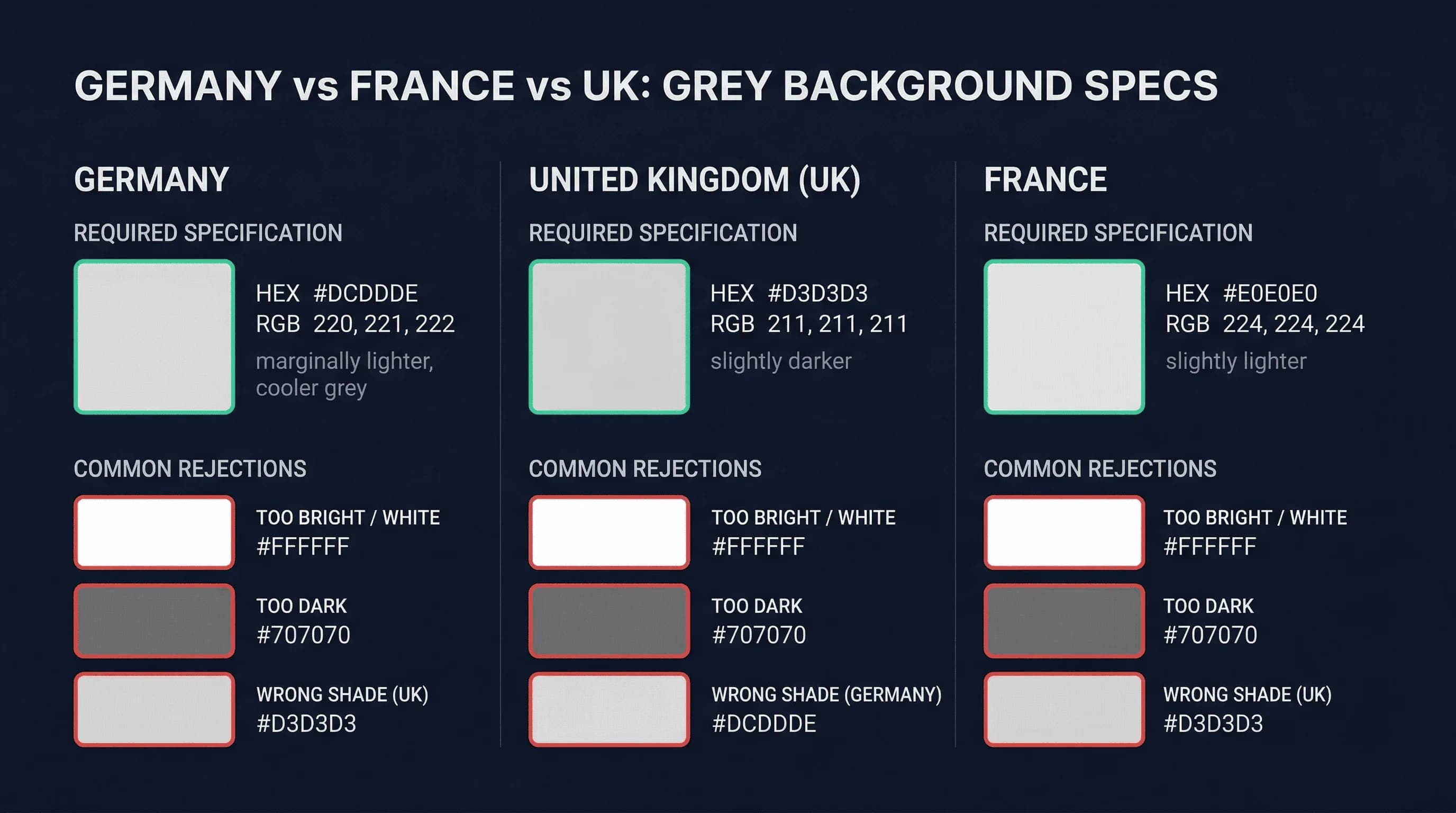
White backgrounds (#FFFFFF) are rejected. Off-white, cream, and ivory are rejected. Dark grey is rejected. Only light grey in the correct range passes.
Get a compliant passport photo online
The November 2024 Bürgeramt Photo Change in Germany
Since November 2024, German passport photos must be taken digitally at the Bürgeramt (registration office) during your appointment. You no longer bring printed photos from an external photographer for most passport applications. The Bürgeramt equipment is calibrated for the correct light grey background.
This change significantly simplifies background compliance for applicants inside Germany — the system handles it automatically. However, the background knowledge remains important for:
- Applications at German consulates abroad (where you may still need to provide your own photo)
- Understanding why old photos from other countries cannot be reused
- Verifying output if using the Bürgeramt's digital system
What Background Colors Fail for German Passport Photos?
White backgrounds. The single most common error. Applicants from the US, France, Japan, and most other countries assume white works everywhere. In Germany, white is explicitly rejected.
Too-dark grey. Grey below approximately RGB 200, 200, 200 (#C8C8C8) is too dark and creates insufficient contrast.
Too-light grey. Grey above approximately RGB 245, 245, 245 (#F5F5F5) starts looking white and is rejected.
Shadows. Uneven lighting creates darker patches that fall outside the acceptable range. Even if the base grey is correct, shadows push areas too dark.
Gradients. Single overhead lighting makes the background darker at the bottom. The system expects uniform grey everywhere.
Coloured tints. Greenish, bluish, or yellowish grey fails. The grey must be neutral — equal values in all three RGB channels.
German Passport Photo Background vs Other Countries
| Country | Background | Notes |
|---|---|---|
| Germany | Light grey | RGB 230,230,230 |
| United Kingdom | Light grey | Same shade as Germany |
| France | White | Different — will fail in Germany |
| Italy | White | Different — will fail in Germany |
| United States | White | Different — will fail in Germany |
| Japan | White | Different — will fail in Germany |
| Switzerland | White | Different — will fail in Germany |
| Netherlands | White | Different — will fail in Germany |
Germany and the UK are the only major countries in our dataset that use light grey. They share the same shade (RGB 230, 230, 230). A UK passport photo should have the correct background for Germany (verify size and other rules separately). Photos from all other major countries — US, France, Japan, Switzerland, Italy, Netherlands — use white and will not pass German requirements.
For German-American, German-French, or other dual citizens, this is critical: your other country's passport photo almost certainly has a white background that fails in Germany.
Where to Get a German Passport Photo with Grey Background
Bürgeramt (since November 2024). For domestic applications, photos are taken digitally during your appointment. The equipment is calibrated for the correct grey. This is now the standard process.
Fotostudio (photo studios). Professional studios in all major German cities understand the requirement. Useful for applications that still accept external photos, or for preparations. Prices: €10–30. Studios near Bürgerämter have the most experience.
Drogeriemärkte kiosks. dm and Rossmann locations often have photo kiosks. These are calibrated for German requirements. Prices: €6–10. Quality varies — check the output.
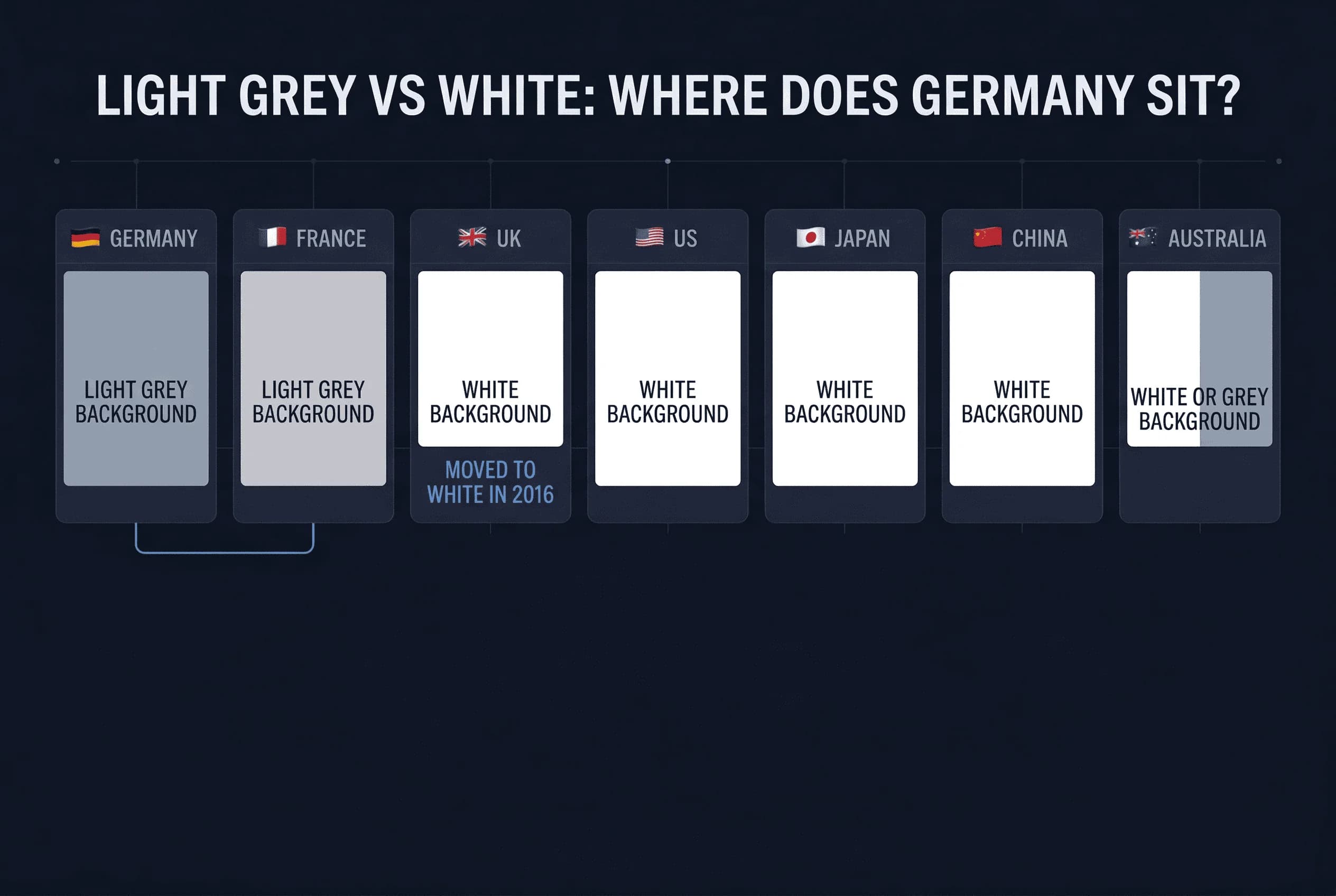
Photo booths. Self-service booths in train stations and shopping centres. Some are calibrated for the German grey; others may not be. Verify the background shade in the preview before printing.
Germans abroad. German consulates and embassies may take photos on-site or direct you to approved local photographers. In most cities, local studios produce white backgrounds by default. You must specify "hellgrauer Hintergrund" (light grey background) and verify the result. In the UK, local studios' grey output may be directly compatible since the shade matches.
DIY Grey Background for German Consulate Applications
If you need a grey-background photo outside Germany (for consulate applications), achieving the correct shade requires care:
- Buy a light grey foam board from a craft or art supplies store. Test the shade by photographing it and checking the RGB values — you need approximately 230, 230, 230.
- Light it evenly with two lamps at 45-degree angles. Use daylight bulbs (5000K) for neutral colour.
- Stand 40–60cm from the board to prevent your shadow from appearing.
- Check the result on a computer screen. Open the image in editing software, use the colour picker on the background, and verify it reads near RGB 230, 230, 230.
- If the grey is slightly off, minor brightness/contrast adjustment in editing software is acceptable. Major colour shifts are not.
Why Does Germany Require Grey Instead of White?
Germany chose light grey for several technical reasons:
- Consistent contrast across skin tones. Light grey provides more even contrast than white for both very light and very dark skin. White can cause overexposure issues with lighter skin tones.
- Reduced sensor glare. Pure white backgrounds can cause flare and overexposure artefacts in digital photography, especially with flash. Grey eliminates this.
- Biometric optimisation. German facial recognition systems are calibrated for this specific grey. The algorithms perform best when the background falls within the expected range.
Common German Passport Photo Background Mistakes
Using a white background. The most common error for international applicants. White fails.
Reusing photos from other countries. A US, French, or Japanese passport photo has a white background. It will be rejected.
Uneven lighting at home. If you need to take your own photo (for consulate applications abroad), achieve the correct grey with a grey foam board or backdrop, lit evenly with two light sources at 45 degrees.
Confusing with UK requirements. Although Germany and the UK use the same grey shade, the photo sizes differ (Germany: 35×45mm, UK: 35×45mm — same) and other rules differ (Germany allows glasses conditionally; UK also allows glasses conditionally). The background is compatible, but verify everything else.
Using grey foam board that's too dark. Art shop grey board comes in many shades. You need a very light grey — RGB 230,230,230. Test by photographing the board and checking RGB values. If it looks "obviously grey" to your eye, it might actually be too dark.
Verifying Your German Passport Photo Background
Before submitting, check:
- Background is light grey (approximately RGB 230, 230, 230)
- Not white, not dark grey, not coloured
- No visible shadows behind you
- No texture, pattern, or seam visible
- Uniform shade from edge to edge
Open the photo in editing software and use the colour picker on multiple background areas. All readings should be near RGB 230, 230, 230 with minimal variation.
Use our passport photo checker to validate your background. For German passport photo size requirements, see the Germany passport photo size guide. View the complete requirements on the Germany hub page.