Employment Authorization Document (EAD) photos follow the standard USCIS format — 2×2 inches (51×51mm), white background, no glasses. Same specs as a US passport photo.
USCIS uses one photo standard for nearly all immigration documents. Green card, naturalization, EAD — the physical dimensions, background color, and face requirements are consistent across the board. If you've had passport photos taken recently, you may be able to reuse them.
EAD Photo Specifications (2×2 Inches, 600×600px)
| Requirement | Specification |
|---|---|
| Print size | 2×2 inches (51×51mm) |
| Digital size | 600×600 pixels |
| Resolution | 300 DPI |
| Background | White (255, 255, 255) |
| Head coverage | 50–69% of frame height |
| Expression | Natural, neutral or slight smile |
| Glasses | Not allowed (since 2016) |
| Photo age | Taken within 30 days of filing |
| Eyes | Open, looking directly at camera |
| Prints required | 2 identical photos |
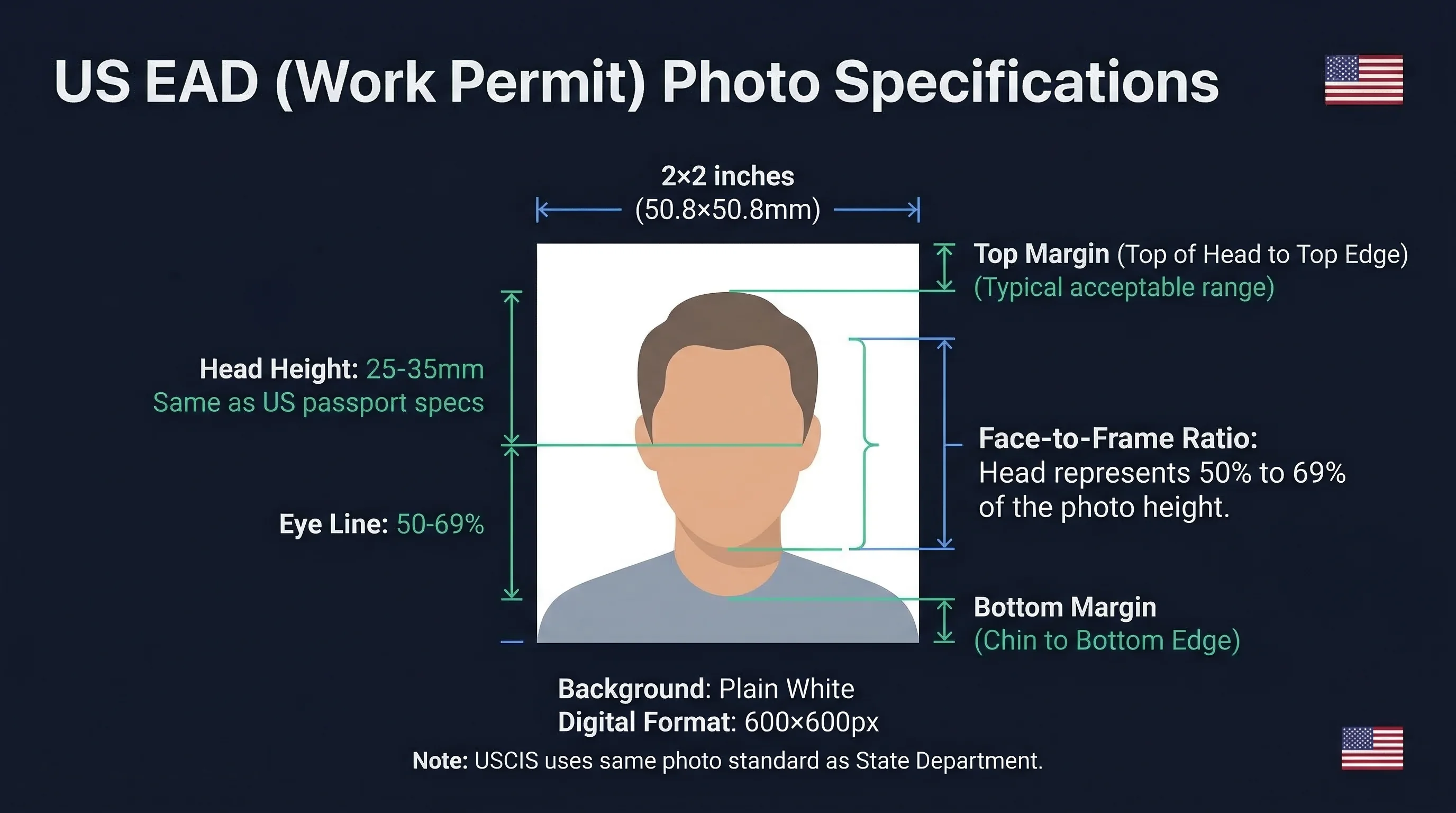
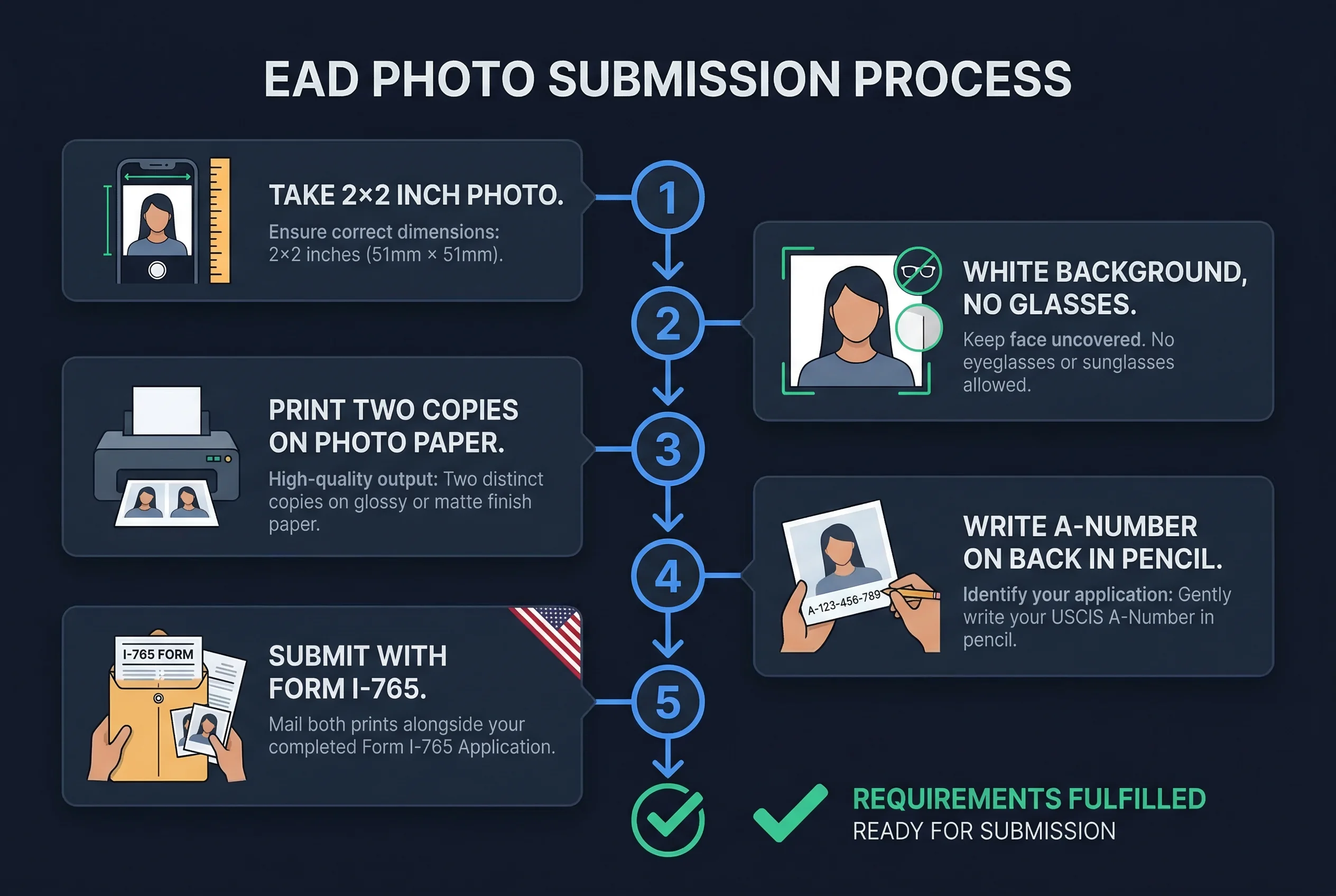
Two identical prints go with your paper Form I-765. For online USCIS filings, you'll upload a digital copy instead — details on that below.
Get a compliant passport photo online
EAD Photo vs US Passport Photo
The specs are identical. White background, 2×2 inches, head covering 50–69% of the frame, no glasses. USCIS and the State Department both follow the ICAO (International Civil Aviation Organization) photo standards.
One practical difference: USCIS technically asks for photos "taken within 30 days of filing," which is stricter than the State Department's 6-month window. In practice, rejections based on photo age alone are rare as long as your face doesn't look significantly different from the photo. But if you have recent photos that are 2–3 months old and you're filing soon, you're fine. If your photos are from a year ago, take new ones.
USCIS Photo Requirements Across Immigration Documents
All of these USCIS immigration documents use the same 2×2 inch photo standard:
- EAD (Form I-765) — employment authorization
- Green card (Form I-485) — adjustment of status
- Naturalization (Form N-400) — citizenship application
- Advance Parole (Form I-131) — travel document for pending applicants
- DACA renewal (Form I-821D) — deferred action
That consistency is deliberate. Once you understand the spec, it applies everywhere. The biggest mistake applicants make is assuming different USCIS forms have different photo requirements. They don't.
How to Submit Your EAD Photo with Form I-765
Paper filing (mail): Print two identical 2×2 inch photos. Write your name and Alien Registration Number (A-Number) lightly in pencil on the back of each photo — do not use ink, which can bleed through and damage the front. Attach them to your I-765 with a paperclip, not staples.
Online filing: USCIS now accepts online I-765 submissions for most categories. For online filing, you'll upload a digital photo in JPEG format. Requirements:
- File size: 240 KB maximum
- Format: JPEG (.jpg)
- Dimensions: at least 600×600 pixels (square)
- Background: white
- Face must occupy 50–69% of the image height
Use the passportsize-photo.online checker to confirm your digital photo meets these specs before uploading. USCIS's online system will reject photos that don't pass their automated checks.
EAD Categories That Require Photos
Most EAD categories require photos, but it's worth knowing which ones are most commonly filed:
- C09 — Pending adjustment of status (I-485)
- C10 — Withholding of removal
- C16 — Parolee seeking adjustment
- A05 — Asylee
- A03 — Refugee
- C03A — Spouse of an A, G, or NATO visa holder
- C26 — Spouse of an H-1B worker with approved I-140
The complete list has over 70 categories. Your immigration attorney or the Form I-765 instructions will confirm which category applies to your situation.
EAD Processing Times and Automatic Extensions
USCIS processing times for EADs vary significantly by category and filing location. As of early 2026, most categories are running 3–5 months for standard processing.
Premium processing is not available for Form I-765 in most categories. However, if your EAD is expiring soon, you may be able to file under the "90-day rule" — USCIS must adjudicate renewals filed more than 90 days before expiration within 30 days under certain circumstances.
Automatic extensions exist for some categories: if you file your renewal before your current EAD expires, your work authorization automatically extends for up to 540 days while USCIS processes the renewal. Check the USCIS website for the current list of eligible categories.
The EAD application fee is $520 (as of 2024, though USCIS fees change periodically — verify the current amount on their fee schedule before filing). Biometric services fees may apply on top of this depending on your category. If you're applying online, the system calculates fees automatically when you complete the form.
One more thing worth knowing: your I-765 application is typically filed alongside or after another petition (like an I-485 for adjustment of status). Some applicants file them concurrently to reduce total processing time. Your EAD approval is often what lets you work in the US while your underlying immigration petition is still pending — so getting the photo right and filing promptly matters.
Common EAD Photo Mistakes That Cause USCIS Rejection
Photo older than 30 days. USCIS asks for recent photos. Take them within a week or two of filing to be safe.
Wrong file size for online submission. USCIS's online portal rejects files over 240 KB. If your JPEG is too large, reduce the compression slightly or resize to exactly 600×600 pixels.
Using photos with a light gray or off-white background. The background must be pure white (RGB 255, 255, 255). Photos taken against a painted wall that photographs as cream or light beige will fail automated review.
Glasses in the photo. USCIS has prohibited glasses in immigration photos since 2016, aligning with State Department policy. This applies even if you wear glasses daily.
Stapling the photos to the form. USCIS explicitly says to use a paperclip for paper submissions. Staple holes can damage the photo and create issues during processing.
Submitting different photos. "Two identical photos" means the same image printed twice from the same file. Photos taken at slightly different moments — even fractions of a second apart — count as different photos. Make two prints from one digital file.
Head coverings. Religious head coverings are allowed if worn daily for religious reasons, but the face must be fully visible from the bottom of the chin to the top of the forehead, and from ear to ear. Medical head coverings require a signed statement from a medical professional.
Where you get your photos matters less than the specs. A professional passport photo service, a pharmacy kiosk, or a careful self-taken photo against a white wall all work — provided the output meets the 2×2 inch, white background, face-in-frame requirements.
For a complete look at how EAD photo requirements compare to other USCIS documents, see the green card photo requirements guide — the specs are identical, but the application context is different.
Quick Checklist for EAD Photo Submission
- Size: 2×2 inches (51×51mm) / 600×600px
- Background: white
- Expression: natural, neutral or slight smile
- No glasses (any type — since 2016)
- Photo taken within 30 days of filing
- Two identical prints (paper filing) or JPEG upload (online)
- I-765 form completed
- Filing fee paid ($410 or fee waiver approved)