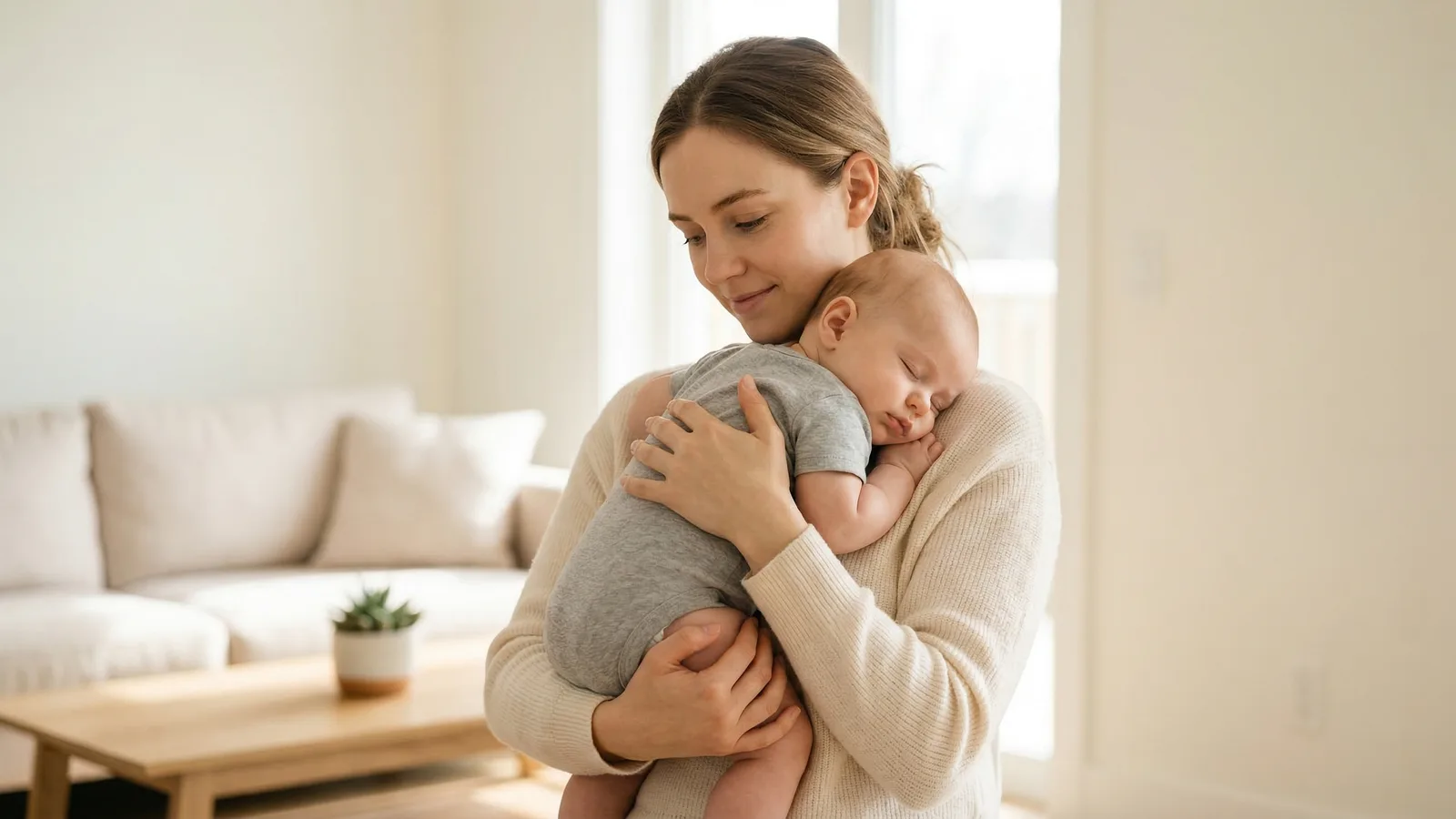
No - your baby's eyes must be open in a passport photo. This applies in nearly every country, with very limited exceptions for newborns.
It's one of the strictest rules, and there's a good reason. Automated passport gates use facial recognition software. Closed eyes don't provide enough data points for the system to verify identity. Even manual verification by officers becomes harder when they can't see the full eye shape and position.
The Universal Rule: Baby Eyes Must Be Open in Passport Photos
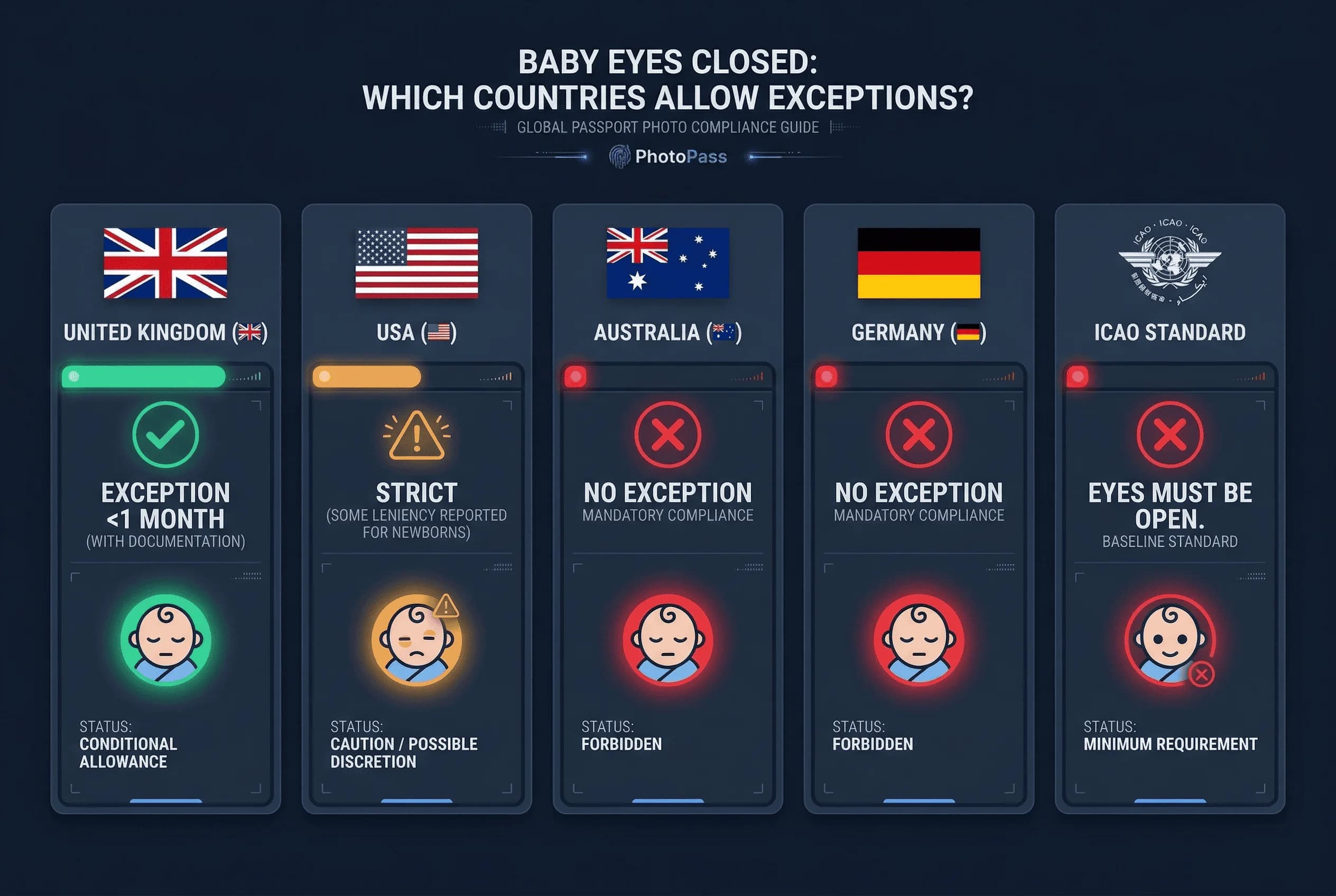
ICAO, the international body that sets passport standards, requires eyes to be open in all passport photos. This standard is adopted by most countries worldwide.
The rule exists because your passport photo needs to match you - the real you - when you arrive at border control. Officers or machines compare your photo to your face. Closed eyes make that comparison unreliable.
There are almost no exceptions for adults. For babies, the exceptions are barely more generous.
Get a compliant passport photo online
Which Countries Allow Closed Eyes in Baby Passport Photos?
Only one country offers a real exception: the United Kingdom.
UK passport rules state that for newborns under one month old, eyes may be closed in "exceptional circumstances." This is not a blanket permission - it's meant for cases where the baby genuinely cannot open their eyes due to medical reasons or extreme prematurity. Even then, the application requires documentation explaining why.
The UK is also unusual in that it allows eyes to be "slightly closed" for newborns, not fully closed. There's a difference between "mostly closed" and "shut."
Australia has no exception. Even for newborns, eyes must be open. This is part of why Australian baby passport photos are among the hardest to get approved.
The United States technically requires open eyes, but some parents report lenient approval for very young infants - newborns in their first weeks. This isn't official policy. It's not guaranteed. But if your newborn simply won't open their eyes and you're applying for a US passport, there's a chance it might be approved.
Every other country enforces the open-eyes rule strictly.
How Your Baby's Age Affects the Passport Photo Eye Challenge
The difficulty of getting open eyes depends heavily on age.
0–2 weeks: This is the hardest window. Newborns sleep 16–17 hours a day and their alert-awake periods last only minutes. You may need to attempt photos across multiple days. Don't rush — waiting even 3–4 days can make a noticeable difference in how often the baby's eyes are open.
2–6 weeks: Alert periods lengthen to 10–30 minutes after feeds. This is the realistic window for most newborn passport photos. Schedule your attempts around feeds and have everything set up before the baby wakes.
6 weeks–3 months: Babies start tracking objects and responding to faces. Getting open eyes becomes much easier. If you have the luxury of waiting, this period is dramatically simpler for passport photos.
3–6 months: Eyes are reliably open during waking hours. The challenge shifts from getting eyes open to keeping the baby still and looking at the camera.
If your travel timeline allows it, waiting until the baby is at least 3–4 weeks old makes the process significantly easier. Many parents who struggle at day 5 find it trivial at day 25.
How to Get a Newborn's Eyes Open for a Passport Photo
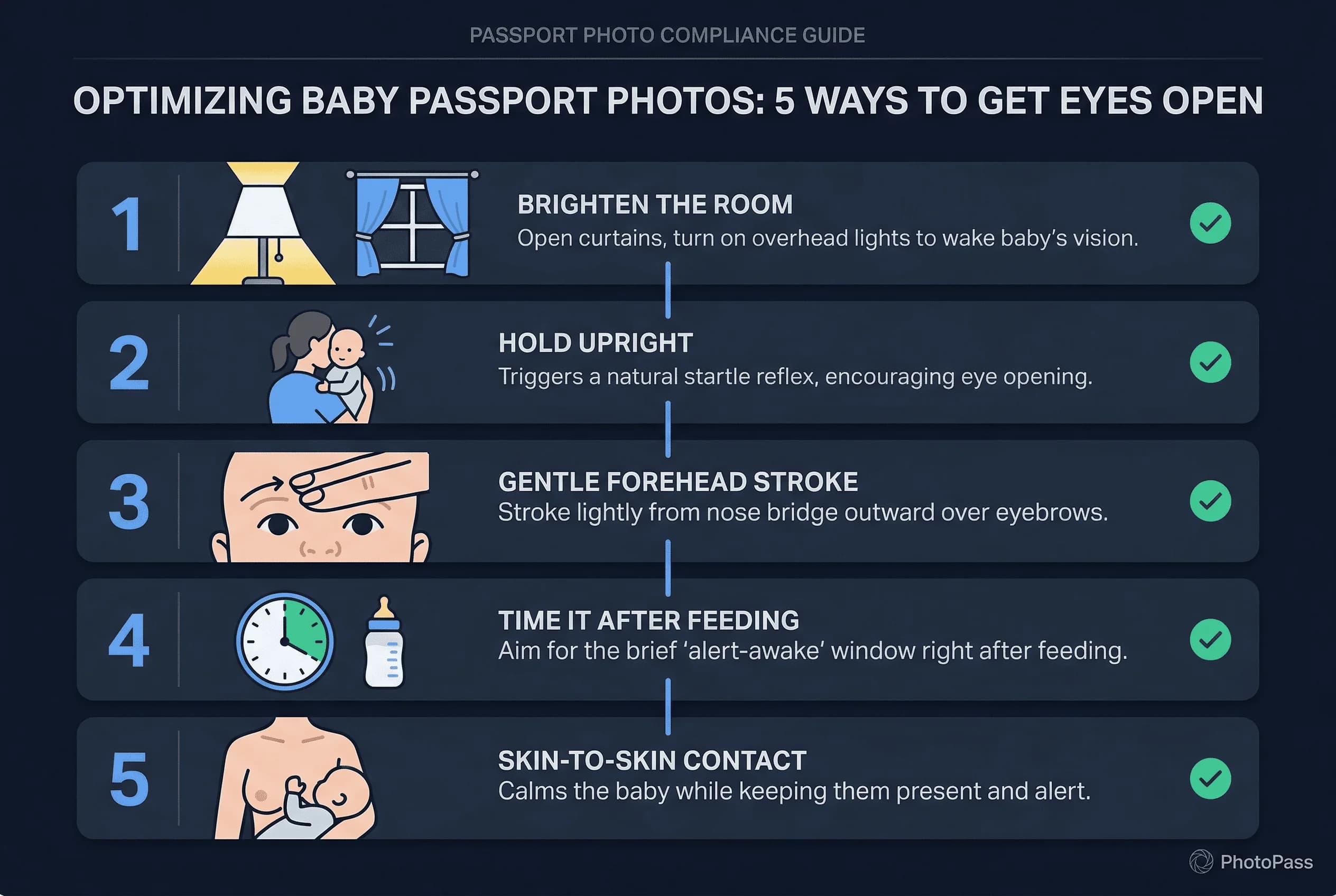
Most newborns can open their eyes. They just don't do it on command. Here's how to encourage them:
Brighten the room. Not harsh light - that makes them squeeze tighter. But a well-lit room helps. Open curtains, turn on lights. Dim rooms make babies want to sleep.
Hold them upright. Newborns often open their eyes more when held upright than when lying down. The change in position triggers a startle response that opens the eyes.
Gentle forehead stroke. A light touch on the forehead, running from the bridge of the nose outward, can trigger the eye-opening reflex in newborns.
Timing after feeding. The alert-awake window after a feeding is when newborns are most likely to have their eyes open. This is when you should attempt the photo.
Skin-to-skin contact. Holding the baby against your chest, skin to skin, often calms them and keeps them alert. Some parents find this helps with eye-openness.
Use burst mode aggressively. Don't try to time a single photo. Set your phone camera to burst mode and fire 20–50 shots in a few seconds while the baby's eyes are fluttering open. Review them all afterward and pick the best frame. Even if the eyes are only open for half a second, burst mode catches it.
Set up before the baby is ready. Have your background, lighting, and camera position completely prepared before you unwrap the baby. Alert-awake windows in newborns are short — you don't want to waste them adjusting a tripod. A white towel or muslin on a flat surface works as both background and a comfortable surface for the baby.
What to Do If Your Baby's Eyes Won't Open for the Photo
Some newborns truly won't open their eyes, no matter what you try. This can be normal in the first day or two after birth. Premature babies sometimes take longer.
If you've tried different times of day, different methods, and your newborn still won't open their eyes, consider waiting a few days and trying again. A few days can make a big difference with newborns — the difference between day 3 and day 10 is enormous in terms of how often a baby's eyes are open and alert.
Try different environments too. Some babies open their eyes more in natural daylight. Others respond to being moved outdoors briefly — the temperature change and new stimuli can trigger alert wakefulness. Try a different room, a different time of day, or gently blowing on the baby's face (which triggers the startle-open reflex in most newborns).
Consult your paediatrician if you're concerned. But in most cases, the eyes will open — it just takes time and patience. Parents who feel stuck after 3–4 attempts usually succeed on attempt 8 or 9.
The Practical Answer: Plan for Open Eyes in Baby Passport Photos
Plan for open eyes. Don't count on exceptions. Give yourself time to try multiple sessions before your passport application deadline.
Take the photo after a feeding when the baby is alert. Have a second person make noise to capture attention. Use burst mode. Try, try again.
Most parents find that with enough attempts, they get a photo with open eyes. The ones who struggle are the minority.
And if you're dealing with a preemie or a baby with a medical condition, contact the passport office in advance. They may have additional guidance or an exception process.
Don't Risk a Rejection: Check Your Baby's Passport Photo First
It's tempting to submit a photo with closed eyes and hope for the best. Don't.
Rejection means delays. You resubmit, they review again, and you've lost weeks. If you're traveling soon, this can derail your plans entirely.
Run your photo through a passport photo checker before submitting. Make sure eyes are open. Make sure they're visible. Then submit with confidence.
For UK applicants, review the specific UK requirements to understand exactly what's needed. For US applicants, the US passport requirements are straightforward: eyes must be open.
Get it right the first time. Your baby's passport depends on it.