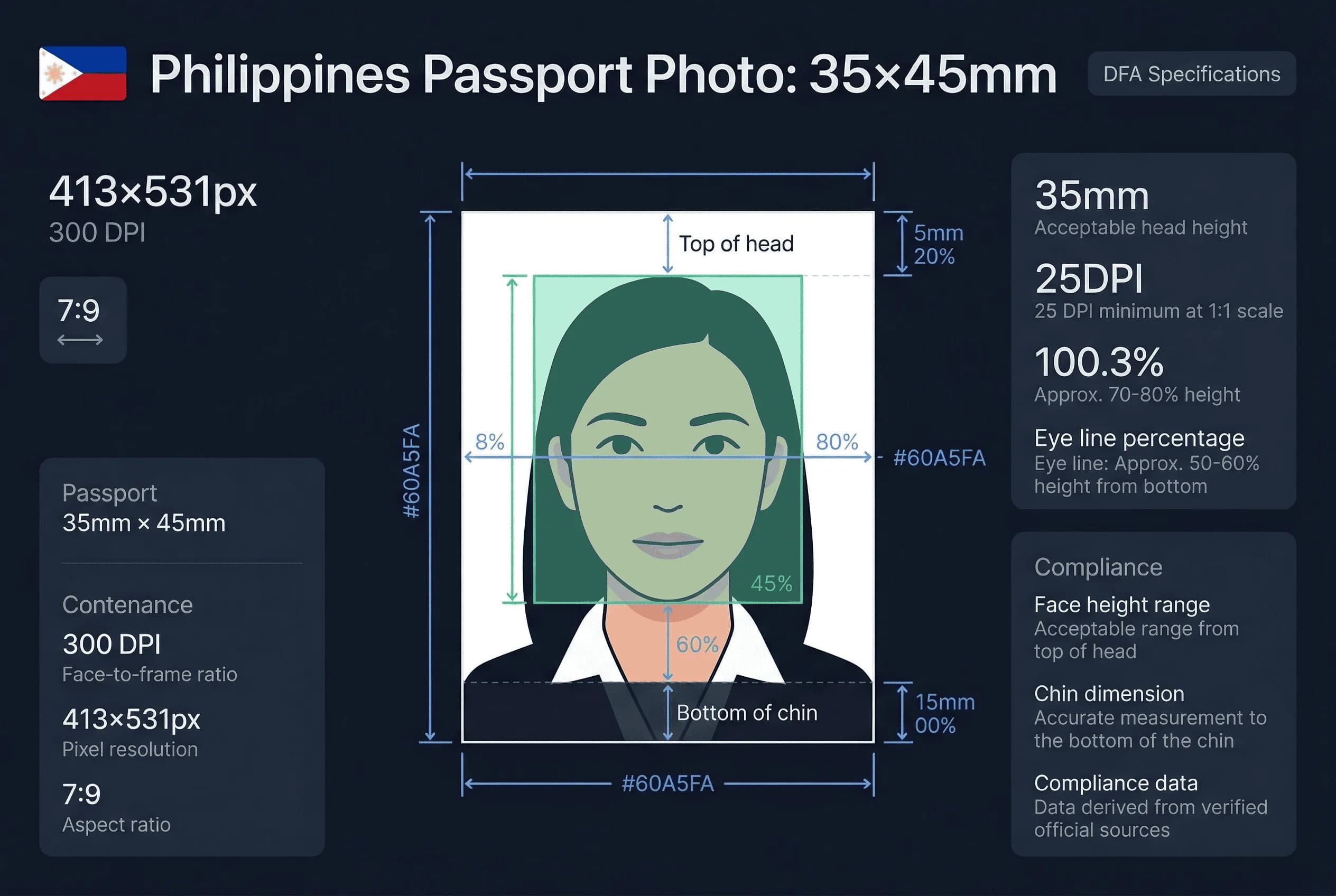
The Philippines requires passport photos measuring 35×45 millimeters (approximately 1.38×1.77 inches). At standard 300 DPI, this translates to 413×531 pixels. These specifications are set by the Department of Foreign Affairs (DFA) and apply to all passport applications processed through DFA offices throughout the Philippines and Philippine embassies and consulates worldwide.
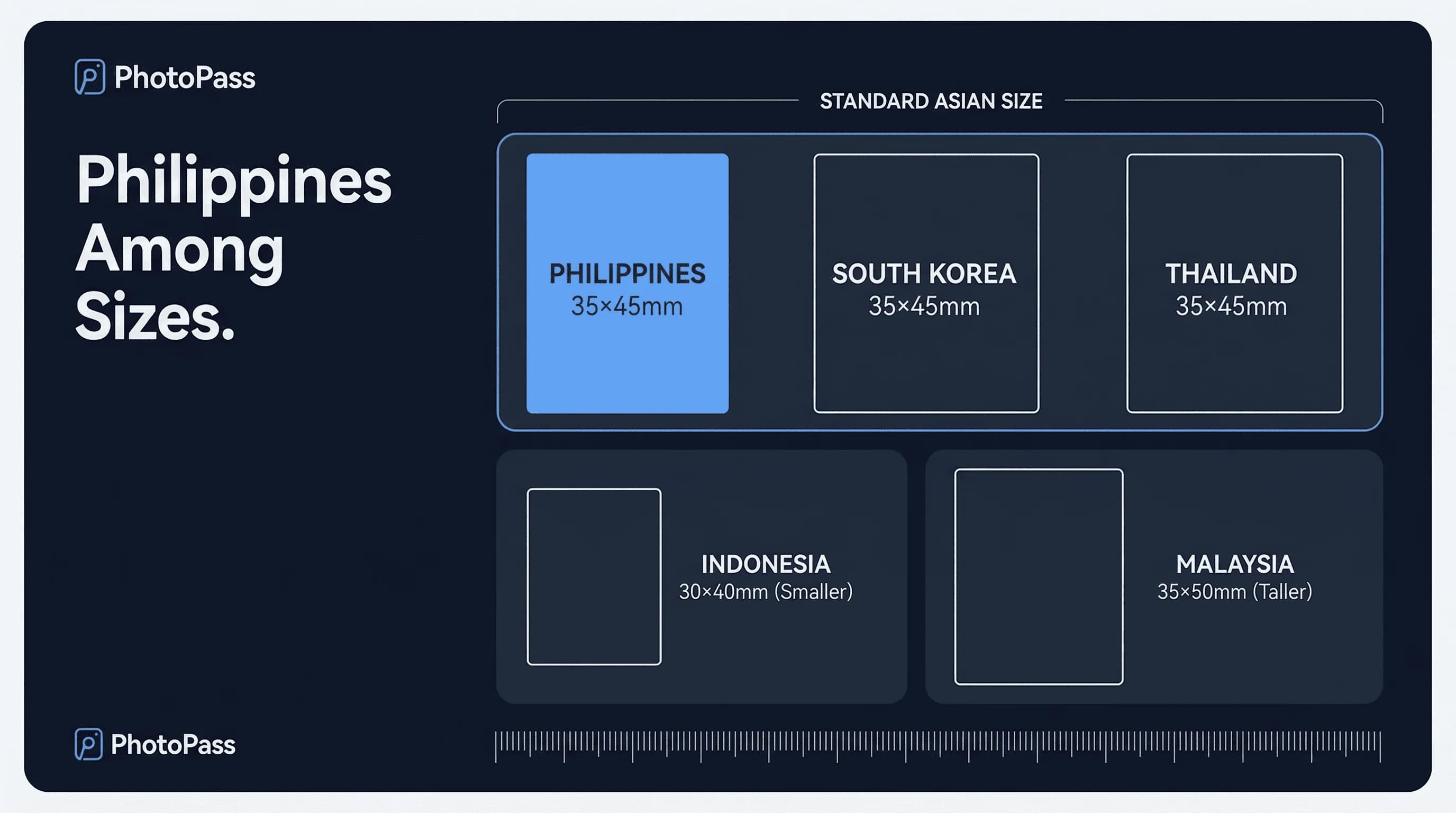
The 35×45mm format places the Philippines among countries using the standard ICAO passport photo size, shared with South Korea and Singapore.
Philippine Passport Photo Size vs Other Countries
| Country | Size | Shape | Head height |
|---|---|---|---|
| Philippines | 35×45mm | Rectangle | 60–80% |
| South Korea | 35×45mm | Rectangle | 60–80% |
| Singapore | 35×45mm | Rectangle | 60–80% |
| Thailand | 40×60mm | Rectangle | 60–80% |
| United States | 51×51mm | Square | 50–69% |
| India | 35×35mm | Square | 60–80% |
| China | 33×48mm | Rectangle | 60–80% |
A photo taken for South Korea or Singapore will match the Philippines' size exactly. Thailand is significantly larger (40×60mm), and the US uses a completely different square format. For OFWs (Overseas Filipino Workers) who also need photos for destination countries, check the specific requirements before assuming your DFA photo will work.
Get a compliant passport photo online
Digital Specifications for Philippine Passport Photo Size
| Specification | Value |
|---|---|
| Width | 35mm / 1.38 inches / 413px |
| Height | 45mm / 1.77 inches / 531px |
| Aspect Ratio | 7:9 |
| Minimum DPI | 300 |
| Color Space | RGB |
| File Format | JPEG |
Verify these exact dimensions in your photo editing software. Many apps default to different aspect ratios — always check and adjust manually before submission.
Philippine Passport Photo Head Height: The 60–80% Rule
The Philippines requires head height — measured from the bottom of the chin to the top of the skull — to occupy 60-80% of the photo's 45mm vertical space.
In concrete terms:
- Minimum (60%): 27mm from chin to crown
- Maximum (80%): 36mm from chin to crown
- Target (70%): approximately 31.5mm — the safest position
- Eye line: Approximately 56% from the bottom of the image
If your face is too small in the frame — a common result of arm's-length selfies — the DFA's automated system will reject it. Position the camera about 1.5 metres away, or have someone else take the photo.
Glasses and Appearance Rules for Philippine Passport Photos
These rules directly affect how you frame the photo:
- Glasses: Not permitted. Remove all eyewear before photographing, including prescription glasses and sunglasses. This prevents glare and ensures the biometric system can read your full eye area.
- Expression: Neutral, mouth closed. No smiling.
- Background: White, evenly lit with no shadows.
- Hair: Must not cover the face or forehead. Ears should be visible.
- Head coverings: Only for religious reasons, and the full face must remain visible from forehead to chin.
Common Philippine Passport Photo Sizing Mistakes
Using a US 2×2 inch photo. Particularly common for Filipinos in the United States. The US square format (51×51mm) is a completely different size and shape. You need a separate 35×45mm photo for your Philippine passport.
Using a Thai photo. Thailand uses 40×60mm — much larger. OFWs in Thailand cannot use their Thai work permit photos for Philippine passport renewal.
Wrong aspect ratio from phone cameras. Most phones default to 4:3 or 16:9. The Philippines requires 7:9. Crop carefully to the correct ratio before resizing.
Face too small from selfie distance. Arm's-length selfies produce a face at roughly 40-50% of the frame — well below the 60% minimum. Use a tripod or ask someone to photograph you.
Enlarging a small image. Stretching a low-resolution photo to 413×531 pixels creates visible pixelation. Always start with a full-resolution original.
Where to Get a Correctly Sized Philippine Passport Photo
Several options exist throughout the Philippines:
DFA-run photo centers. The most reliable option. DFA offices in Manila, Cebu, Davao, and other locations have official photo services that guarantee compliance. Cost is typically ₱300-500.
Private DFA-accredited photographers. Look for "DFA Accredited" signs. These professionals understand requirements thoroughly. Prices range from ₱200-500.
Malls and shopping centers. Many large malls (SM, Robinsons, Glorietta) have passport photo services. Quality varies — check samples before accepting. Prices are typically ₱150-300.
Online services. Various websites accept uploads and provide properly formatted digital photos. Prices start around ₱100-200 for digital files.
For OFWs abroad: Philippine embassies and consulates follow the same 35×45mm requirement. If getting photos taken in your host country, specify "35×45mm passport photo" — do not accept the host country's default size. In the US, the default is 2×2 inches (wrong). In the Middle East, some studios default to 40×60mm (also wrong). Always state the dimensions explicitly.
Philippine Passport Photo Size Rules for Babies and Children
Children's Philippine passport photos follow the same 35×45mm size and 60-80% head height requirements. The DFA applies the same automated checks regardless of age.
Infants (under 1 year): The most challenging. Lay the baby on a white sheet and photograph from directly above. Both eyes should be open — try photographing after feeding when the baby is calm and alert. The face must be centered and clearly visible. DFA offices with on-site photo services are the most reliable option for infants, as the staff handle baby photos regularly.
Children (1-5 years): Same rules as adults — neutral expression, eyes open, face centered. Getting a toddler to sit still with a neutral expression is the real challenge. Studios near DFA offices in Manila (Aseana), Cebu, and Davao have experience managing young children. Bring a favourite toy to distract between shots, but ensure no toys or objects appear in the final photo.
All children under 18: Philippine children's passports are valid for 5 years instead of 10 for adults. This means more frequent renewals and more frequent photos. Keep a compliant digital copy — you'll need it again sooner.
DIY Tips for Taking Philippine Passport Photos at Home
Taking your own photo is possible with careful attention to the technical requirements:
- Lighting: Use indirect natural light from a large window. Avoid direct sunlight (creates harsh shadows) and overhead fluorescent lights (uneven colour). Position yourself facing the window so the light falls evenly on your face.
- Background: Stand in front of a white wall, at least 50cm away from it to avoid casting a shadow. A white bed sheet taped flat to the wall works if you don't have a plain white wall.
- Camera position: Place your phone on a tripod or prop it at eye level about 1.5 metres away. Use the timer function so you're not reaching for the shutter button.
- Framing: Include your full head plus shoulders. Don't crop — the DFA system will crop for you during online submission.
- Verification: After shooting, open the photo in an editor and verify it's at least 413×531 pixels. Use our passport photo checker to confirm compliance before submitting.
DFA Online Appointment System Photo Upload Requirements
The DFA's ePayment and Appointment System requires digital photo uploads. When submitting online:
- Upload a JPEG at exactly 413×531 pixels, 300 DPI
- The system runs automated dimension and face detection checks
- Rejected photos get a generic error — use a compliance checker first to identify specific issues before uploading
Even if your digital upload is accepted, bring printed copies (35×45mm on photo paper) to your DFA appointment. The on-site photo verification may require physical prints.
For complete background requirements, read our guide to Philippines passport photo background. View all specifications on the Philippines passport photo hub.