
The Permanent Voter's Card (PVC) photo is taken at an INEC centre. You don't bring a photo to your registration — the Independent National Electoral Commission captures it on-site, along with your fingerprints, during the biometric registration session. The process is free. The PVC is the only document that allows you to vote in Nigerian federal, state, and local government elections.
What Happens at INEC Registration for a Nigerian PVC
INEC conducts Continuous Voter Registration (CVR) throughout the year at Local Government Area offices, ward collation centres, and special registration drives. When you go for registration:
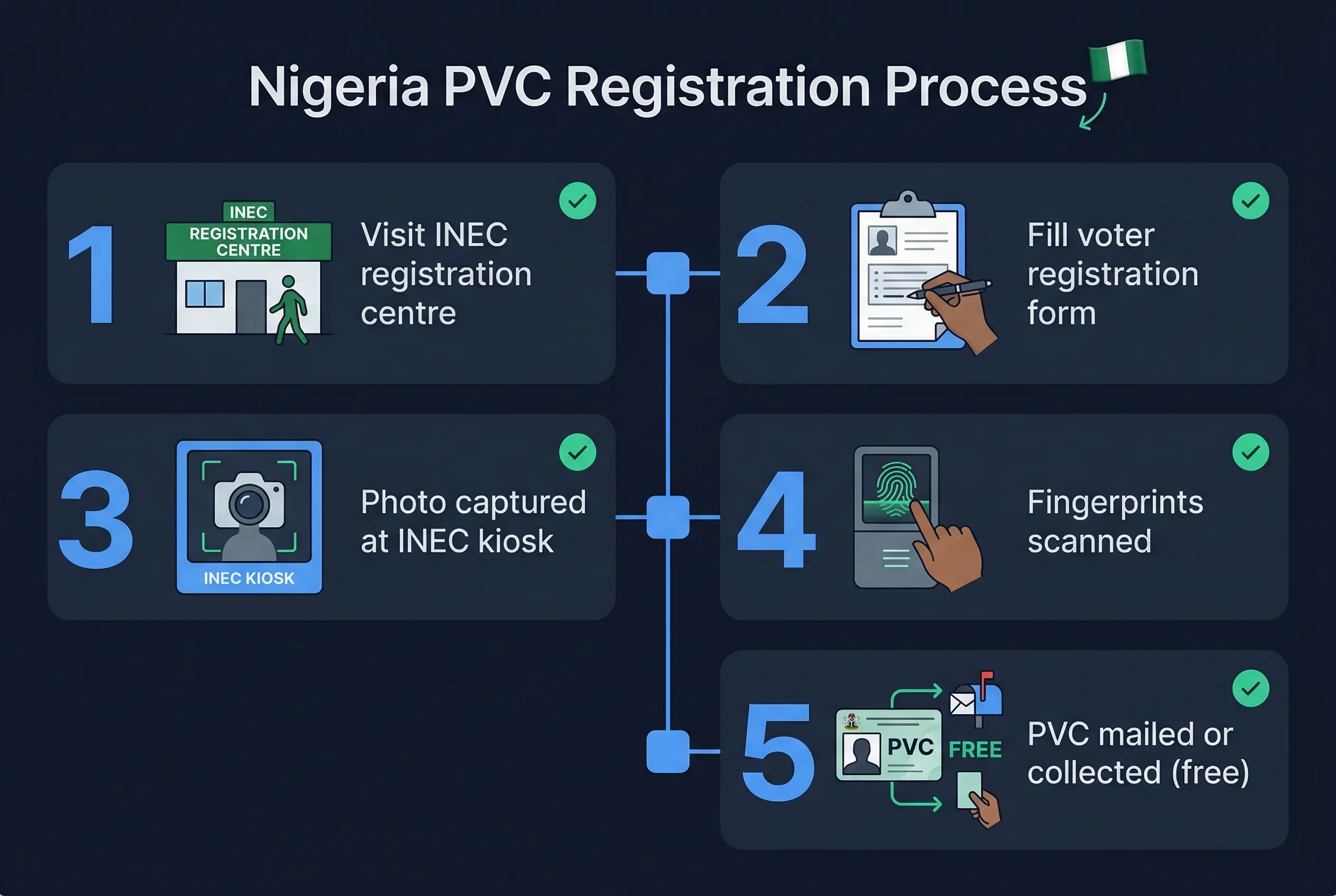
- An INEC official captures your photograph using a standardised camera
- Your ten fingerprints are scanned
- Your personal details — full name, date of birth, state of origin, local government area, and residential address — are recorded
- You receive a Voter Registration Slip with your Voter Identification Number (VIN)
The photo is taken against a plain backdrop. You sit or stand in front of the camera, face it directly, and the officer captures the image. The full biometric session typically takes 10–20 minutes.
After registration, the PVC itself takes 2–4 weeks to produce. You collect it from the same registration centre or a designated INEC office in your area. INEC also runs PVC collection drives where you can pick up the card at ward and LGA offices.
Get a compliant passport photo online
How to Prepare for Nigerian PVC Voter Registration
You can't choose the backdrop or the lighting at an INEC centre. But how you show up affects the quality of the photo captured — and the photo on your PVC is fixed for the card's lifetime.
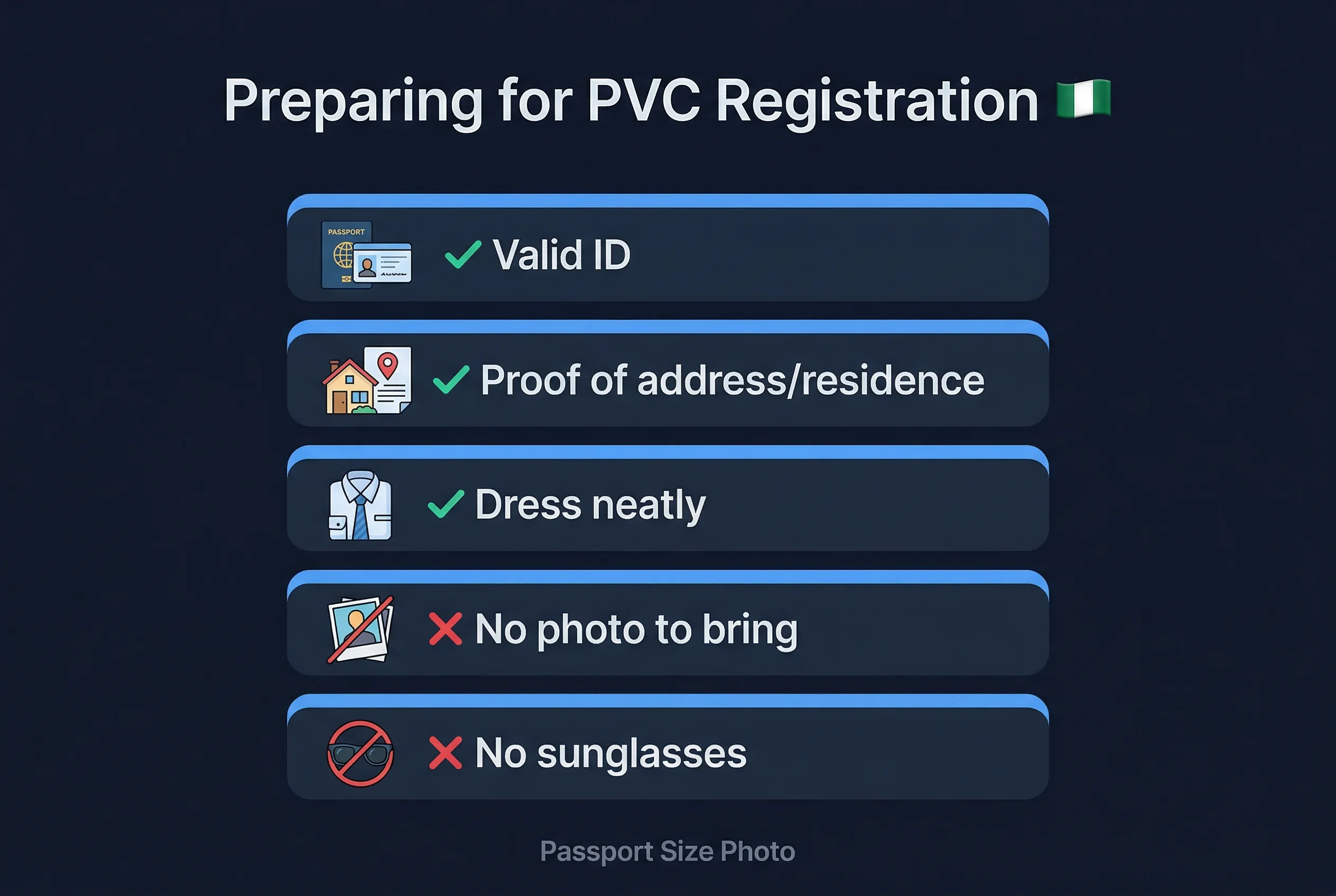
Wear something with contrast. The backdrop at most INEC centres is white or light-coloured. A pale or white top will blur into it. Mid-toned solid colours — a plain blue, green, or grey shirt — give the image definition.
Remove glasses. INEC does not permit eyewear in voter registration photos. Remove them before the session begins.
No headwear. Caps, hats, and other headgear are not permitted unless worn for religious reasons. Head coverings for religious use are allowed, provided the full face is visible.
Keep your face visible. Hair should not cover your eyes or a significant portion of your face. The officer needs a clear, unobstructed view from hairline to chin.
Neutral expression. No smile. Face relaxed, mouth closed, eyes open and looking directly at the camera.
Bring a valid means of identification. INEC requires at least one of the following: birth certificate, national passport, driver's licence, NIN slip, or another recognised government document. You'll also need your phone number for the registration record.
Dress for 8+ years. Your PVC photo is permanent — it stays on the card for as long as you have it. Dress in something you'll still recognise yourself wearing years from now. Avoid trendy clothing that will date badly. A simple, solid-coloured collared shirt or blouse is the safest choice.
Quick Preparation Checklist for PVC Registration
- Bring valid ID (passport, driver's licence, NIN slip, or birth certificate)
- Bring your phone number for registration records
- Wear a solid-coloured top with contrast against light backdrop
- Remove glasses (all types, including prescription)
- Remove caps, hats, and non-religious headgear
- Hair pulled back from face
- Arrive early to avoid long queues
- Practice neutral expression — no smile, mouth closed
Who Needs a Nigerian Permanent Voter's Card (PVC)?
Every Nigerian citizen aged 18 and above is eligible to register and vote. The PVC is the only valid identification for voting — no other document is accepted at the polling unit. If you have a national passport, NIN, or driver's licence but no PVC, you cannot vote.
Registration is based on your current residential address. You register at the Local Government Area where you live, and you vote there. If you move to a different LGA, you must transfer your voter registration — which involves visiting the new LGA's INEC office.
Common Problems at Nigerian INEC Registration Centres
Long queues. INEC registration centres can be extremely busy, especially during registration drives before elections. Some registrants report waiting several hours. Arrive early — before the centre opens if possible — to reduce waiting time.
Equipment failure. INEC's biometric equipment occasionally experiences technical problems — camera malfunctions, server connectivity issues, or fingerprint scanner problems. If the equipment is down, you may be asked to return another day. There's no workaround for this.
Blurry or dark photos. The lighting at some INEC centres is inconsistent. If the registration centre is in a temporary structure or has poor electricity (common in rural areas), the photo quality may suffer. Unfortunately, you don't get to review the photo before it's committed to your record.
Wrong details on the card. If your name, date of birth, or address is recorded incorrectly during registration, the PVC will reflect that error. Review the Voter Registration Slip carefully before leaving the centre. Corrections after the card is printed require a separate visit.
Registration during off-peak periods. INEC suspends Continuous Voter Registration (CVR) in the weeks leading up to major elections. Plan your registration well in advance of any election cycle.
PVC vs. Other Nigerian Identity Documents
| Feature | PVC | Nigerian Passport | Driver's Licence | NIN Slip |
|---|---|---|---|---|
| Photo source | On-site (INEC) | Self-supplied | Self-supplied | On-site (NIMC) |
| Photo size | Captured digitally | 35×45mm | 35×45mm | Captured digitally |
| Background | Controlled by INEC | White | White | Controlled by NIMC |
| Glasses | Not allowed | Not allowed | Not allowed | Not allowed |
| Smile | Not allowed | Not allowed | Not allowed | Not allowed |
| Cost | Free | ₦25,000+ | Varies by state | Free |
| Validity | Permanent | 10 years (64pp) | 3–5 years | Permanent |
Two Nigerian documents (PVC and NIN) capture photos on-site. Two (passport and driver's licence) require you to supply your own 35×45mm photo on a white background.
The Nigerian PVC Is Permanent: No Expiry Date
Once issued, the Permanent Voter's Card does not expire. The validity is indefinite. You do not renew it unless your details change — such as moving to a different local government area — which requires a transfer of voter registration rather than a new registration.
If you lose your PVC, you can apply for a replacement at your INEC LGA office. A replacement requires going through verification against your biometric record already in the system.
Nigerian PVC Registration Is Free (No Official Fees)
INEC voter registration and PVC issuance cost nothing. The programme is funded by the Federal Government of Nigeria. Any individual or agent who charges a fee for voter registration is operating outside the official process.
INEC announces registration windows and collection periods through its official website and social media channels. Registration centres are based on your residential address — you register in the local government area where you live, and you vote there.
Nigerian Documents That Require Your Own 35×45mm Photo
Voter registration is handled on-site — the INEC photo isn't something you prepare in advance. But many Nigerian identity documents do require you to submit your own photo: the passport, the driver's licence, and others. Those all use the 35×45mm white-background standard described in the Nigeria passport photo size guide.
For those applications, the passportsize-photo.online checker verifies your photo meets the specification before you upload it. Background colour, head size, lighting — checked before submission.
For the full picture on Nigerian identity documents, the Nigeria documents page has everything in one place.