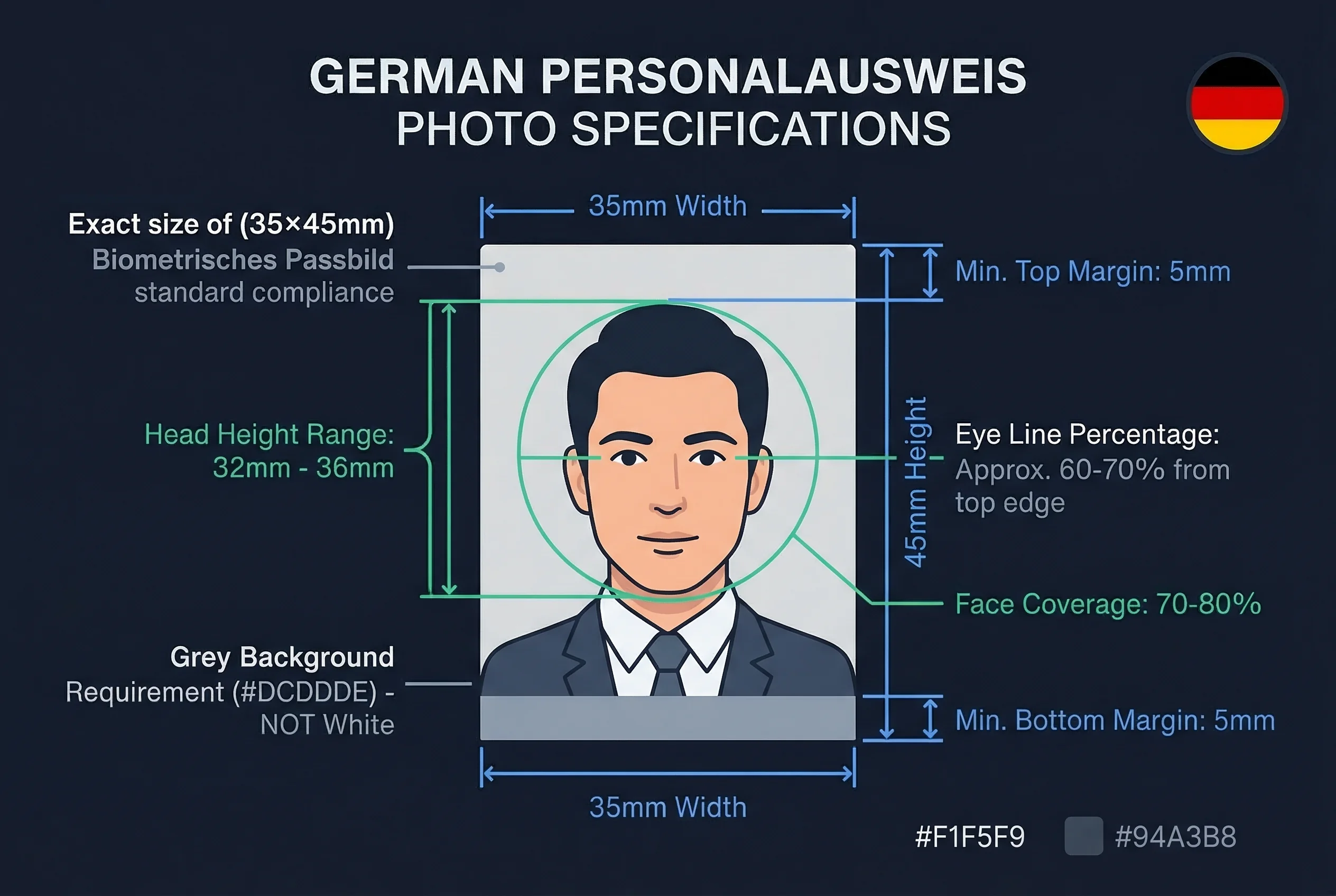
The Personalausweis photo must be 35×45mm — and the background is grey, not white. This is the detail that trips people up most often. Germany's biometric photo standard (biometrisches Passbild) uses a light grey background with hex code #DCDDDE. White background photos get rejected at the Bürgeramt. Take note before you book an appointment.
Personalausweis Photo Specifications
| Requirement | Specification |
|---|---|
| Size | 35×45mm (413×531 pixels at 300 dpi) |
| Background | Light grey — #DCDDDE (NOT white) |
| Head position | Centred, 70–80% of frame height |
| Expression | Neutral, mouth closed |
| Glasses | Permitted (no tinted lenses, no glare) |
| Head coverings | Only for religious reasons |
| Photo age | Taken within 6 months |
The Personalausweis uses the same biometrisches Passbild standard as the German passport. If you have a compliant German passport photo, it will work for your Personalausweis too. The two documents are interchangeable on photo requirements — same size, same grey background, same rules.
Get a compliant passport photo online
The Grey Background Rule for the Personalausweis
This is worth repeating. Germany's biometric standard specifies a light grey background, not white. The German Bundesdruckerei documentation references the #DCDDDE colour code. At automated passport photo machines (Fotoautomat) in Germany, the output is calibrated to this grey — if you print elsewhere, confirm the background colour before your appointment.
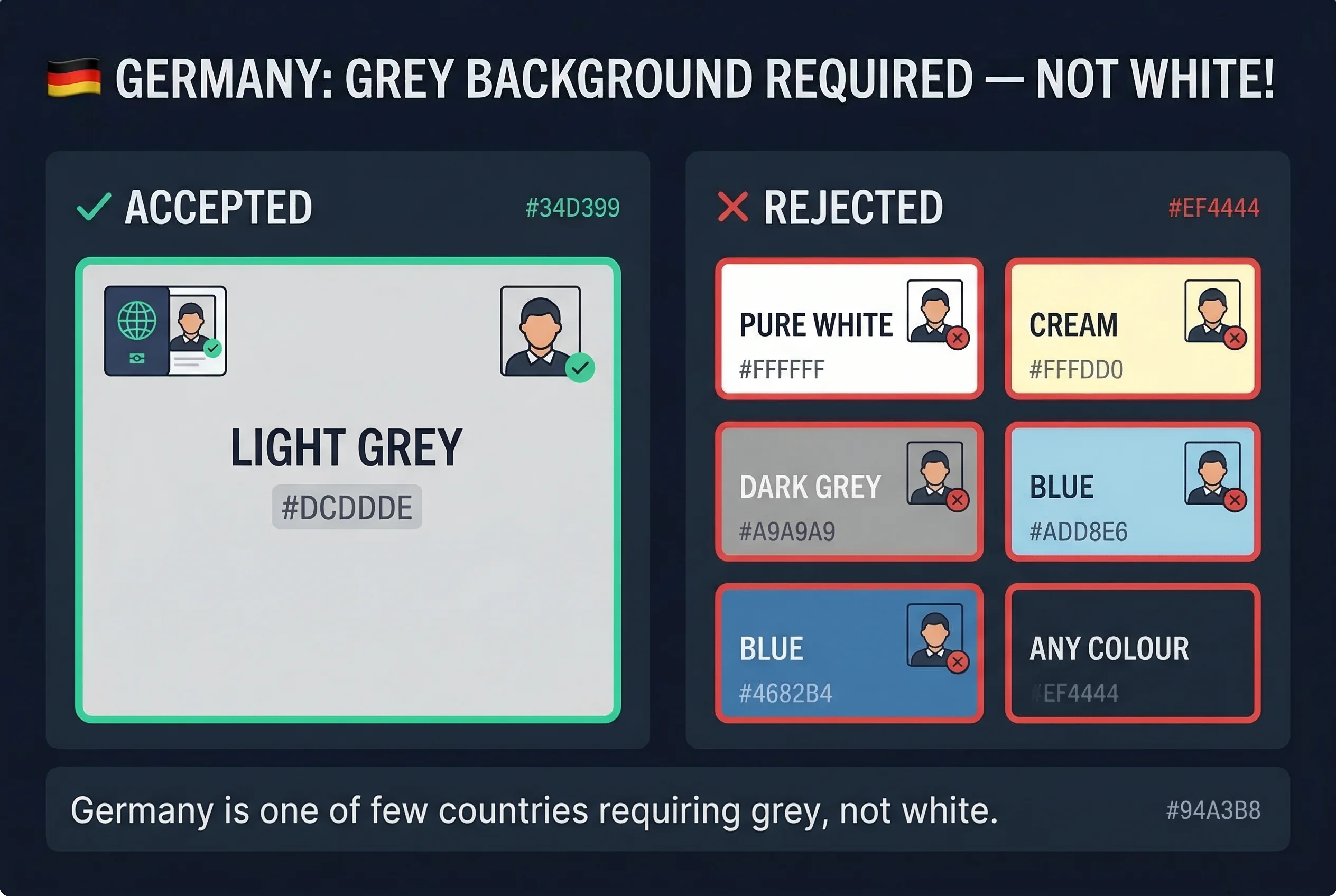
Why grey? Uniformity and contrast. A white background can cause facial features near the hairline to wash out. Grey provides consistent contrast regardless of skin tone or hair colour, and it meets ICAO biometric standards for machine-readable documents.
A white background photo will be refused. Bürgeramt staff are trained to check this, and the automated acceptance systems at the Bundesdruckerei processing centre do too.
Biometrisches Passbild: What It Means
Biometrisches Passbild — biometric passport photo — is the German standard for any government-issued identity document that contains a facial image chip. This includes:
- Reisepass (German passport)
- Personalausweis (national ID card)
- Führerschein (driving licence)
- Aufenthaltstitel (residence permit)
All four documents use the same photo. If you're getting multiple documents renewed around the same time, one compliant photo session covers all of them.
| Document | Size | Background | Glasses | Smile |
|---|---|---|---|---|
| Reisepass | 35×45mm | Light grey | Allowed | Not allowed |
| Personalausweis | 35×45mm | Light grey | Allowed | Not allowed |
| Führerschein | 35×45mm | Light grey | Allowed | Not allowed |
| Aufenthaltstitel | 35×45mm | Light grey | Allowed | Not allowed |
One photo session, four documents. The specs are identical across all German biometric identity documents.
The biometric standard requires:
- Both eyes open and clearly visible
- Looking directly at the camera, not angled
- No shadows on the face or behind the head
- No strong glare on glasses (if worn)
- Face centred and filling 70–80% of the frame height
- Neutral expression — a slight natural smile is generally accepted, but keep mouth closed
Where to Get Your Personalausweis Photo
Fotoautomat (photo booths). Germany has a dense network of certified passport photo booths at post offices, supermarkets, train stations, and shopping centres. Look for the biometric certification label. Machines at dm, Rossmann, and Deutsche Post locations are generally reliable. Cost is typically €7–9 for four prints.
Fotografen (professional photographers). For the most reliable result, use a professional photographer who offers biometrische Passbilder. They know the grey background standard and will check compliance before you leave. Expect to pay €10–20.
Digital upload option. If you apply for your Personalausweis online (possible via the AusweisApp2 in some municipalities), you may be able to upload a digital photo. The file must meet the same biometric standards: correct proportions, grey background, neutral expression. An automated check reviews the submission, but human review at the Bürgeramt may still occur.
Applying for a Personalausweis: The Bürgeramt Process
-
Book an appointment. Most German cities require a Termin (appointment) at your local Bürgeramt. Book online at your municipality's website — waiting times vary from same week to several weeks in larger cities.
-
Bring your documents. You'll need: your current Personalausweis or passport, one biometric photo (35×45mm, grey background), your Geburtsurkunde (birth certificate) for first-time applicants, and the application fee.
-
Fees. Adults pay €37. Applicants under 24 pay €22.80. There's no online discount — the fee is set by German law.
-
Processing time. Standard processing takes 3–6 weeks. Your new Personalausweis is mailed to you from the Bundesdruckerei. Express processing isn't routinely available for the Personalausweis (unlike passports, which offer a Vorläufiger Reisepass as a temporary document).
-
Validity. Adults receive a 10-year Personalausweis. Applicants under 24 receive a 6-year card.
Personalausweis vs Reisepass: Practical Differences
Both documents use identical photo requirements. The Personalausweis is free for EU/EEA travel and costs less to obtain. The Reisepass is needed for travel outside the EU. Many Germans hold both.
For photo purposes, there's no practical difference. One compliant biometrisches Passbild works for both. If you're applying for both at the same appointment (possible at some Bürgerämter), bring two photos — one for each document.
Common Personalausweis Photo Rejection Reasons
White background. The most common reason for photo refusal at German authorities. The background must be grey (#DCDDDE), not white. This error is easy to make if you use a non-German photo booth or upload a US/UK-standard passport photo.
Shadows. A shadow on the background, on the neck, or on the side of the face fails the biometric check. Professional booths are lit to prevent this. Home photos often aren't.
Glasses glare. Reflections on glasses lenses can cause the automated facial recognition system to fail at matching you to your photo. Remove glasses for the photo if possible; if not, reposition to eliminate glare.
Wrong proportions. The face must occupy 70–80% of the 35×45mm frame. Passport photos taken for other countries (e.g., US 2×2 inch format) often have different framing ratios.
Old photo. Photos older than six months are not accepted. If you got photos done for a passport application last year, book a new session — the Bürgeramt will check the date on photos printed by professional photographers, and automated systems check photo metadata on digital uploads.
After You Submit Your Personalausweis Application
The Bundesdruckerei in Berlin processes all German identity documents. Your Personalausweis is printed and mailed directly to you within 3–6 weeks of the Bürgeramt submission. You'll receive a notification letter when it's dispatched.
Keep your old Personalausweis until the new one arrives. You're entitled to hold the old card during the transition period, though the expiry date remains in effect.
Once the new card arrives, the Bürgeramt can optionally register the old card as cancelled — some municipalities do this automatically when the new card is issued.
For a compliant biometric photo, the passportsize-photo.online checker verifies your image against German biometric standards before you submit — including the grey background check that catches the most common mistake.
Quick Checklist for German Personalausweis Photos
- Size: 35×45mm
- Background: light grey (not white)
- Expression: neutral, mouth closed
- Glasses: clear lenses only, no glare
- Photo taken within 6 months
- Bürgeramt appointment booked
- Current ID or passport for identification
- Application fee ready (€37 for adults, €22.80 for under-24)
Also see: German Aufenthaltstitel photo requirements | Germany passport photo size and specs