German Führerschein photos are 35×45mm with a light grey background — the same biometrisches Passbild standard used for the passport and Personalausweis. If you already have a compliant photo from a recent passport or ID card application, it will work for your driving licence too.
Führerschein Photo Specifications
| Requirement | Specification |
|---|---|
| Size | 35×45mm (413×531 pixels at 300 dpi) |
| Background | Light grey — #DCDDDE (not white) |
| Expression | Neutral, mouth closed |
| Glasses | Permitted (no tinted lenses, no glare) |
| Head coverings | Religious reasons only |
| Photo age | Taken within 6 months |
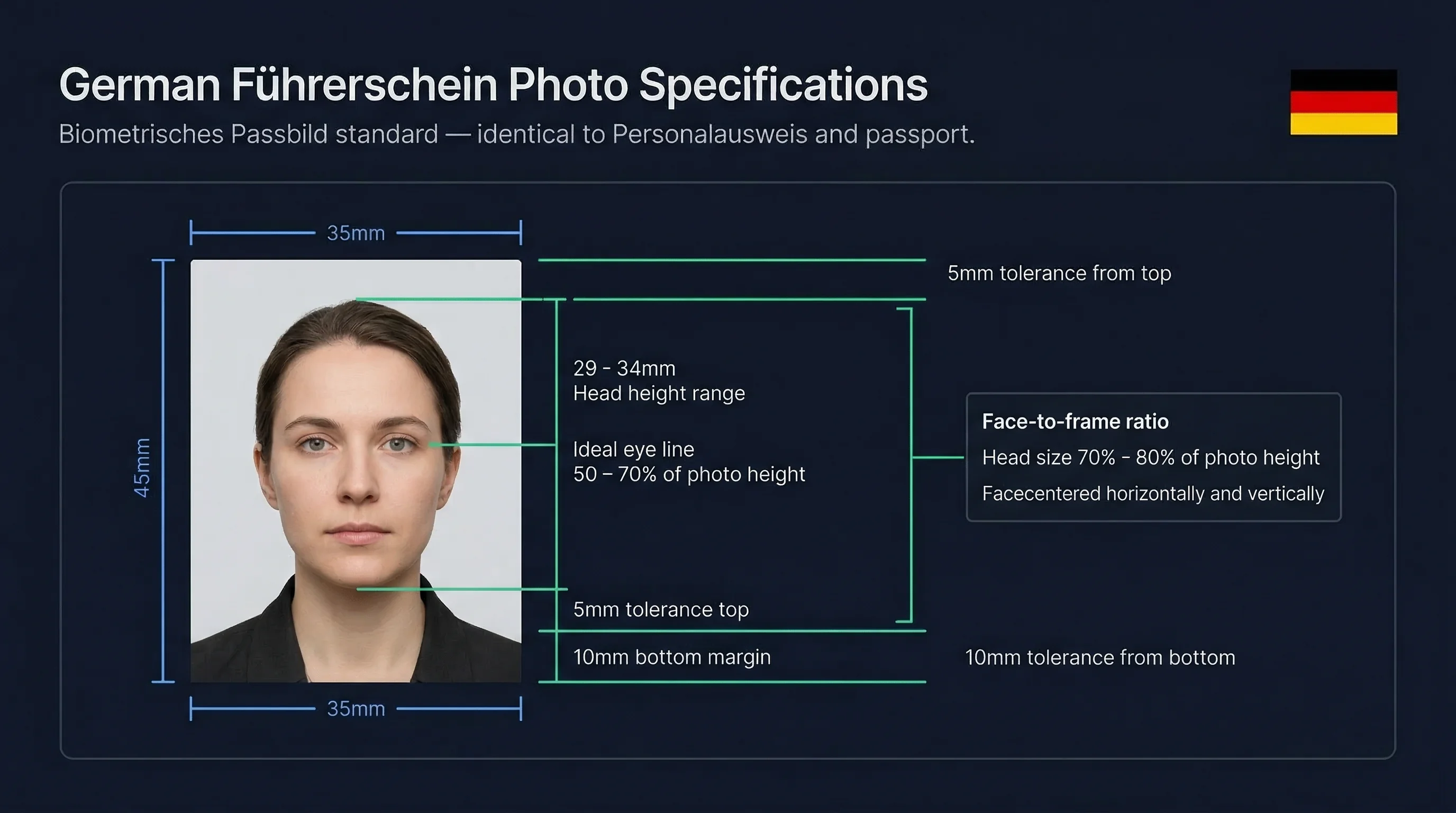
The grey background is mandatory. Germany's biometric standard specifies colour code #DCDDDE. White background photos — common in the UK, US, and many other countries — do not meet the German standard and will be refused at the Fahrerlaubnisbehörde.
Get a compliant passport photo online
Germany's EU Driving Licence Standard
The EU standardised driving licence format in 2013. Since then, all EU member states issue the same credit-card-sized plastic licence, and Germany adopted the biometrisches Passbild standard for the photo embedded in the card.
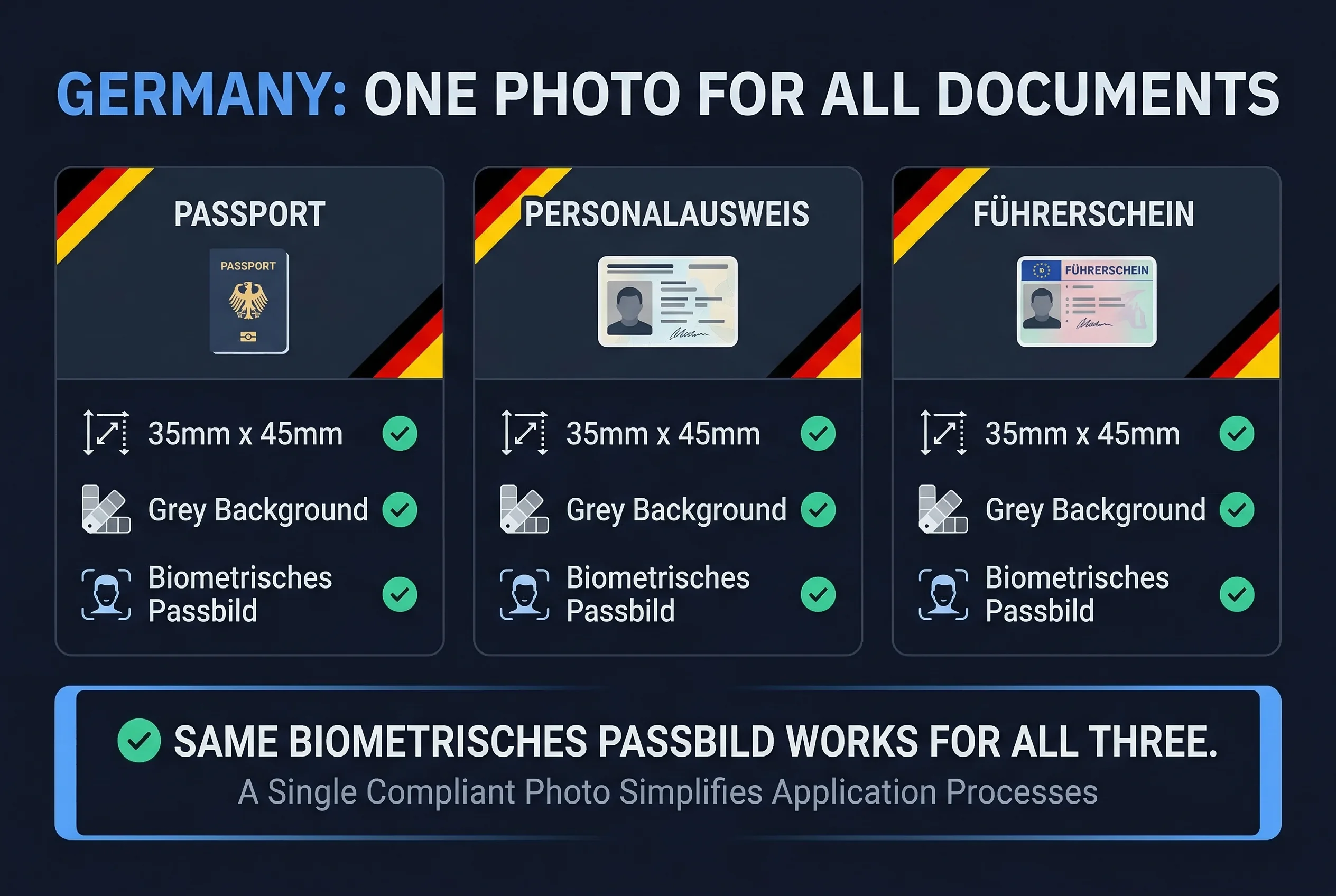
The photo requirements are unified across Germany's most common identity documents:
- Reisepass (passport)
- Personalausweis (national ID)
- Führerschein (driving licence)
- Aufenthaltstitel (residence permit)
One compliant photo session covers all of them. If you're renewing multiple documents, plan it in one trip to the photographer.
Where to Get a Compliant Führerschein Photo
Certified Fotoautomat (photo booth). The easiest route. Photo booths at dm, Rossmann, Deutsche Post, and major train stations produce biometric-compliant prints calibrated to the grey background standard. Cost is around €7–9 for four prints.
Professional photographer. Ask for biometrische Passbilder. A photographer with experience in German documents will know the grey standard and check compliance before handing over the prints. Typically €10–20.
Digital upload. Some municipalities accept digital photo uploads via their online portals. File requirements: correct proportions, grey background (#DCDDDE), minimum file size. The online portal runs an automated biometric check. Paper prints are still required at some Fahrerlaubnisbehörde offices — confirm with your local office before applying.
Applying for a German Führerschein
New licence (first time). Photo is submitted as part of the full application package: theory test pass, practical test pass, Sehtest (eye test), first aid certificate, and the application form at the Fahrerlaubnisbehörde. The issuing authority submits the documentation to the Bundesdruckerei, which produces and mails the card.
Renewal. EU-format licences issued since 2013 are valid for 15 years and then require renewal. Earlier licences without an expiry date were grandfathered but must be converted to the EU format by 2033 at the latest. Renewal requires a fresh photo meeting the current biometric standard.
Exchange of foreign licence. Converting a non-EU licence to a German Führerschein requires a photo along with the relevant application documents. Same biometric standard applies.
Fees vary by application type and municipality, typically €35–45 for a new licence, less for a straightforward renewal.
Processing time is 4–8 weeks. The Führerschein is mailed directly from the Bundesdruckerei.
Common German Führerschein Photo Mistakes
White background. Same issue as the Personalausweis. The grey background is the German standard. A photo printed for a UK, US, or Australian document won't meet German requirements.
Outdated photo. Photos must be recent — taken within the past six months. If your passport photos are older than that, book a new session.
Wrong size. German driving licence photos are the same 35×45mm as the passport. Smaller formats (such as Spain's 26×32mm or older national ID sizes) will be rejected.
Glasses glare. Germany permits glasses in biometric photos, but any visible glare on the lenses causes the automated system to fail. A professional photographer or a well-lit Fotoautomat will reposition you until glare is eliminated. If you can't get a clean shot with glasses on, remove them.
Shadows behind the head. The biometric standard requires an evenly lit, plain grey background. Any shadow — from the subject standing too close to the backdrop, or from uneven studio lighting — will cause rejection at the Fahrerlaubnisbehörde.
Processing and Collecting Your Führerschein
Once your application is submitted at the Fahrerlaubnisbehörde, the documentation goes to the Bundesdruckerei in Berlin for card production. The Führerschein is mailed directly to your registered address, not collected from the authority. Processing takes 4–8 weeks.
If you're between licences (old one expired, new one not yet arrived), ask the Fahrerlaubnisbehörde for a temporary document (vorläufigen Nachweis der Fahrerlaubnis). This is a paper document that confirms your licence is valid while the new card is in production. It's accepted by police during roadside checks in Germany.
Expression and Appearance Rules for Führerschein Photos
The Führerschein applies the same biometrisches Passbild standard as all German identity documents:
- Mouth closed — no teeth visible, lips together gently
- Neutral expression — no smiling, no frowning
- Eyes open — both eyes fully visible, looking directly at the camera
- Glasses allowed — clear prescription glasses permitted with no tinted lenses and no glare
- Hair away from face — forehead visible, hair should not cover eyes or eyebrows
- Head coverings — only for documented religious reasons; face from chin to forehead must be visible
- Even lighting — no shadows on face or behind head
Germany is one of the few EU countries that still allows glasses in biometric photos. France, the Netherlands, Spain, and Ireland have all banned them. If you regularly drive between Germany and these countries, your German photo may look different from their standards — but it's correct for Germany.
How German Photo Standards Compare to EU Neighbours
| Country | Background | Size | Glasses |
|---|---|---|---|
| Germany | Light grey | 35×45mm | Allowed |
| France | White | 35×45mm | Not allowed |
| Netherlands | White | 35×45mm | Not allowed |
| Spain | White | 26×32mm | Not allowed |
| Italy | White | 35×45mm | Allowed |
| Poland | White | 35×45mm | Allowed |
| UK | Light grey | 35×45mm | Allowed |
Germany and the UK share a grey background standard. France, the Netherlands, and Spain use white. If you're arriving in Germany from one of these countries, your existing photos may have the wrong background.
All German Identity Documents Compared
| Document | Size | Background | Glasses |
|---|---|---|---|
| Führerschein | 35×45mm | Light grey | Allowed |
| Reisepass (Passport) | 35×45mm | Light grey | Allowed |
| Personalausweis | 35×45mm | Light grey | Allowed |
| Aufenthaltstitel | 35×45mm | Light grey | Allowed |
All four use the same biometrisches Passbild standard. One photo session covers every German identity document.
Quick Checklist for German Führerschein Photos
- Size: 35×45mm (413×531px at 300 DPI)
- Background: light grey (not white)
- Expression: neutral, mouth closed
- Glasses: allowed if no glare (remove if glare is unavoidable)
- Photo taken within 6 months
- Sehtest (eye test) certificate ready
- First aid certificate ready (for new licence)
Verify your photo with the passportsize-photo.online checker before your Fahrerlaubnisbehörde appointment. For the full German photo standards, see the Personalausweis guide and the Germany hub.