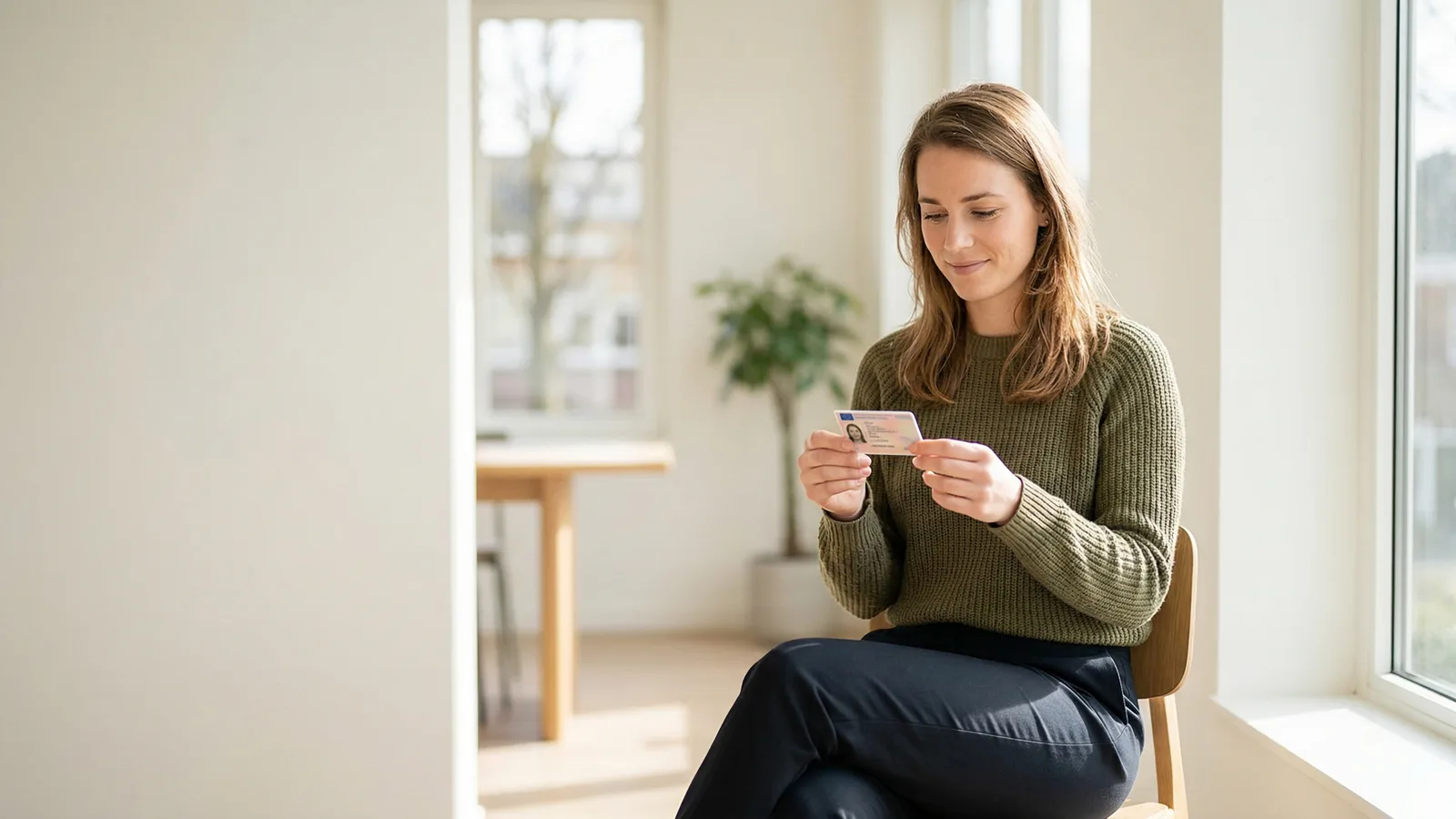
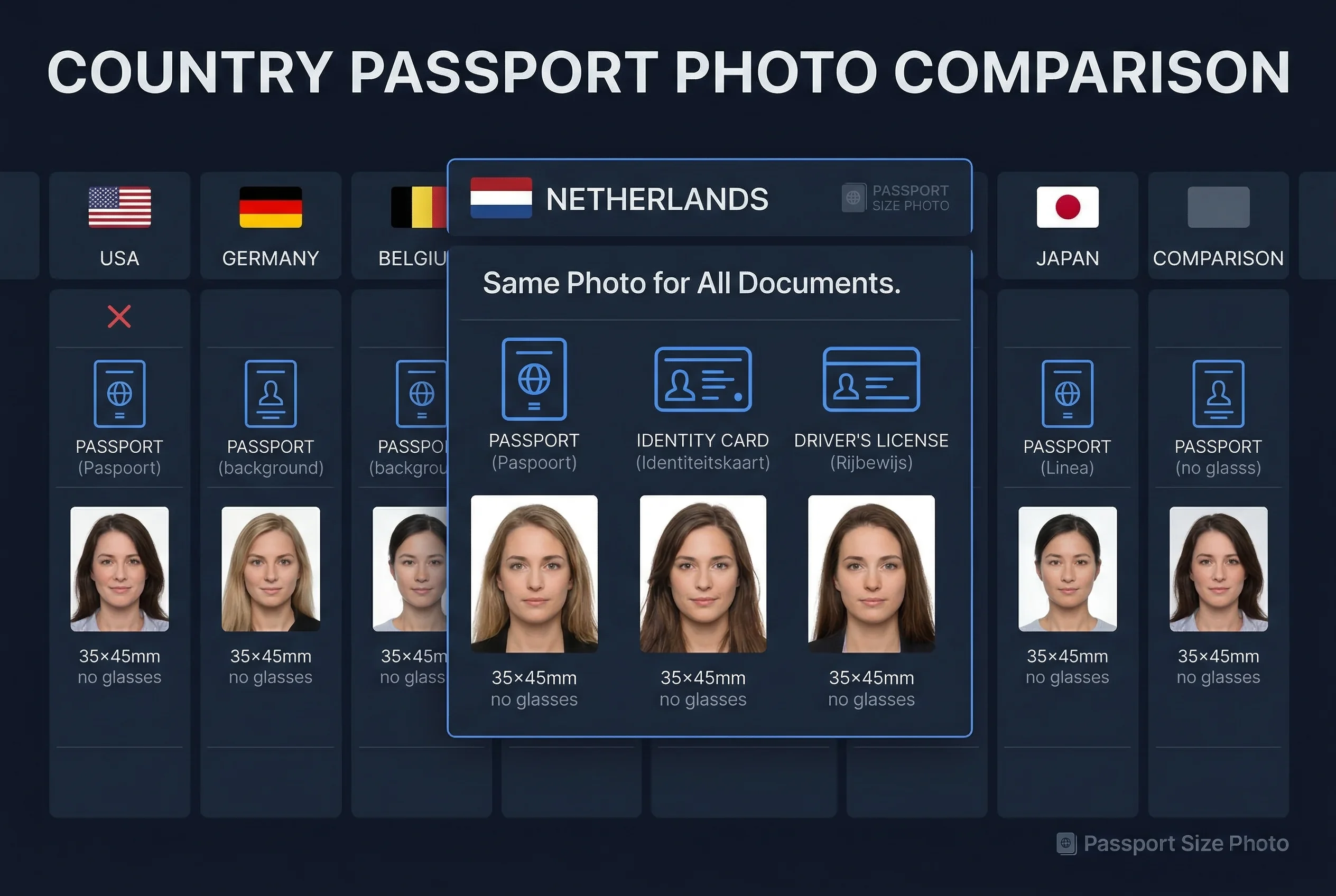
Dutch rijbewijs photos are 35×45mm with a white background and no glasses — identical to the Dutch passport and Identiteitskaart standard. If you have a compliant passport photo already, it will work for your rijbewijs. The same no-glasses rule applies.
Rijbewijs Photo Specifications
| Requirement | Specification |
|---|---|
| Size | 35×45mm |
| Background | White |
| Expression | Neutral, mouth closed |
| Glasses | NOT allowed |
| Head coverings | Religious reasons only |
| Photo age | Taken within 6 months |
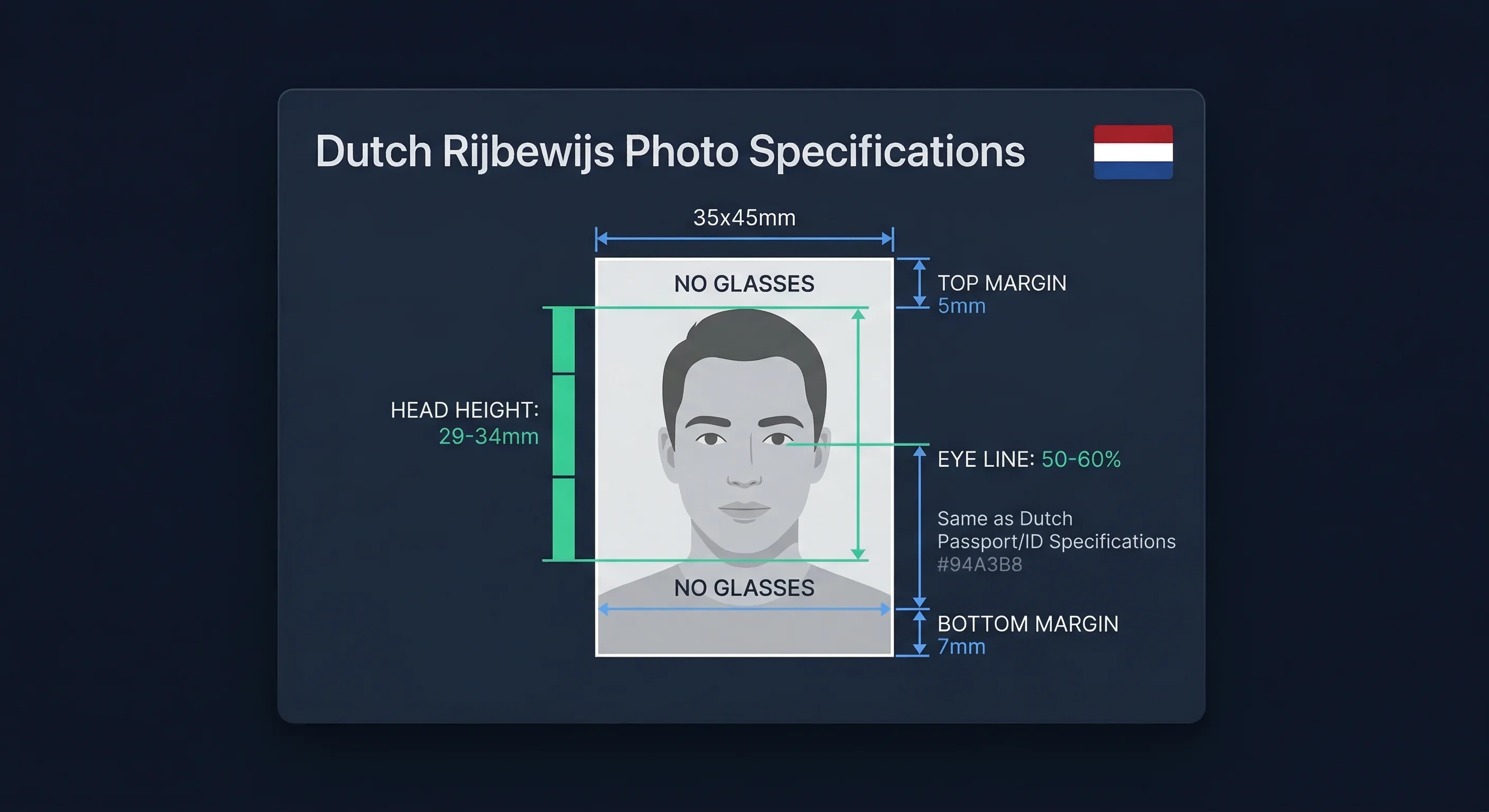
No changes relative to the Dutch passport standard. The Netherlands applies one unified biometric photo specification across all major identity documents — consistency is the entire point of a national biometric standard.
Get a compliant passport photo online
The No-Glasses Rule for Dutch Rijbewijs Photos
Same rule as the passport and Identiteitskaart. Since 2007, the Netherlands has prohibited glasses in all biometric identity document photos. Remove them before the photo is taken. There is no partial exception for clear, non-tinted glasses (unlike in Germany or France).
This is the rule that most non-Dutch residents are surprised by when they first apply. If you moved from Germany or the UK, you may have obtained a driving licence photo with glasses in your home country. That photo doesn't meet the Dutch standard. Germany and the UK still allow glasses; the Netherlands does not.
Getting a Rijbewijs: Two Routes
Via gemeente (municipality). Many Dutch driving licence applications and renewals are processed at your local gemeente. You bring a compliant photo, your old licence (if renewing), and pay the fee. Processing takes 1–5 working days, significantly faster than passport processing.
Via RDW (Rijksdienst voor het Wegverkeer). The RDW is the Dutch vehicle and driving authority. Some licence applications — particularly for special categories (e.g., C, CE, D licences) or when exchanging a foreign licence — go directly to the RDW or are coordinated by the gemeente with RDW input.
Fees: €41.50–€44 for a standard renewal at most municipalities. First-time licence issuance is bundled with your driving school costs.
Validity: Dutch rijbewijzen are valid for 10 years. After age 75, medical fitness checks are required at renewal.
Exchanging a Foreign Driving Licence for a Dutch Rijbewijs
Moving to the Netherlands from outside the EU? If your home country has a bilateral exchange agreement with the Netherlands, you can exchange your foreign licence without retaking the driving test. A compliant Dutch-standard photo is required.
Countries with full exchange agreements include most EU states, the US, Japan, South Korea, Australia, Switzerland, and others. Check the RDW website for the current list — it changes periodically.
If no exchange agreement exists, you'll need to go through the full Dutch driving test process, which includes passing the Theorie-examen (theory test) and CBR practical exam. Either way, a compliant Dutch photo is required — and remember to remove glasses, which may have been allowed in your home country's photo.
Getting a Compliant Rijbewijs Photo in the Netherlands
Photomaton. Use a booth at Albert Heijn, Hema, a train station, or a post office. Select the paspoort/rijbewijs option. Remove glasses before sitting down. The correct background is applied automatically by certified Dutch machines.
Professional photographer. Ask for biometrische paspoortfoto. For a driving licence, the requirements are identical to a passport photo — any photographer familiar with Dutch document standards will know them.
Common Dutch Rijbewijs Photo Rejection Reasons
Glasses in the photo. Same as the passport — remove them before the shutter clicks. The gemeente will send the application back if glasses are visible.
Wrong background colour. The Dutch standard requires a white background. Off-white, cream, or strongly coloured backgrounds will be rejected.
Photo older than 6 months. If you got passport photos done last year and have a few leftover, check the date on the packet. The gemeente checks this.
Face not centred or angled. Looking slightly to the side, even by a few degrees, can cause the biometric check to flag the photo. Dutch photomaten apply a real-time alignment guide — follow it precisely.
Driving in the Netherlands on a Foreign Licence
EU/EEA licence holders can drive in the Netherlands without exchanging their licence. Non-EU holders generally have 6 months to 1 year from registering as a resident before they need a Dutch licence, depending on their home country.
Countries with bilateral exchange agreements (including the US, Australia, Japan, Canada, South Korea, and others) allow direct exchange without a road test — just the application, photo, and fee. Countries without an agreement require the full CBR examination process.
The RDW maintains the current list of exchange countries at rdw.nl. If your country is listed, a compliant photo is the main hurdle — the rest is paperwork.
Expression and Appearance Rules for Dutch Rijbewijs Photos
The rijbewijs uses the same biometric expression standard as the Dutch passport:
- Mouth closed — no teeth visible, lips together gently
- Neutral expression — no smiling, no frowning
- Eyes open — both eyes fully visible, looking directly at the camera
- No glasses — all types banned since 2007, including clear prescription lenses
- Hair away from face — forehead and both eyes must be fully visible
- Head coverings — only for documented religious reasons; face from chin to forehead must remain visible
- No heavy makeup — the photo should represent your natural everyday appearance
The no-glasses rule is often the biggest surprise for newcomers to the Netherlands. Germany, the UK, Italy, and Poland all still allow prescription glasses. The Netherlands does not, and has not since 2007.
How Dutch Photo Standards Compare
| Document | Size | Background | Glasses |
|---|---|---|---|
| Rijbewijs | 35×45mm | White | Not allowed |
| Dutch Passport | 35×45mm | White | Not allowed |
| Identiteitskaart | 35×45mm | White | Not allowed |
| Visa | 35×45mm | White | Not allowed |
All Dutch identity documents share one unified specification. One photo session covers all documents.
International Driving Licence Photo Comparison
| Country | Background | Glasses |
|---|---|---|
| Netherlands | White | Not allowed |
| Germany | Light grey | Allowed |
| UK | Light grey | Allowed |
| France | White | Not allowed |
If you're arriving in the Netherlands from Germany or the UK, you need new photos. The glasses policy differs — Germany and the UK still allow prescription glasses, the Netherlands does not.
Dutch Rijbewijs Categories and Photo Requirements
All licence categories use the same photo specification:
- AM — Mopeds
- A1/A2/A — Motorcycles
- B/BE — Cars and car-trailer combinations
- C/CE — Heavy goods vehicles
- D/DE — Buses
Whether you're applying for your first B licence or adding a C category, the same 35×45mm white-background no-glasses photo is required.
Quick Checklist for Dutch Rijbewijs Photos
- Size: 35×45mm (413×531px at 300 DPI)
- Background: white
- Expression: neutral, mouth closed
- No glasses (any type — banned since 2007)
- Photo taken within 6 months
- Bring photo to gemeente appointment or RDW office
Check your photo against the Dutch standard with the passportsize-photo.online checker before your gemeente appointment. For the full Netherlands requirements, see the Netherlands hub.