Dutch Identiteitskaart photos must be 35×45mm with a white background and no glasses. The Netherlands removed glasses from its biometric standard in 2007 — the same year it changed the passport rules — and the policy applies equally to the national ID card. If you normally wear glasses, remove them for the photo. No exceptions unless medically necessary with written confirmation from a doctor.
Identiteitskaart Photo Specifications
| Requirement | Specification |
|---|---|
| Size | 35×45mm |
| Background | White |
| Expression | Neutral, mouth closed |
| Glasses | NOT allowed (since 2007) |
| Head coverings | Religious reasons only; full face visible |
| Head position | Straight ahead, centred |
| Photo age | Taken within 6 months |
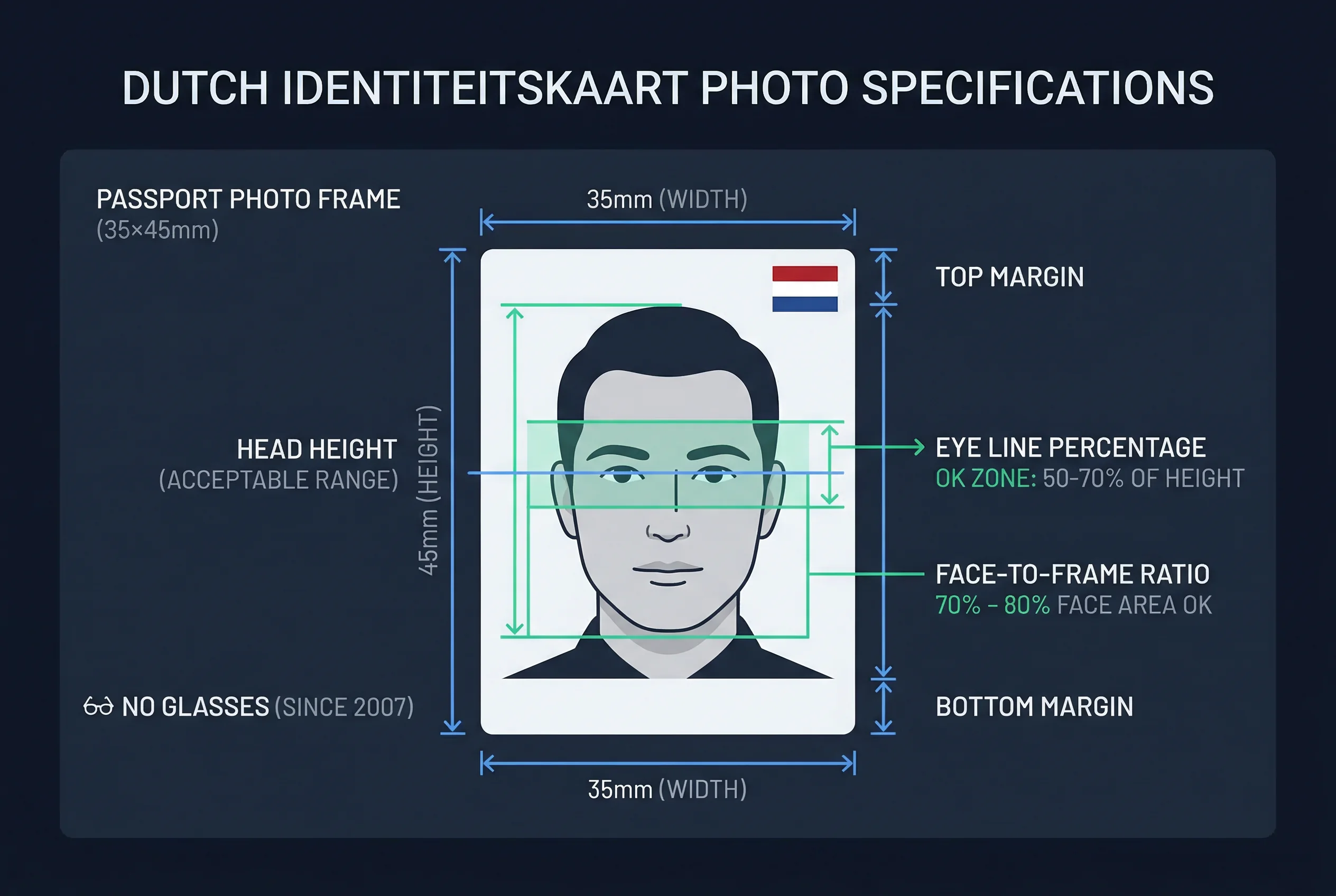
The Identiteitskaart and Dutch passport use identical photo requirements. This is the same standard — the same white background, the same no-glasses rule, the same framing — applied consistently. A photo compliant with the Dutch passport spec will be accepted for the Identiteitskaart without modification.
Get a compliant passport photo online
No Glasses: The Rule That Catches People Out
The Netherlands adopted the ICAO biometric standard strictly in 2007. ICAO's guidance discourages glasses because lens reflections and tinted lenses both interfere with automated facial recognition. The Dutch government went further than most — making glasses a hard prohibition rather than a preference.
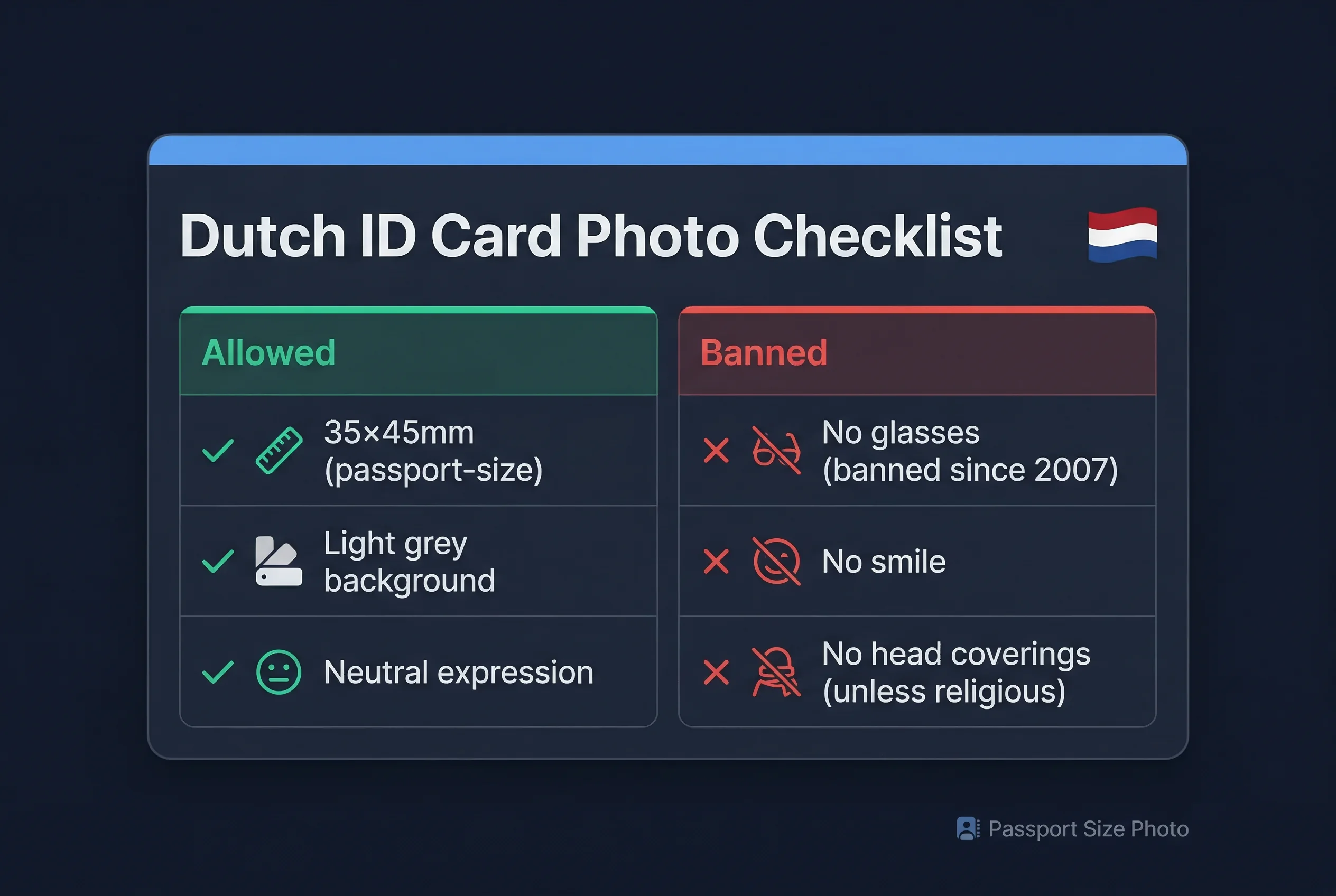
Other countries still allow glasses under certain conditions (Germany permits them if there's no glare; the UK permits non-tinted glasses). France, like the Netherlands, bans glasses entirely. The Dutch rule is absolute for both the passport and the Identiteitskaart.
There is one exception: a medical exemption. If you are unable to remove glasses due to a medical condition, bring written confirmation from a treating physician to your gemeente appointment. The photo will be reviewed case by case. This exception is rarely invoked.
The practical implication: if you wear prescription glasses full-time, you still need a photo without them. The photo you carry for identity purposes will not match your everyday appearance. This is a known limitation of the Dutch standard that the government has accepted as the trade-off for biometric accuracy.
Identiteitskaart vs Dutch Passport
Both documents are valid for EU/EEA travel. The Identiteitskaart is cheaper and faster to obtain. The passport is needed for travel outside the EU and Schengen area.
Key differences:
- Identiteitskaart: Valid for 10 years (adults), 5 years (under 18). Fee: €75.80 (adults). Processing: 5 working days.
- Passport: Valid for 10 years (adults), 5 years (under 18). Fee: €77.70 (adults). Processing: 5 working days.
Photo requirements are identical for both. Getting both renewed simultaneously saves a second appointment at the gemeente.
Applying for a Dutch Identiteitskaart
Step 1: Book an appointment at your gemeente. All Dutch municipalities (gemeenten) process identity documents. Book a biometric data appointment (biometrische gegevens afgifte) via your municipality's website. Most municipalities offer online booking; some allow walk-ins at off-peak times.
Step 2: Bring your documents. For renewal: your current Identiteitskaart or passport, a compliant photo (35×45mm, grey background, no glasses), and the application fee. For first-time adults: birth certificate may also be required.
Step 3: Pay the fee. €75.80 for adults. Under-18 rates vary by municipality. Payment is typically at the counter by pin or cash.
Step 4: Collect the card. Processing takes approximately 5 working days. Some municipalities offer home delivery; others require you to collect in person.
Where to Get a Compliant Dutch ID Photo
Passport photo booths in the Netherlands. Booths at Albert Heijn, Hema, post offices, and train stations are common. Select the "paspoort/identiteitskaart" option. Make sure to remove your glasses before sitting down — some machines will flag glasses automatically, but the responsibility is yours.
Professional photographer. Ask for paspoortfoto's that comply with Dutch biometric standards. A good photographer will know the no-glasses rule and the grey background requirement.
Bringing photos from abroad. Photos taken for other countries' documents may not comply. UK passport photos use white backgrounds. US passport photos have different framing ratios. German passport photos are grey but glasses are permitted under some conditions. Verify Dutch compliance specifically before your appointment.
Digital Photo Submission for the Dutch Identiteitskaart
Some Dutch gemeenten allow digital photo submission online when booking or via a pre-registration portal. The Dutch government's digital photo system (DigiD / Rijksdienst voor Identiteitsgegevens) is expanding, but in-person submission of printed photos remains the standard for most municipalities.
If digital submission is available in your gemeente:
- File format: JPEG
- Minimum resolution: 300 dpi equivalent at 35×45mm
- Same biometric rules apply: grey background, no glasses, neutral expression
Common Identiteitskaart Photo Rejection Reasons
Glasses visible. The most common rejection at Dutch gemeenten. Remove them before the photo is taken.
White background. The Dutch standard requires light grey, not white. If you use a photomaton calibrated for another country's standard, the background may be wrong.
Head not centred. The face should be looking straight ahead, not angled. Some people naturally tilt their head in photos — the biometric check will catch it.
Photo too old. Six months is the limit. Photos from a previous document application are almost never recent enough unless both documents are being renewed in the same session.
Shadows. A shadow on the background or on the face from poor lighting causes biometric check failures.
Run your photo through the passportsize-photo.online checker before your gemeente appointment — it validates Dutch biometric compliance, including the no-glasses check and background colour.
Expression and Appearance Rules for the Identiteitskaart
- Neutral expression — mouth closed, no smile, no frown
- Eyes open — both eyes fully visible, looking directly at the camera
- No glasses — all types banned since 2007, including clear prescription lenses
- Hair away from face — forehead and both eyes clearly visible
- Head coverings — permitted for religious reasons only; full face from chin to forehead must remain visible
- Clean, even lighting — no shadows on face or background
- Recent photo — taken within the last 6 months
Dutch Document Photo Comparison
| Document | Size | Background | Glasses | Smile |
|---|---|---|---|---|
| Identiteitskaart | 35×45mm | White | Not allowed | Not allowed |
| Dutch Passport | 35×45mm | White | Not allowed | Not allowed |
| Rijbewijs (Driving Licence) | 35×45mm | White | Not allowed | Not allowed |
All three Dutch identity documents share the same 35×45mm / white background / no-glasses specification. One photo session covers every Dutch document application.
Common Mistakes That Get Identiteitskaart Photos Rejected
- Glasses present — the most common rejection reason at Dutch gemeentes; even clear prescription lenses are rejected
- Non-white background — grey, cream, or off-white backgrounds fail
- Shadows on background — uneven lighting creates grey patches behind your head
- Photo too old — must be taken within the last 6 months
- Eyes not fully visible — hair, glasses, or head coverings obscuring any part of the eye region
Quick Checklist for Dutch Identiteitskaart Photos
- Size: 35×45mm
- Background: white
- Expression: neutral, mouth closed
- No glasses (any type — since 2007)
- Photo taken within 6 months
- Gemeente appointment booked
- Current ID or passport ready
- Application fee ready
Also see: Netherlands passport photo size and requirements | Netherlands passport photo background | Full Netherlands guide