The Netherlands requires a plain white background for passport photos. The Rijksdienst voor Identiteitsgegevens (RvIG) specifies a uniform white background with no patterns, gradients, textures, or shadows. This aligns the Netherlands with most EU and ICAO-compliant countries.
Exact Background Rules for Dutch Passport Photos
The background must be:
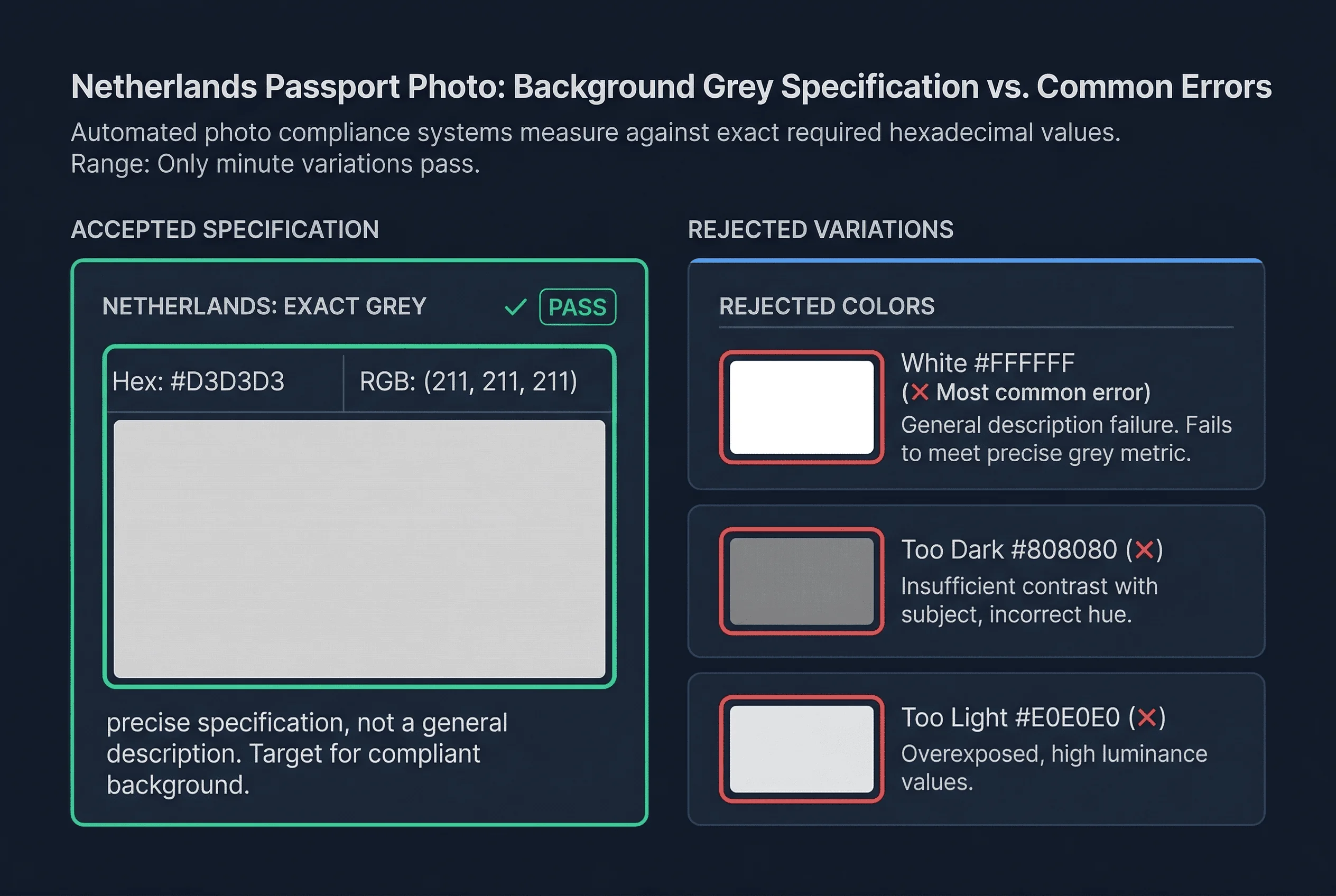
- White (#FFFFFF) — pure white, not off-white, cream, ivory, or grey
- Uniform — the same shade from edge to edge
- Smooth — no visible texture, grain, or pattern
- Shadow-free — no shadows from your head, body, or hair
The background requirement applies to both printed photos submitted at gemeente (municipality) offices and digital submissions.
Get a compliant passport photo online
What Background Colors Fail for Dutch Passport Photos?
Off-white and cream. Walls that appear white to the eye often photograph as cream or pale yellow under warm indoor lighting. Dutch processing systems detect the difference.
Shadows. Standing too close to the wall casts a body shadow behind you. Your head shadow is especially problematic — it creates a dark halo the automated system flags.
Gradients. A single overhead light makes the background brighter at the top and darker at the bottom. The system expects uniform white everywhere.
Textured surfaces. Dutch apartment walls with stucwerk (decorative plaster) or behang (wallpaper) create visible patterns. Smooth surfaces only.
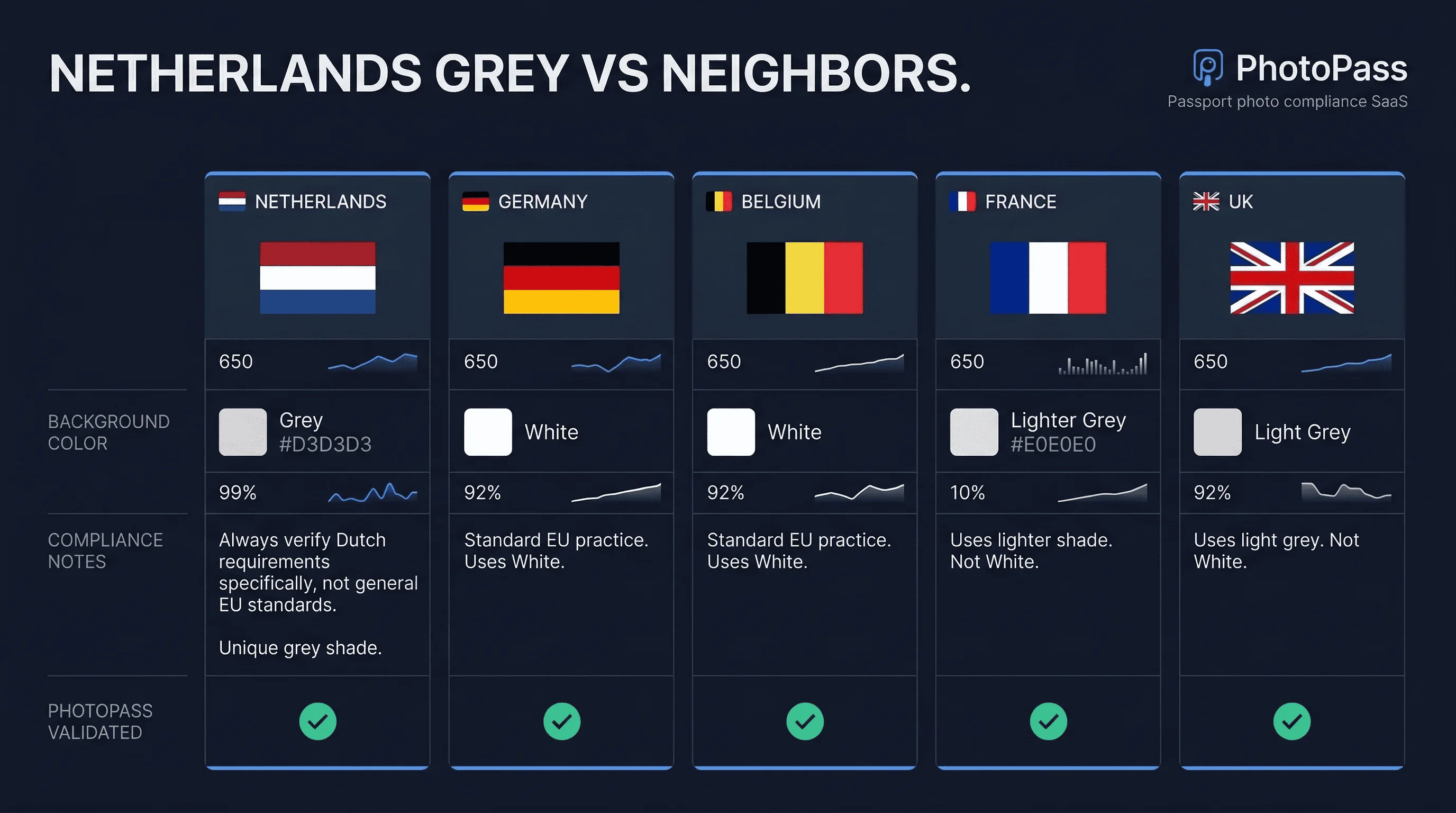
Light grey. What passes in Germany or the UK (light grey at 230,230,230) fails in the Netherlands. The Netherlands requires white, not grey. This is a critical distinction for Dutch-German and Dutch-British dual citizens.
Coloured tints. Pale blue, pale green, or warm-toned backgrounds fail even if they look white in the room.
Background too small. If using a backdrop, it must extend beyond the photo frame edges. Visible edges cause rejection.
Dutch Passport Photo Background vs Other Countries
| Country | Background | Notes |
|---|---|---|
| Netherlands | White | Plain white required |
| France | White | Same as Netherlands |
| Italy | White | Same as Netherlands |
| Switzerland | White | Same as Netherlands |
| Spain | White | Same as Netherlands |
| Japan | White | Same as Netherlands |
| United States | White | Same as Netherlands |
| Germany | Light grey | Different — will fail in Netherlands |
| United Kingdom | Light grey | Different — will fail in Netherlands |
The Netherlands shares its white background requirement with most countries. A white-background photo taken for France, the US, or Japan will have the correct background for the Netherlands (verify size and other rules separately). Photos taken for Germany or the UK (light grey) will not pass Dutch requirements.
How to Create a White Background at Home for Dutch Photos
The White Wall Method for Dutch Passport Photos
- Find a smooth white wall. Interior walls painted in wit mat (flat white) work best. Avoid glossy finishes.
- Stand 40–60cm from the wall. This gap eliminates your body shadow.
- Use two light sources at 45 degrees. Place one lamp on each side. Cross-lighting cancels shadows.
- Use daylight bulbs (5000K+). Standard warm Dutch lighting casts yellow. Switch to daglicht (daylight) bulbs.
- Check the result on a computer screen. Open the photo on a laptop and zoom into the background. It should be uniformly white.
The Foam Board Method for Dutch Passport Photos
White foam board (schuimplaat) from a Bruna, HEMA, or craft shop works well. Sizes of 70cm × 100cm or larger are sufficient. Prop it behind you and light evenly.
The Paper Roll Method for Dutch Passport Photos
White seamless background paper from a photography supplier provides the cleanest result. Hang it and let it curve behind you to eliminate seams.
Where to Get Dutch Passport Photos with Correct Background
Photomaton / Pasfotomaat kiosks. Self-service photo booths found in gemeente offices, train stations, shopping centres, and Albert Heijn locations. These are calibrated for Dutch requirements and produce white backgrounds automatically. Cost: €6–10 per session. The easiest option.
Professional studios (fotostudio). Studios in Amsterdam, Rotterdam, Den Haag, Utrecht, and other cities reliably produce compliant white backgrounds. Cost: €8–20 for prints plus digital file. Studios near gemeente offices have the most experience.
Pharmacy and retail chains. Etos, Kruidvat, and HEMA offer passport photo services at some locations. Quality varies — verify the output before accepting. Cost: €6–12.
Dutch citizens abroad. Dutch embassies and consulates accept photos taken locally. In cities with Dutch communities, specify "witte achtergrond" (white background) and verify the result. Photos from Germany or the UK (grey background) will not pass.
Dutch Passport Photo Background Rules for Babies and Children
Infants and young children must meet the same white background requirement. Getting this right is more challenging because young children move.
Newborns and infants (under 1). Lay the baby on a plain white sheet on a flat surface and photograph from directly above. The white sheet becomes the background. Ensure the sheet is smooth with no wrinkles — fabric texture can cause problems. Use soft, even lighting from the side (not directly above, which casts facial shadows).
Toddlers (1–5). Seat the child in a high chair or car seat against a white background. An assistant can hold the child's attention with a toy above the camera. The white background must fill the entire frame behind the child. Watch for the chair or car seat creating shadows on the background.
Children's passports in the Netherlands are valid for 5 years (vs 10 for adults). A new photo is required at each renewal.
Why Lighting Matters More Than the Wall for Dutch Photos
A white wall does not guarantee a white background in the final photo. Lighting determines how the camera captures it.
Warm lighting (2700K) casts yellow tones. White walls photograph as cream. Switch to daylight bulbs (5000K+).
Uneven lighting creates gradients. Brighter at the top, darker at the bottom. Use multiple light sources placed symmetrically.
Underlit backgrounds appear grey even when the physical surface is white. If your face receives more light than the background, the background will photograph darker. A dedicated background light or positioning the subject further from the background helps.
The Shadow Problem in Dutch Passport Photo Backgrounds
Shadows are the number-one background issue in DIY photos.
The fix: distance. Stand 40–60cm from the wall. The gap gives the shadow space to fall below the frame.
Phone flash makes it worse. The built-in flash casts a sharp shadow behind your head. Disable the flash and use room lighting or natural light.
Third light. If a faint shadow persists, add a third light aimed at the background from below or the side.
Common Dutch Passport Photo Background Mistakes
Yellow lighting. Standard warm bulbs (2700K) make white walls photograph as cream. Switch to daylight bulbs (5000K+) or shoot near a window.
Using a bedsheet. Fabric wrinkles create shadows and texture. Use paper, foam board, or a smooth wall.
Confusing Dutch and German rules. Germany uses light grey. The Netherlands uses white. Dutch-German dual citizens must use separate photos.
Overexposing the background. Extreme brightness creates a glow. White, not blindingly bright.
Aggressive digital editing. Minor brightness adjustments are fine. Background replacement or heavy masking creates artefacts.
Verifying Your Dutch Passport Photo Background
Before submitting, check:
- Background is white across the entire frame (no cream, no grey, no tint)
- No visible shadows behind you
- No texture, pattern, or seam visible
- Background extends beyond all edges of the photo
- Lighting is even from top to bottom, left to right
Use our passport photo checker to validate your background. For Dutch passport photo size requirements, see the Netherlands passport photo size guide. View the complete requirements on the Netherlands hub page.