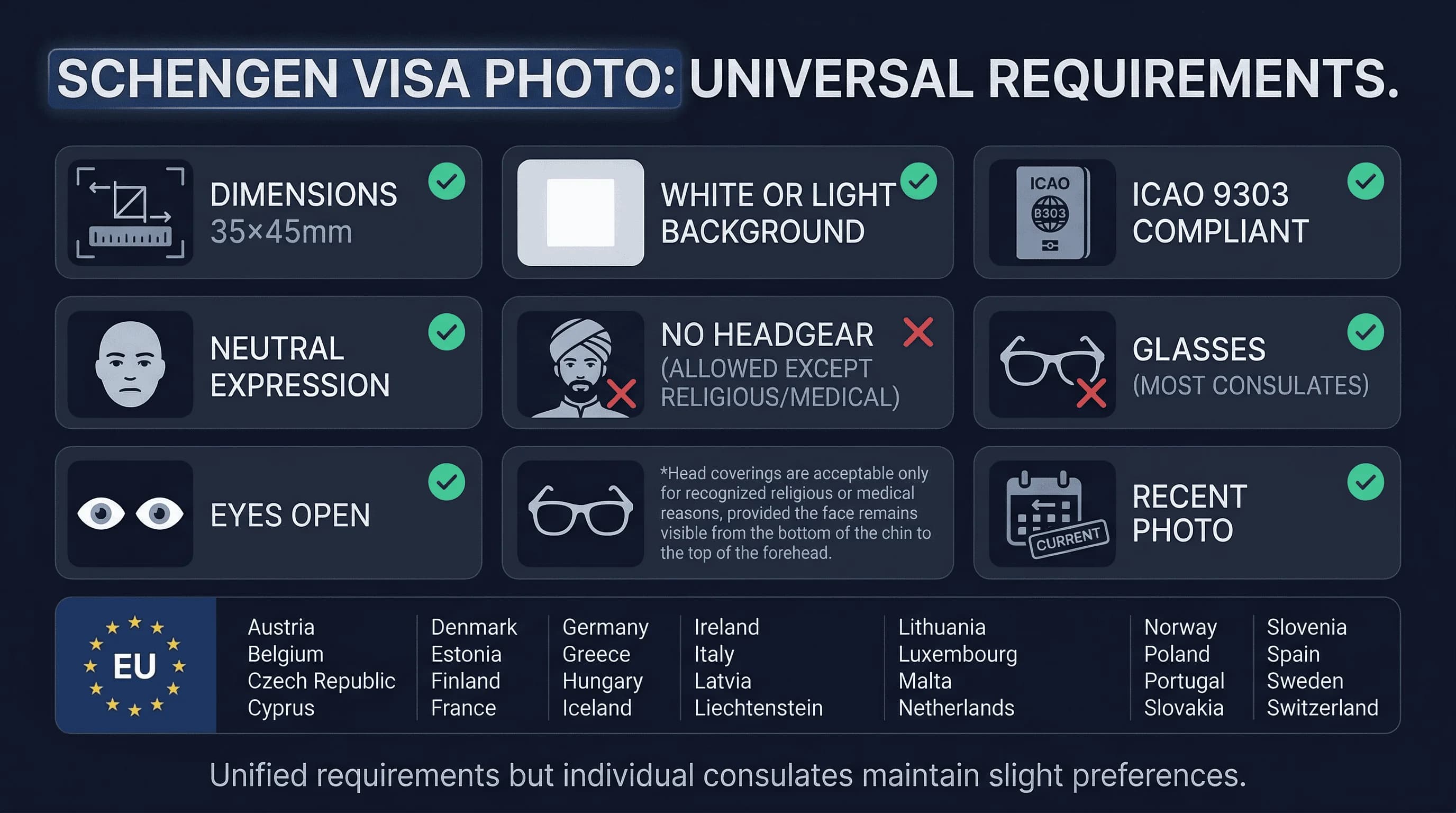
Schengen visa photos must measure 35×45mm against a white or light-colored background. While the Schengen visa system unifies requirements across 27 European countries, individual consulates maintain slight preferences that catch unprepared applicants.
Understanding these requirements prevents application delays or rejections that could derail your European travel plans.
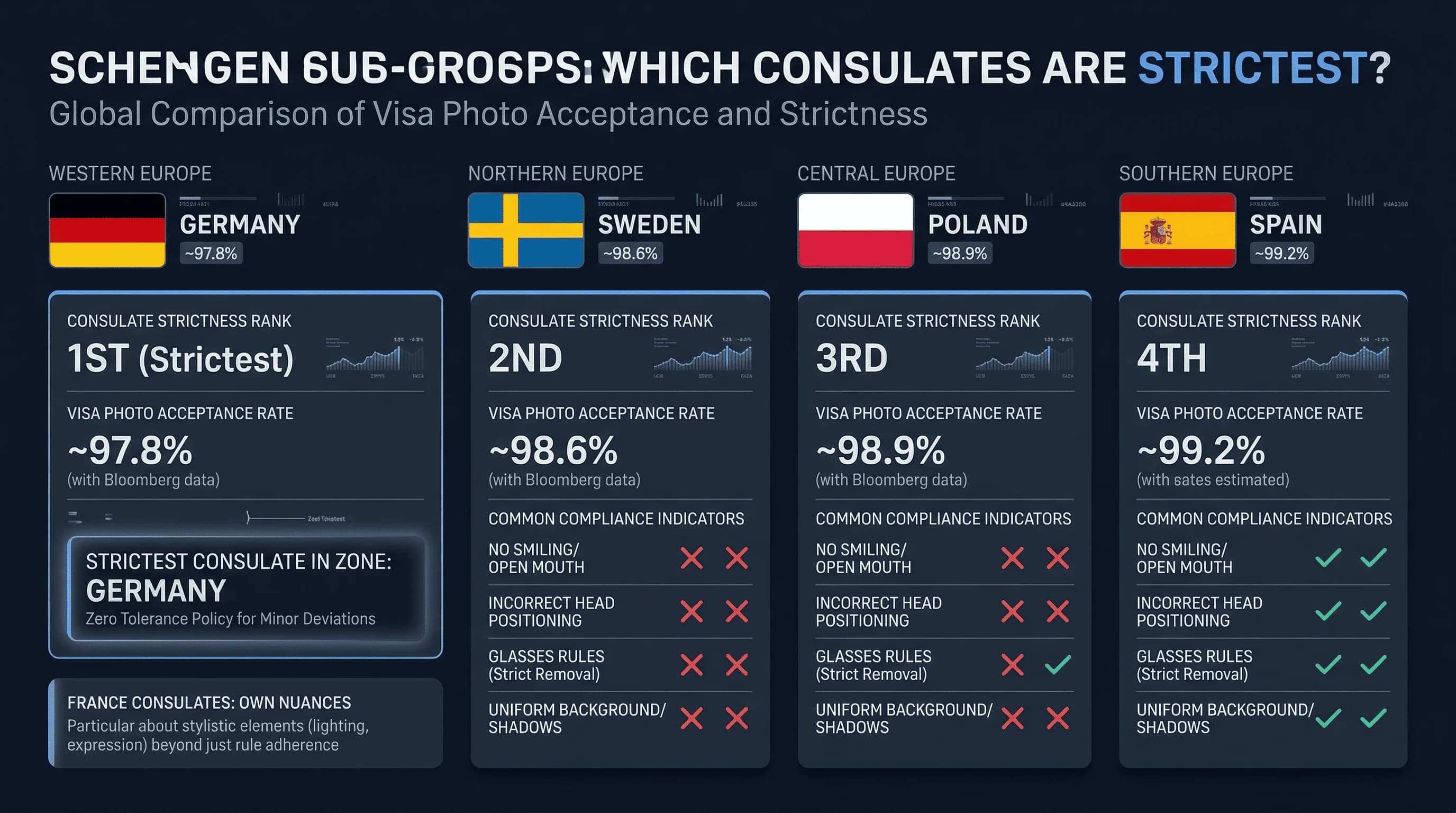
If you're applying to Germany specifically, German visa photo requirements tend to be the strictest in the Schengen zone. For applications to France, French visa requirements have their own nuances worth understanding.
The 27 Schengen Countries and Their Visa Photo Rules
The Schengen Area includes these European nations:
Western Europe: Austria, Belgium, France, Germany, Luxembourg, Netherlands, Switzerland
Northern Europe: Denmark, Finland, Iceland, Norway, Sweden
Central Europe: Czech Republic, Hungary, Poland, Slovakia, Slovenia
Southern Europe: Croatia, Greece, Italy, Malta, Portugal, Spain
Baltic States: Estonia, Latvia, Lithuania
Eastern Europe: Liechtenstein
These 27 countries share open borders with no passport control between them. However, visa applications go through individual country consulates.
Get a compliant passport photo online
Unified Schengen Visa Photo Requirements (35×45mm)
The Schengen Visa Code establishes baseline photo requirements for all member countries:
Dimensions: 35×45mm (passport size) Background: White or light grey Recent photo: Within last 6 months Format: Color, clear and sharp Expression: Neutral, mouth closed Eyes: Open, clearly visible Glasses: Permitted in some countries, prohibited in others Headwear: Only for religious reasons
These unified standards form the baseline. Individual countries add their own interpretations.
Schengen Visa Photo Variations by Country
Despite harmonization, practical differences exist:
France: Prefers pure white backgrounds. Slightly stricter on facial expression than other countries. Photos from French-approved photographers work best.
Germany: Very strict on ICAO 9303 compliance. Background can be light grey or white. Glasses generally prohibited.
Italy: Flexible on background color. Accepts white or light grey. Photos from Italian consulates often accept a wider range.
Netherlands: White background preferred. Accepts digital photos easily. Generally more lenient than northern European countries.
Spain: White background required. Accepts photos from most professional sources. Processing tends to be straightforward.
Poland, Czech Republic, Hungary: These eastern Schengen members tend to follow German strictness. Light grey backgrounds preferred over white.
Scandinavian countries (Denmark, Finland, Norway, Sweden): Strict compliance expected. Follow ICAO 9303 precisely. Light grey backgrounds common.
What Is the ICAO 9303 Standard for Schengen Photos?
Most Schengen countries require photos meeting ICAO Document 9303 specifications. This international standard covers:
- Facial measurements and proportions
- Image resolution minimums
- Color space definitions
- Compression standards
- Data formatting
A photo meeting ICAO 9303 works for virtually any Schengen application. Look for photographers advertising "ICAO compliant" or "international passport photos."
How to Submit Schengen Visa Photos (Print and Digital)
Different application routes accept photos differently:
VFS Global centers: Most Schengen countries use VFS Global for visa processing. These centers accept photos and can often take new photos for a fee.
Direct embassy applications: Some countries require direct embassy submission. Follow their specific photo requirements carefully.
Online portals: A few Schengen countries now accept digital uploads. Requirements vary by country.
When in doubt, bring two printed photos to your appointment. Most processing centers can scan printed photos even if digital isn't accepted.
How Many Photos Does a Schengen Visa Application Need?
Schengen visa applications typically require:
Short-stay visas (Schengen C): Two identical photos
Long-stay visas (National D): Two to four photos, depending on country
Multiple entry visas: Two photos, same as single entry
Always bring extras. Photos get damaged or lost during processing. Having backups prevents delays.
Common Schengen Visa Photo Rejection Reasons
These issues cause Schengen visa photo rejections:
Wrong background. White is safest. Light grey works for some countries. Blue or colored backgrounds always fail.
Old photos. Photos older than six months get rejected. Take new photos specifically for your application.
Expression issues. Neutral expression means no smiling, no raised eyebrows. Both eyes must be clearly visible.
Glasses without good reason. Germany prohibits glasses. Other countries allow them with certain restrictions. When in doubt, remove glasses.
Wrong dimensions. The 35×45mm standard is nearly universal. Non-standard sizes fail.
Shadow or poor lighting. Shadows on the face or background cause rejection. Professional lighting is essential.
Special Cases: Children, Glasses, and Religious Headwear
Children: Infants and young children need photos too. The child should face the camera directly with eyes open. A white blanket or sheet can serve as background.
Religious headwear: Allowed when it doesn't obscure facial features. A statement explaining religious reasons may be required.
Glasses for medical reasons: If you must wear glasses for medical reasons, provide documentation. Some countries make exceptions.
Facial changes: If you've significantly changed your appearance (major weight change, facial hair), take a new photo even if under six months old.
German vs French Requirements: A Comparison
Germany and France represent opposite ends of the Schengen strictness spectrum:
Germany
- Light grey background preferred
- Glasses prohibited
- Very strict ICAO compliance
- Professional photos recommended
France
- Pure white background required
- Moderate on glasses
- Less strict on technical specifications
- More flexible on sources
Applying to either country? Use the stricter requirements as your baseline. A photo that works for Germany works everywhere.
Tips for Taking Compliant Schengen Visa Photos
Follow these recommendations:
Use professional passport photo services. Those advertising "international" or "Schengen" photos understand requirements.
Specify the country you're applying to. Tell the photographer your destination so they can adjust if needed.
Bring your own photo on a USB drive. This allows reprinting if needed without another photo session.
Check your country's specific requirements on their embassy website before applying.
Digital Photo Specifications for Schengen Visa Upload
For countries accepting digital uploads:
Format: JPEG Size: Typically under 500KB Resolution: Minimum 300 DPI Dimensions: 35×45mm aspect ratio
Some countries have specific portals. Follow their technical requirements exactly.
Before submitting, verify your photo using our passport photo checker. This helps ensure compliance with the specific country requirements.
Understanding the 35×45mm Schengen Photo Standard
The 35×45mm dimension represents international passport photo standard. This size appears in most countries worldwide, making compliance easier if you understand the baseline.
Physical measurements
- Width: 35mm
- Height: 45mm
- Aspect ratio: 1:1.29
Digital equivalents
- Approximately 413×531 pixels at 300 DPI
- File sizes vary by country (typically 100KB-500KB)
The background color debate continues. While officially "white or light grey," practical experience shows:
- Pure white works everywhere
- Light grey works in most countries
- Cream or off-white often fails
Schengen Visa Processing Times by Country
Photo-related issues extend visa processing significantly:
Without photo issues
- Standard processing: 15 days average
- Peak season: Up to 30 days
With photo issues
- Additional 10-15 days minimum
- Some cases require entirely new application
Getting your photo right initially saves weeks of waiting.
Schengen Visa Photo Rules by Travel Purpose
Different visa types sometimes require different photos:
Tourist visa: Standard requirements apply. Most straightforward process.
Business visa: May require more recent photo. Additional documentation usually accompanies.
Student visa: Some countries request larger photos or additional copies. Check specific requirements.
Work visa: Typically requires biometric enrollment. Photo gets taken at application center.
Transit visa: Same as tourist requirements. Simpler process overall.
How to Choose Which Schengen Country to Apply Through
Your photo requirements may influence where you apply:
Strict countries: Germany, Austria, Switzerland. These enforce ICAO 9303 strictly.
Moderate countries: France, Italy, Spain. More flexible on backgrounds and sources.
Lenient countries: Portugal, Greece, Poland. Generally accept most compliant photos.
If you have flexibility in which Schengen country you apply through, consider the photo requirements. Applying through a more lenient country might expedite your process.
Common Schengen Visa Photo Mistakes to Avoid
These errors cause unnecessary rejections:
Mistake 1: Using passport photos from non-Schengen countries
UK or US passport photos don't meet Schengen specifications. Take specifically Schengen-compliant photos.
Mistake 2: Assuming online templates work
Generic online photo tools often produce incorrect aspect ratios. Verify final dimensions.
Mistake 3: Ignoring eye level requirements
Eyes must be at a specific height in the frame. Photos with eyes too high or low fail.
Mistake 4: Wrong file format
Some countries require specific JPEG compression. Check submission requirements.
Mistake 5: Insufficient contrast
Photos that are too dark or too light fail automated checks. Aim for even lighting.
Professional vs DIY Schengen Visa Photos
Professional photographers understand requirements:
Professional photos ($15-30)
- Guaranteed compliance
- Knowledge of country-specific preferences
- High-quality prints and digital files
DIY photos
- Possible with proper equipment
- Requires careful editing
- Risk of subtle compliance issues
For important applications, professional photos are worth the investment.
What Happens at a Schengen Visa Application Centre?
When you submit your Schengen visa application:
Step 1: Document check. Staff verifies all required documents including photos are present.
Step 2: Photo scanning. If submitting digital, photos get scanned. Printed photos are scanned for digital records.
Step 3: Biometric collection. Most Schengen countries now collect fingerprints.
Step 4: Interview. Short interview about your travel plans.
Step 5: Payment. Visa fee collection.
Photos get verified at multiple stages. Non-compliant photos get flagged and cause delays or rejection.
Timeline for Schengen Visa Photo Preparation
Follow this timeline for best results:
8 weeks before travel
- Research specific country requirements
- Book professional photo appointment
6 weeks before travel
- Obtain compliant photos
- Test digital files if required
4 weeks before travel
- Submit visa application
- Include all required photos
2 weeks before travel
- Follow up on application status
- Prepare for interview
1 week before travel
- Receive passport with visa
- Verify photo looks correct
Rushing photos leads to mistakes. Plan ahead.