
Passport photo rules change more often than most people think. In the last decade, the United States banned glasses, the UK clarified that white backgrounds cause rejections, Canada tightened its head-size rules, and at least a dozen countries launched digital photo submissions for the first time. If you're reusing a photo from a few years ago, there's a real chance it no longer meets your country's current requirements.
We tracked every major passport photo rule change from 2015 to 2026 across the 31 countries in our compliance database. Some of these changes came from government announcements. Others emerged when we audited our own database against current government specifications and found that rules had shifted since the original data was recorded.
Here's the full timeline — what changed, when, and why it matters.
The Three Biggest Passport Photo Rule Changes Since 2015
The US Glasses Ban (November 2016)
The single most impactful passport photo rule change of the decade. In November 2016, the US State Department banned glasses in all passport and visa photos. Previously, glasses were allowed as long as your eyes were clearly visible and there was no glare on the lenses.
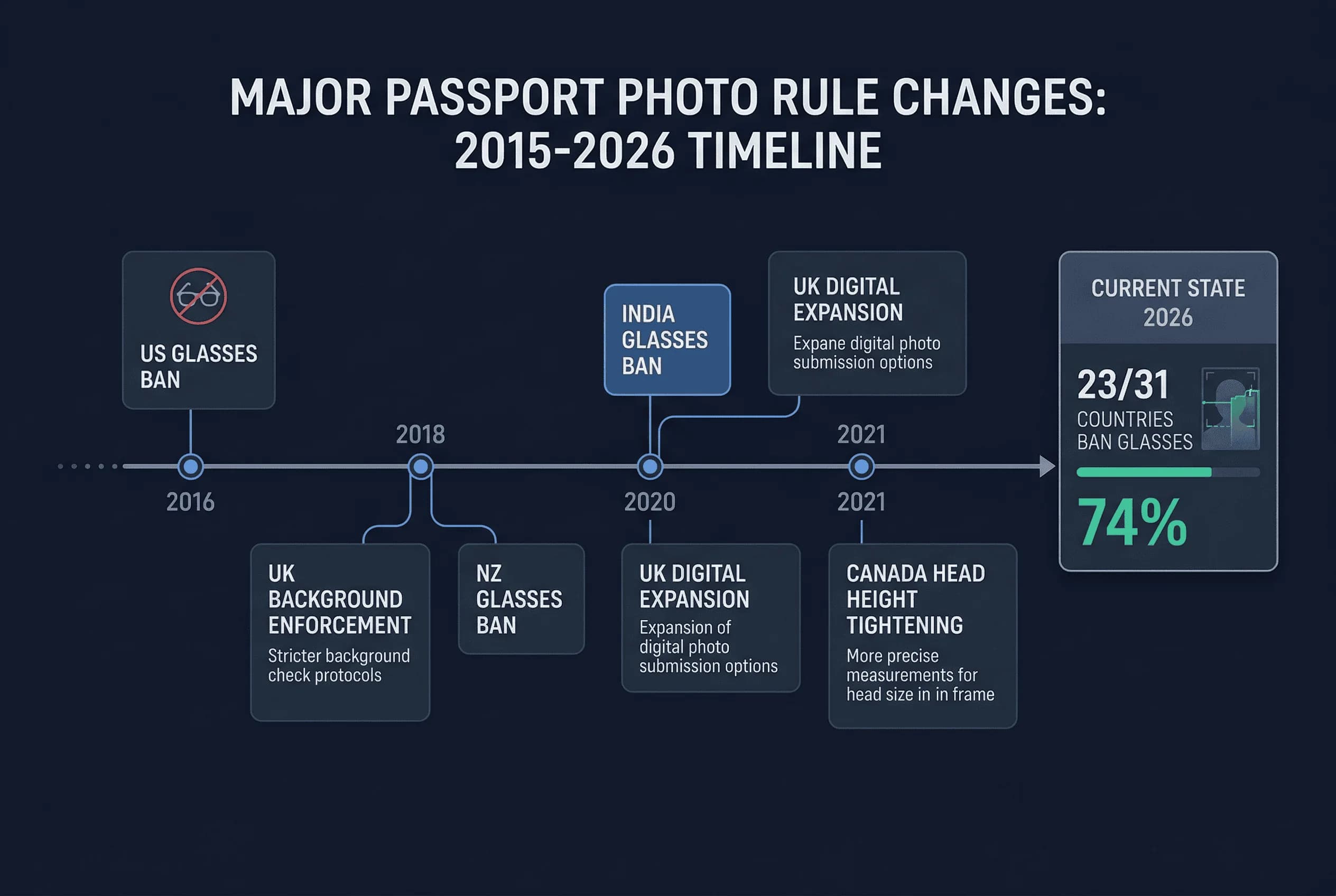
The ban was absolute. No exceptions for prescription glasses, reading glasses, or transition lenses — unless you have a signed medical statement explaining why the glasses cannot be removed. Before this change, millions of Americans wore their glasses in passport photos without issue. After it, every glasses-wearing applicant had to remove them.
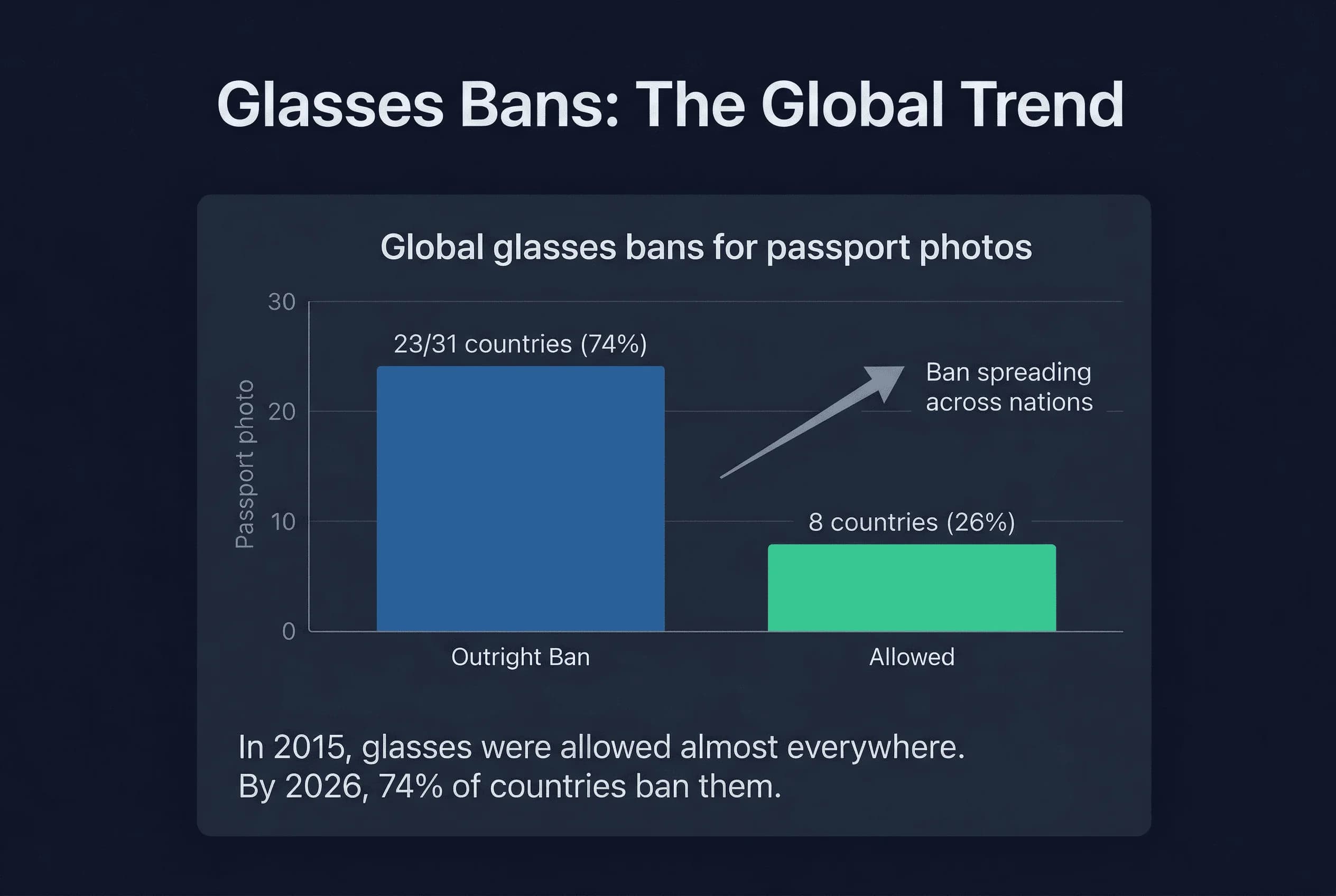
Why did this happen? The State Department cited interference with facial recognition systems at automated border gates. Glasses create glare, shadows, and distortion that reduce biometric matching accuracy. The ban aligned the US with the majority of countries: as of 2026, 23 of 31 countries in our database (74%) ban glasses outright.
The UK Background Clarification (2020)
The UK has required "plain cream or light grey" backgrounds since at least 2015. But for years, many photo booths and studios produced white-background photos — and many of those were accepted.
Around 2020, HM Passport Office began enforcing the rule more strictly, particularly for digital submissions. White backgrounds became a documented rejection cause. Our database records the UK's required background as RGB 230,230,230 (light grey), not 255,255,255 (white).
This catches travelers from nearly every other country off guard. If you're American, Canadian, or Australian and you assume "white background" is universal, your UK passport photo will likely be rejected. Only two countries in our database require non-white backgrounds: the United Kingdom and Germany (which also uses light grey for passports and national ID cards).
Canada's Passport Photo Head Height Tightening
When we audited our database against current Canadian government specifications, we found a significant discrepancy. Our original data recorded Canada's head height range as 62–82% of the frame. The current government specification states 31–36mm in a 70mm frame — that's 44–51%.
This is a 7-percentage-point window, tied with Brazil for the tightest in the world. The previous 20-point range was far more forgiving. Whether this reflects a formal policy change or a correction of previously misrecorded data, the practical effect is the same: Canadian passport photos now require precise head sizing that most quick-service photo counters get wrong.
Get a compliant passport photo online
Passport Photo Requirements Timeline: 2015–2026
| Year | Country | Change | Impact |
|---|---|---|---|
| 2015 | 🇬🇧 UK | Digital photo submissions accepted for online passport applications | First major country to accept smartphone-quality digital photos (min 600×750px) |
| 2016 | 🇺🇸 USA | Glasses banned in passport and visa photos | Affected all new applications; no grandfathering of existing photos |
| 2017 | 🇫🇷 France | ANTS digital photo system implemented | Photo booth or studio photos linked directly to application via code |
| 2018 | 🇦🇺 Australia | Online passport renewal launched with digital photo upload | Print applications still accepted; online became preferred channel |
| 2018 | 🇮🇳 India | Online passport renewal via Passport Seva Kendra | Digital photos accepted for renewals; first-time applications still required in-person visit |
| 2019 | 🇨🇦 Canada | Head height requirements tightened to 44–51% | Tightest head-size window globally (tied with Brazil) |
| 2020 | 🇬🇧 UK | White background rejection enforcement begins | Cream/light grey requirement enforced more strictly for digital submissions |
| 2021 | 🇳🇿 New Zealand | Full digitization of passport applications | All applications processed online; paper forms effectively discontinued |
| 2022 | 🇯🇵 Japan | Online Passport Application launched | Digital photo submission via smartphone, linked to My Number Card (マイナンバーカード) |
| 2023 | 🇸🇬 Singapore | ICA accepts smartphone-taken digital photos | Removed requirement for professional studio photos for standard applications |
| 2023 | 🇺🇸 USA | Online passport renewal pilot program | Beta program allowing digital photo upload; limited eligibility |
| 2024 | 🇩🇪 Germany | Live-capture-only for passport photos in some municipalities | Bürgeramt offices take photos on-site to prevent AI-altered or digitally manipulated images |
| 2025 | 🇬🇧 UK | Automated photo validation for online applications | Instant rejection of non-compliant photos during submission — no more waiting weeks for a rejection letter |
| 2025 | 🇮🇳 India | Online passport applications expanded to first-time applicants | Previously online was renewal-only; now covers new applications in many categories |
What Our Passport Photo Database Audit Revealed
When we built the passportsize-photo.online requirements database, we verified every specification against current government sources. In 13 cases, the values we found didn't match previous records. These corrections tell us something about how requirements evolve:
Dimension changes found
- 🇨🇦 Canada: 600×800px → 591×827px (recalculated from the official 50×70mm at 300 DPI)
- 🇮🇳 India: 413×531px (portrait) → 413×413px (square, 35×35mm confirmed)
- 🇦🇪 UAE: 430×559px → 472×709px (corrected to official 40×60mm)
- 🇸🇬 Singapore: 400×514px → 413×531px (corrected to ICAO 35×45mm standard)
- 🇪🇸 Spain: Originally assumed 35×45mm → confirmed 26×32mm (smallest passport photo in our database)
Policy changes found
- 🇺🇸 USA: Smile policy corrected from "banned" to "allowed" (State Department FAQ explicitly permits closed-mouth smile)
- 🇬🇧 UK: Glasses policy corrected from "banned" to "conditionally allowed" (permitted if medically necessary)
- 🇨🇦 Canada: Glasses policy corrected from "banned" to "allowed" (eyes must be visible, no glare)
- 🇩🇪 Germany: Glasses policy corrected from "banned" to "allowed"
- 🇫🇷 France: Background corrected from grey (230,230,230) to white (255,255,255) for passports
These aren't all recent policy changes — some were errors in the original data that persisted because nobody re-verified against the current government spec. That's the core problem: requirements data goes stale, and stale data causes rejections.
Which Countries Changed Passport Photo Rules Most?
High change: The United States, United Kingdom, and Canada have all made significant changes since 2015. The US glasses ban, UK background enforcement, and Canada's head-height tightening were the three most impactful shifts in our dataset.
Moderate change: Japan, India, Singapore, Australia, and New Zealand all launched digital submission systems between 2018 and 2023. The photo specifications didn't change, but the submission format did — from print-only to digital-accepted.
Stable: Most European countries using ICAO 9303 standard specifications (35×45mm, white background, neutral expression) haven't changed their core photo rules in over a decade. France, Netherlands, Ireland, Poland, and Switzerland all use the same specifications they've had for years. Italy, Spain, South Korea, and the Philippines are similarly stable.
The ICAO baseline holds. 20 of 31 countries in our database use the ICAO standard 35×45mm format. The standard itself (ICAO Doc 9303) was last updated substantively in its 8th edition. Countries that deviate from ICAO — the US with 51×51mm, Brazil with 50×70mm, Spain with 26×32mm — tend to keep their deviations stable. It's the policies around the photo (glasses, expression, background color, submission format) that change.
What Passport Photo Rule Changes Are Coming Next?
Three trends are clear from the trajectory of the last decade:
1. Digital-first submission is becoming the default. In 2015, most countries required printed photos. By 2026, every G7 country accepts digital photos, and several (New Zealand, Japan, Singapore) have made digital the primary or only option. Expect more countries to follow. This shifts the requirement emphasis from print quality (DPI, paper stock, matte vs. glossy) to file specifications (pixel dimensions, file size, format).
2. Automated validation is replacing human review. The UK's 2025 launch of instant photo validation for online applications is the direction of travel. When a computer — not a human — checks your photo, the tolerance for errors shrinks. A human reviewer might accept a background that's slightly off-white. An algorithm won't.
3. Anti-manipulation measures are emerging. Germany's 2024 pilot of live-capture-only passport photos at government offices is a direct response to AI-generated and AI-altered photos. As generative AI improves, more countries may require photos taken in controlled settings or with liveness detection. This doesn't change the specification — it changes how and where the photo must be captured.
For travelers, the practical implication is straightforward: check your country's current requirements before every application. Don't assume the rules haven't changed since your last passport. Our passport photo checker validates against the current specification for all 31 countries in our database — updated as governments publish changes.
Methodology: How We Tracked Passport Photo Rule Changes
Timeline events were compiled from official government announcements, ICAO publications, and news coverage of policy changes. Database corrections come from our February 2026 audit of all 31 countries against current government specifications, documented in our internal engineering verification log. Each correction is traceable to the government source URL recorded in the sourceUrl field of our requirements database.
The strictness ranking of these 31 countries provides additional context on how current rules compare.