No — glasses of any kind are not permitted in Malaysia passport photos. The Jabatan Pendaftaran Negara (JPN / National Registration Department) bans all eyewear. This applies to Malaysian passports and Malaysian visa applications.
Exact Glasses Rules for Malaysian Passport Photos
All glasses are banned:
- Prescription glasses (cermin mata) — not allowed, regardless of medical need
- Sunglasses — not allowed
- Tinted lenses — not allowed
- Reading glasses — not allowed
- Blue-light blocking glasses — not allowed
- Photochromic (transition) lenses — not allowed, even if clear indoors
- Non-prescription fashion frames — not allowed
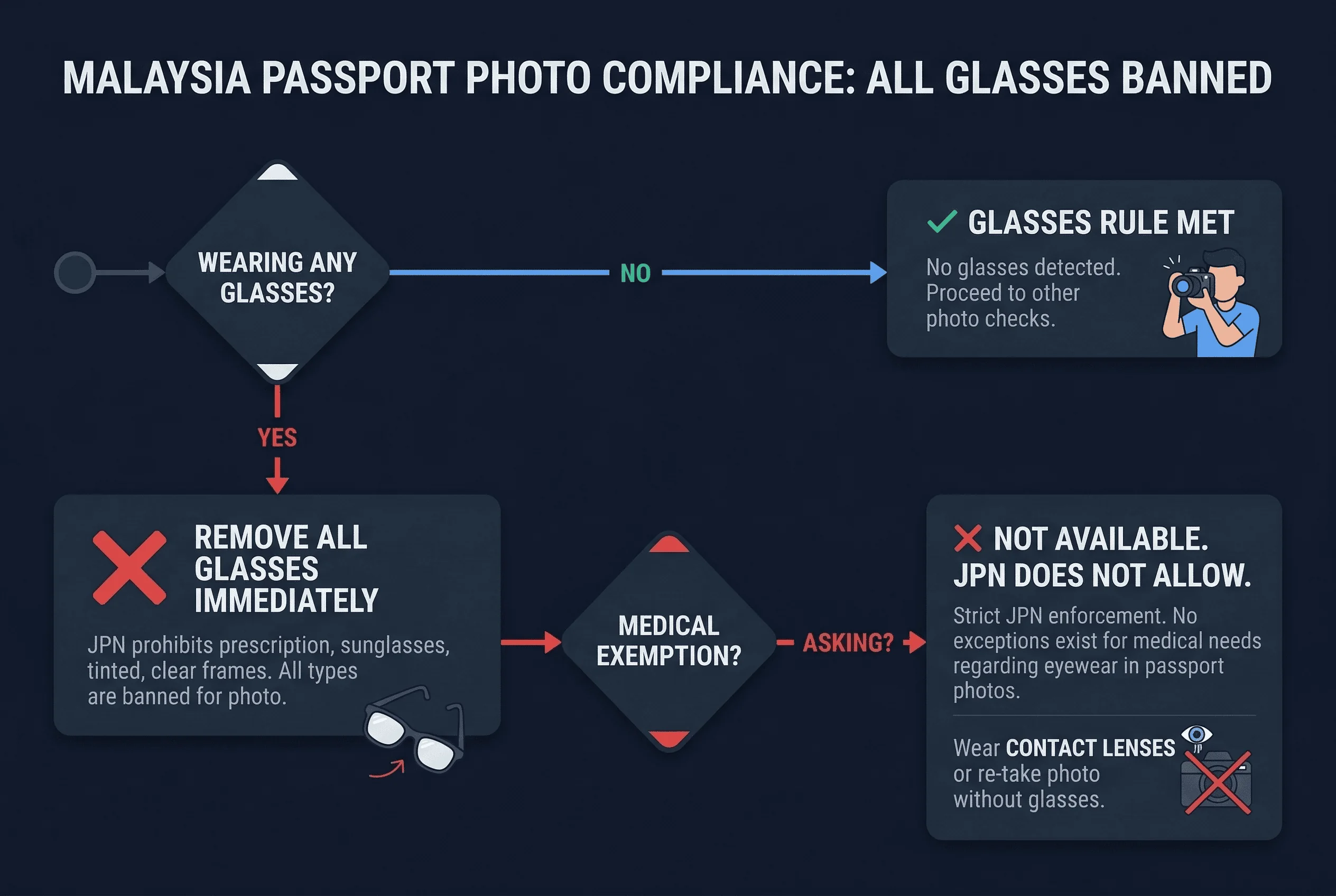
The only item permitted near your eyes is clear prescription contact lenses (kanta lekap).
Get a compliant passport photo online
Why Does Malaysia Ban Glasses in Passport Photos?
Malaysia's JPN uses facial recognition to match applicants against their biometric database. The system is also used at Malaysia's autogate (pintu automatik) at KLIA, KLIA2, and other immigration checkpoints. Glasses interfere because:
- Frames obscure facial geometry. The bridge area between the eyes is a critical measurement point.
- Lenses create reflections. Even anti-glare coatings don't eliminate all reflections under studio lighting.
- Shadows from frames fall on the cheeks and under the eyes.
- Autogate matching compares your passport photo to a live camera scan.
Are There Medical Exemptions for Glasses in Malaysia?
Malaysia does not grant medical exemptions for glasses in passport photos. JPN guidelines contain no documented exceptions. The photo takes only seconds — remove glasses, take the photo, put them back on.
Can You Wear Contact Lenses in Malaysian Passport Photos?
Clear prescription contact lenses (kanta lekap) are fine. The rule targets glasses and tinted lenses.
What might get flagged: Coloured or cosmetic contact lenses that noticeably change your eye colour.
Practical Tips for Glasses Wearers in Malaysian Photos
Before the photo
- Remove glasses 5–10 minutes early. This allows the red marks on the bridge of your nose to fade.
- If you normally squint without glasses, practise keeping your eyes naturally open. The photo requires a neutral expression with both eyes clearly visible.
- If you use contact lenses, insert them before arriving at the UTC, Jabatan Imigresen, or studio.
During the photo
- Keep your eyes relaxed and open. Don't squint.
- If you can't see the camera clearly, ask the photographer to guide you.
After the photo
- Check the photo on screen before accepting.
Where to Get Malaysian Passport Photos Without Glasses
UTC (Urban Transformation Centre). UTC locations in major cities offer JPN passport services and photo services. Cost: RM 8–15. Staff know all requirements.
Jabatan Imigresen offices. Immigration offices have nearby photo studios. Cost: RM 8–15.
Photo studios (kedai gambar). Studios near JPN and Imigresen offices specialise in passport photos. Cost: RM 5–15. Ask for "gambar pasport, tanpa cermin mata, latar belakang putih" (passport photo, no glasses, white background).
Shopping centre photo counters. Found in most shopping centres across Malaysia. Cost: RM 5–10.
DIY at home. If taking your own photo:
- White background (Malaysia requires pure white)
- 35×50mm — taller than the 35×45mm international standard
- No glasses of any kind
- Neutral expression, mouth closed (smiling not allowed)
- Both eyes clearly visible
Malaysia's Unique 35×50mm Passport Photo Size
Malaysia uses a 35×50mm passport photo, which is taller than the 35×45mm standard used by most countries. This matters because:
- Studios abroad may default to 35×45mm — specify 35×50mm for Malaysian passports
- The taller format shows more of the head and shoulders
- Some online printing services may not offer 35×50mm as a standard option
Always specify "3.5 × 5 cm" when ordering Malaysian passport photos.
MyKad Glasses Rules vs Malaysian Passport Rules
The same no-glasses rule applies to MyKad photos. If you're renewing or applying for a MyKad, remove all glasses. A single glasses-free photo can serve for both passport and MyKad if it meets the specific size requirements for each.
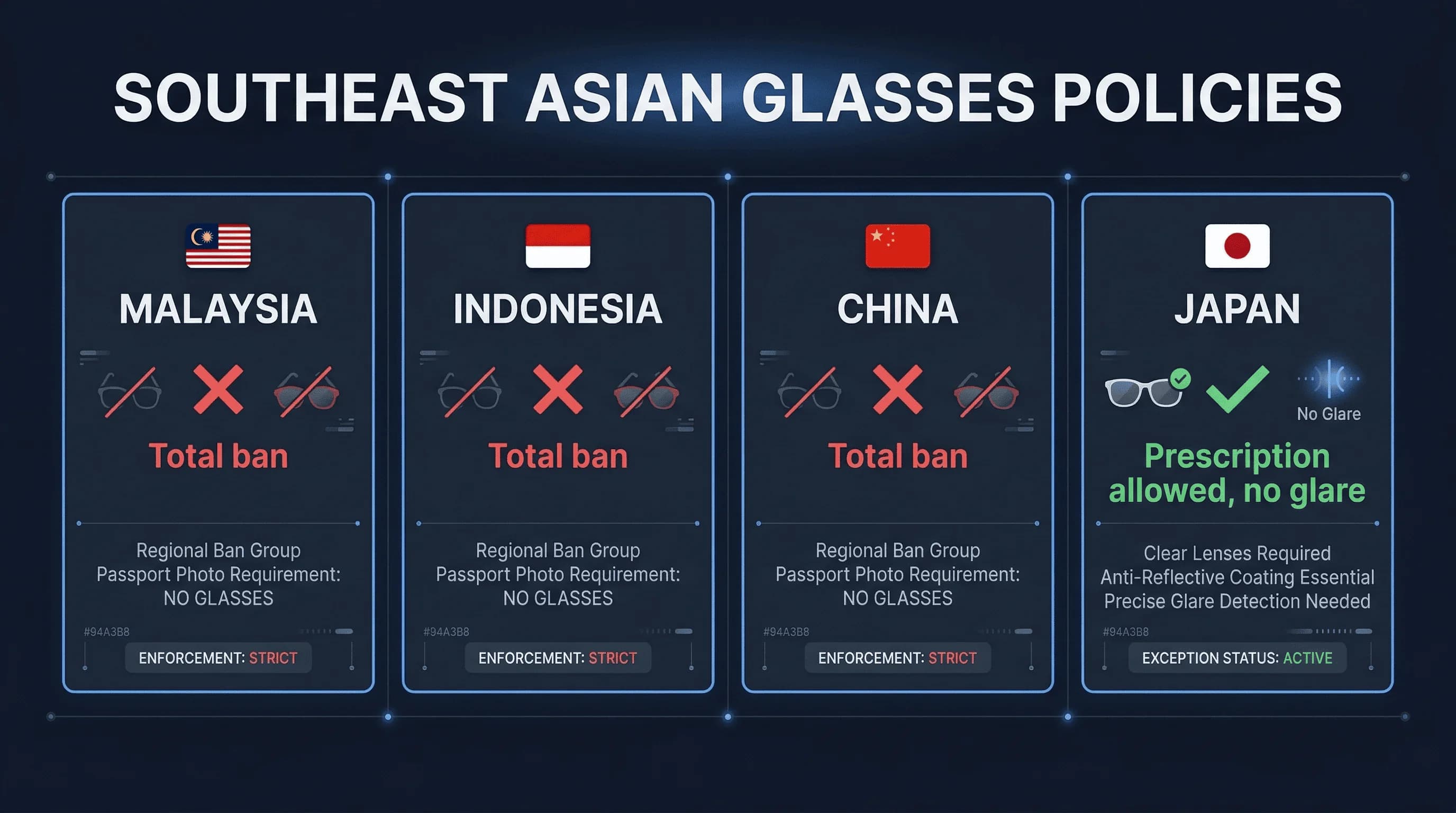
Glasses Rules: Malaysia vs Other Countries
| Country | Glasses | Notes |
|---|---|---|
| Malaysia | ❌ Banned | |
| United States | ❌ Banned | Since 2016 |
| China | ❌ Banned | |
| Japan | ❌ Banned | |
| France | ❌ Banned | |
| India | ❌ Banned | Since 2020 |
| Australia | ❌ Banned | Since 2018 |
| United Kingdom | ✅ Conditional | Prescription only, no glare |
| Canada | ✅ Conditional | Prescription only, no glare |
| Germany | ✅ Conditional | Prescription only, no glare |
| Italy | ✅ Conditional | Prescription only, no glare |
| South Korea | ✅ Conditional | Prescription only, no glare |
Malaysia follows the global majority in banning all glasses.
Common Glasses Mistakes in Malaysian Passport Photos
Keeping glasses on "because they're clear." Even perfectly clear prescription glasses are banned.
Using the wrong photo size. Malaysia's 35×50mm is unique. Don't use 35×45mm.
Wearing transition lenses. These retain a subtle tint indoors. Remove them.
Digitally removing glasses. Photo manipulation is detectable.
Ignoring nose-bridge marks. Remove glasses well before the photo session.
Glasses Rules for Malaysians Renewing Passports Abroad
If you're renewing your Malaysian passport from abroad, the same no-glasses rule applies. Malaysian embassies and consulates in London, Singapore, Canberra, Beijing, Jakarta, and Riyadh all enforce the ban.
In countries where glasses are allowed (UK, Canada, Germany), studios may assume glasses are fine. Specify: "Malaysian passport photo, no glasses, white background, 35×50mm."
How Autogates Use Your Glasses-Free Passport Photo
Malaysia's autogates at KLIA, KLIA2, Johor Bahru (Sultan Iskandar CIQ), and Penang use facial recognition to match your passport photo to your live face. Glasses-free photos produce the best matching accuracy.
Malaysian Children's Passport Photos and Glasses
The same no-glasses rule applies to children. Malaysian passports for children under 12 are valid for 2 years. Passports for those 12–17 are valid for 2 years. Adult passports (18+) are valid for 5 years.
Can You Wear Glasses at JPN and Imigresen Offices?
The glasses ban applies only to your passport photo. You can wear glasses:
- At the JPN or Jabatan Imigresen office during your appointment
- During in-person biometric data capture (fingerprints)
- At immigration autogates (the system captures your live face separately)
- In your supporting documents (MyKad, driving licence, etc.)
Tudung and Glasses Rules for Malaysian Passport Photos
For Muslim women who wear a tudung (headscarf), the tudung is permitted in Malaysian passport photos as long as it does not cover the face. However, glasses must still be removed. The headscarf rule and glasses rule are independent — one does not affect the other.
Advice for Strong Prescription Wearers in Malaysia
If your prescription is strong and you don't normally wear contact lenses:
- Daily disposable contacts are available at most Malaysian optical chains. A single pair costs RM 3–10 and solves the problem.
- Ask someone to guide you. If you can't see the camera clearly, the photographer or a companion can help you position correctly.
- Practise going without. Remove glasses, take the photo, put them back on. The session lasts seconds.
Malaysian Online Passport Renewal and Glasses Rules
Malaysia's online passport renewal system allows you to upload a digital photo. The system validates the photo against JPN requirements. Glasses will be flagged by the automated checker. Ensure your uploaded photo is glasses-free before submitting.
Malaysian Visa Application Photo Glasses Rules
If you're applying for a Malaysian visa from abroad (for non-citizens), the same no-glasses rule applies:
- 35×50mm, white background
- No glasses
- No smiling
- Recent photo (within 6 months)
Malaysian Passport Photo Renewal and Glasses Changes
If your current passport photo shows you with glasses from before the ban was enforced, you'll need a new glasses-free photo for your renewal. Your existing passport remains valid until it expires.
Do Not Digitally Edit Glasses in Malaysian Passport Photos
Do not digitally remove glasses from a photo. Always take the photo without glasses from the start.
Verify your photo meets all Malaysian passport requirements with the passportsize-photo.online checker. For size requirements, see Malaysian passport photo size guide. View all Malaysian passport photo rules on the Malaysia hub.