Yes — Italy allows prescription glasses in passport photos, but with strict conditions. The lenses must be clear, there must be no glare, and your eyes must be fully visible through the lenses. This applies to passaporto, carta d'identità elettronica, and Schengen visa applications processed through Italian consulates.
Exact Glasses Rules for Italian Passport Photos
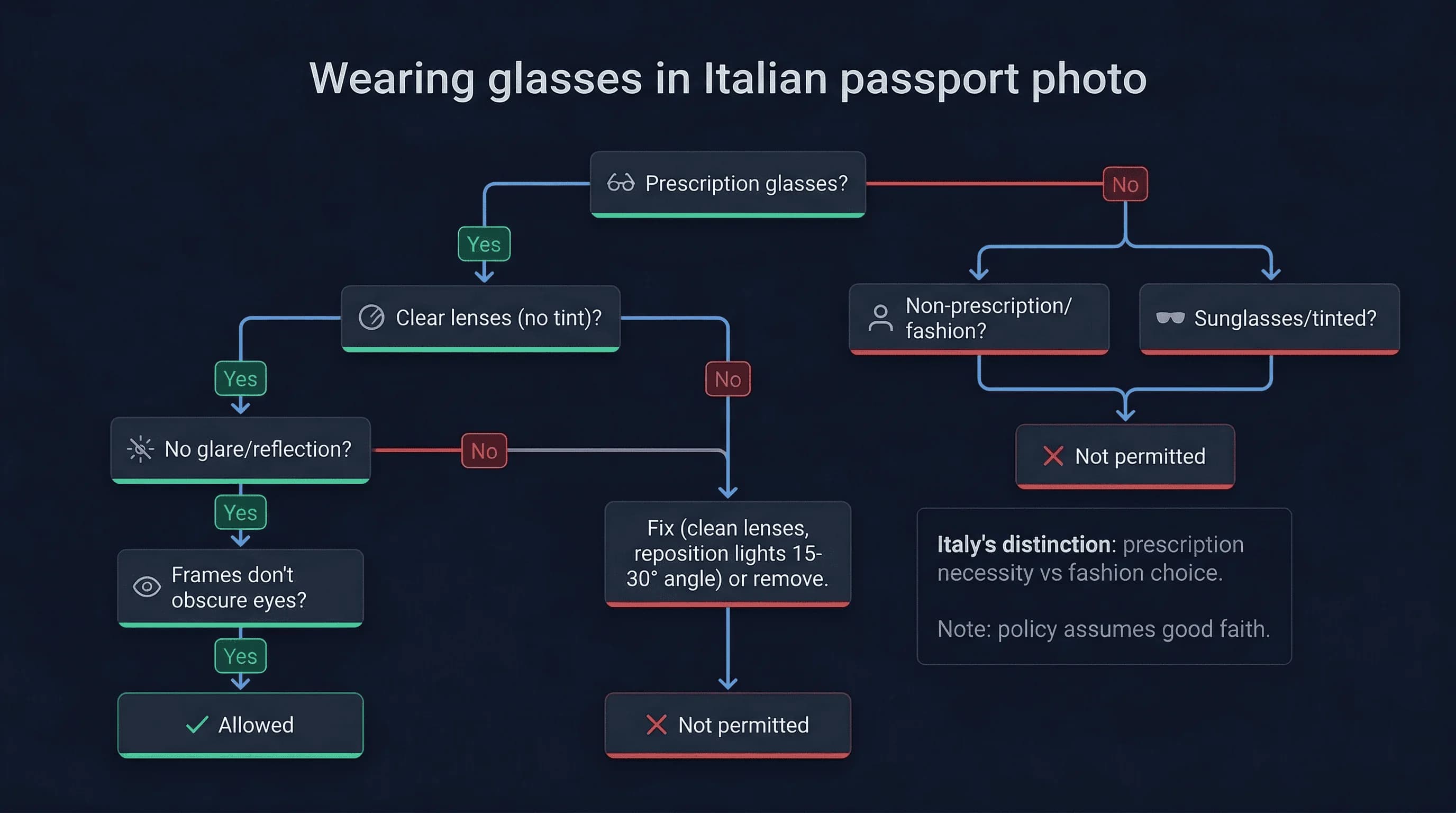
Prescription glasses (occhiali da vista) are conditionally allowed if:
- Lenses are clear — no tint of any kind
- No glare or reflection — both eyes must be fully visible
- Frames do not obscure the eyes — no thick frames covering the eye area or eyebrows
- The glasses are prescription — non-prescription fashion frames are not permitted
What is not allowed:
- Sunglasses (occhiali da sole)
- Tinted lenses
- Photochromic (transition) lenses with any residual tint
- Non-prescription fashion frames
- Frames thick enough to obscure the eyes
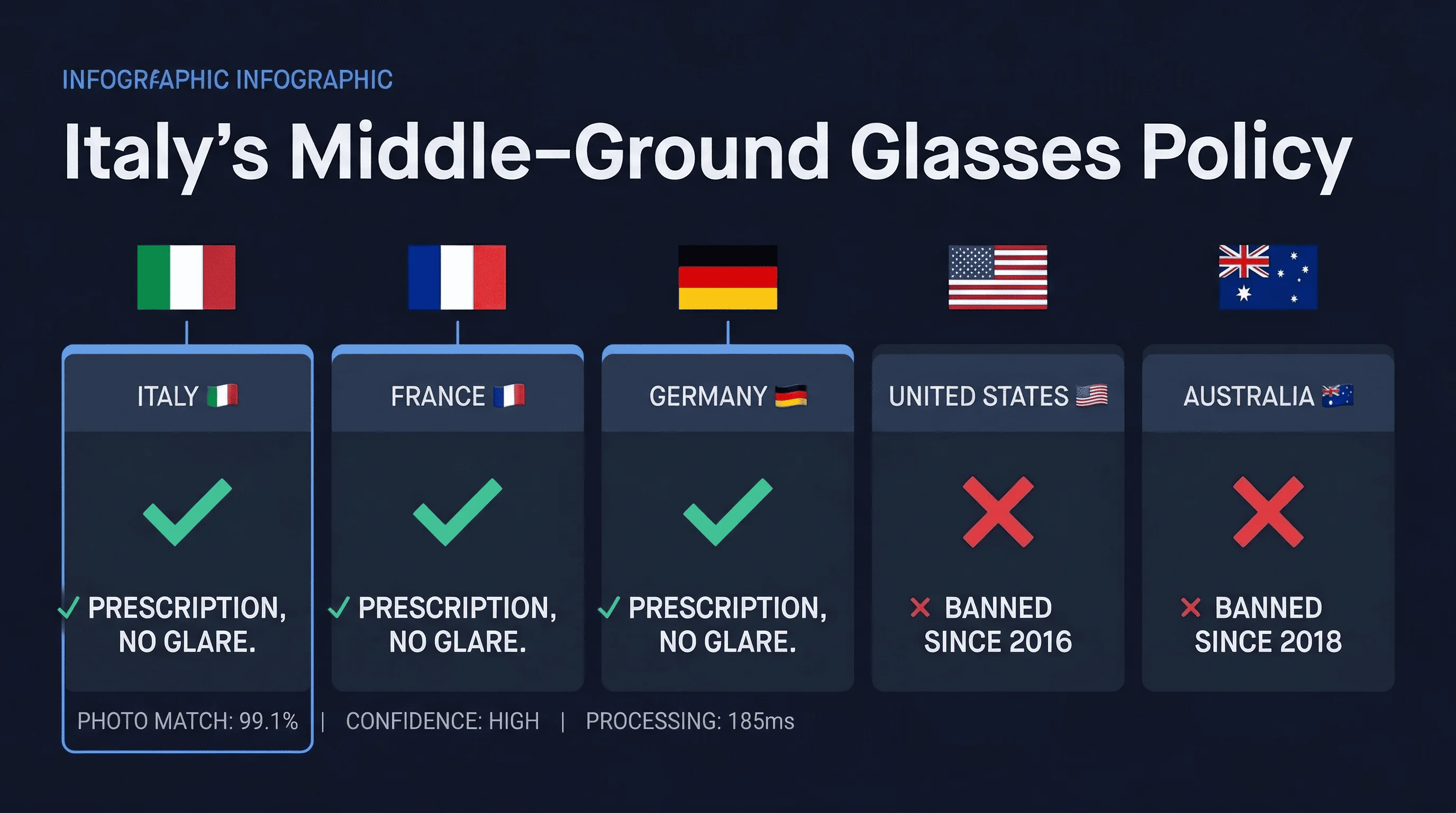
Italy is one of a minority of countries that still allows prescription glasses. Most countries — including the US, France, Japan, China, India, and Australia — now ban all glasses entirely.
Get a compliant passport photo online
How to Avoid Glare in Italian Passport Photos with Glasses
Glare is the most common reason glasses photos get rejected. The lenses must show your eyes clearly with no white spots or light streaks.
Anti-reflective coating (trattamento antiriflesso). If your lenses have AR coating, most glare problems are eliminated. Italian opticians (ottici) can apply AR coating — cost varies from €20–40.
Lighting angle. Ask the photographer to use two diffused lights at 45-degree angles instead of a single direct flash. Direct flash almost always creates glare on glasses.
Head tilt. A very slight downward tilt of the chin redirects reflections away from the camera. The tilt must be minimal.
Clean lenses. Fingerprints and dust create additional reflections. Clean your glasses thoroughly with a microfiber cloth before the session.
Multiple shots. Ask the photographer to take several photos and check each on screen before printing.
When to Remove Glasses for an Italian Passport Photo
Even though Italy allows prescription glasses, removing them is often the safer choice. Consider removing if:
- Your lenses don't have anti-reflective coating
- You're using a photo booth (cabina fotografica) — booths use direct flash
- Your frames are thick enough to obscure your eyebrows
- Your lenses have any tint, including transition lenses that haven't fully cleared
If you remove glasses, wait 5–10 minutes before the photo. This allows the red marks on the bridge of your nose to fade.
Can You Wear Contact Lenses in Italian Passport Photos?
Clear prescription contact lenses (lenti a contatto) are fine. The rule targets glasses frames and tinted lenses.
What might get flagged: Coloured or cosmetic lenses (lenti colorate) that noticeably change your eye colour.
Where to Get Italian Passport Photos with Glasses
Professional studios (studi fotografici). Studios near Questura or Ufficio Passaporti specialise in passport photos (fototessera). Cost: €10–20. Ask for "fototessera per passaporto, con occhiali, senza riflessi" (passport photo, with glasses, no reflections).
Tabaccherie. Many tabaccherie offer fototessera services. Cost: €5–10. Quality varies — ask to check the photo for glare before accepting.
Photo booths (cabine fotografiche). Automated booths at metro stations and shopping centres. Cost: €5–8. These use a fixed flash. If wearing glasses, check the preview carefully.
DIY at home. If taking your own photo:
- White background (Italy requires pure white)
- 35×45mm
- Prescription glasses allowed if glare-free
- Neutral expression, mouth closed (smiling not allowed)
- Both eyes clearly visible through the lenses
CIE Glasses Rules vs Italian Passport Photo Rules
The same glasses rules apply to the carta d'identità elettronica (electronic identity card). Prescription glasses are conditionally allowed with no glare. A single photo works for both passaporto and CIE if it meets all requirements.
Schengen Visa Glasses Rules at Italian Consulates
Italian consulates processing Schengen visa applications also allow prescription glasses under the same conditions.
Glasses Rules: Italy vs Other Countries
| Country | Glasses | Notes |
|---|---|---|
| Italy | ✅ Conditional | Prescription only, no glare |
| United Kingdom | ✅ Conditional | Prescription only, no glare |
| Germany | ✅ Conditional | Prescription only, no glare |
| Canada | ✅ Conditional | Prescription only, no glare |
| South Korea | ✅ Conditional | Prescription only, no glare |
| Poland | ✅ Conditional | Prescription only, no glare |
| United States | ❌ Banned | Since 2016 |
| France | ❌ Banned | |
| China | ❌ Banned | |
| Japan | ❌ Banned | |
| India | ❌ Banned | Since 2020 |
| Australia | ❌ Banned | Since 2018 |
Italy joins the UK, Germany, Canada, South Korea, and Poland in still permitting prescription glasses — a minority position globally.
Common Glasses Mistakes in Italian Passport Photos
Wearing sunglasses or tinted lenses. Only clear prescription lenses are allowed.
Ignoring glare. Most rejections are for reflections, not the glasses themselves.
Using fashion frames. Non-prescription glasses are not allowed.
Wearing transition lenses that haven't fully cleared. Any residual tint disqualifies the photo.
Dirty or scratched lenses. Surface imperfections catch light and create false reflections.
Glasses Rules for Italians Renewing Passports Abroad
If you're renewing your Italian passport from abroad, the same glasses rules apply. Italian consulates in London, New York, Buenos Aires, São Paulo, Melbourne, and Berlin all follow the same standards.
In countries where glasses are banned (US, France, Japan, China), studios may assume glasses are never allowed. Specify: "fototessera per passaporto italiano, con occhiali, senza riflessi, sfondo bianco, 35×45mm" or in English: "Italian passport photo, glasses allowed, no glare, white background, 35×45mm."
Children's Italian Passport Photos and Glasses Rules
The same conditional glasses rule applies to children's passport photos. If your child wears prescription glasses and the lenses are clear with no glare, the photo is acceptable. Italian passports for children under 3 are valid for 3 years; ages 3–18 for 5 years; adults for 10 years.
Can You Wear Glasses at the Questura Passport Office?
The glasses conditions apply only to your passport photo. You can wear any glasses:
- At the Questura or Ufficio Passaporti during your appointment
- During in-person identity verification
- In your supporting documents (carta d'identità, patente di guida, etc.)
Italian Passport Photo Renewal and Glasses Changes
If your current passport photo shows you without glasses and you now wear them, or vice versa, this is not a problem. Italy's biometric system accounts for changes in appearance. However, your new photo must still comply with current rules: if wearing glasses, they must be clear prescription lenses with no glare.
Best Frame Styles for Italian Passport Photos
If you plan to wear glasses in your passport photo, certain frame styles work better:
- Thin metal frames — minimal obstruction, less shadow, fewer reflection issues
- Rimless or semi-rimless — least obstruction of all frame types
- Clear or light-coloured frames — less contrast against the white background
Frames to avoid:
- Thick acetate frames — can obscure eyebrows and cast shadows
- Large oversized frames — may cover too much of the facial area
- Dark frames — create strong contrast that can confuse biometric systems
If your regular glasses have thick frames, consider borrowing a thinner pair for the photo session, or removing glasses entirely.
Transition Lenses in Italian Passport Photos: Why They Fail
Photochromic lenses that darken in sunlight are risky for passport photos. Even indoors, these lenses can retain a subtle tint. If your lenses haven't fully cleared to transparent, the photo will be rejected. Wait until the lenses are completely clear, or better yet, use a separate pair with fixed clear lenses.
Do Not Digitally Edit Glasses in Italian Passport Photos
Do not digitally add or remove glasses from a photo. Manipulated photos can delay your application.
Verify your photo meets all Italian passport requirements with the passportsize-photo.online checker. For size requirements, see Italian passport photo size guide. View all Italian passport photo rules on the Italy hub.