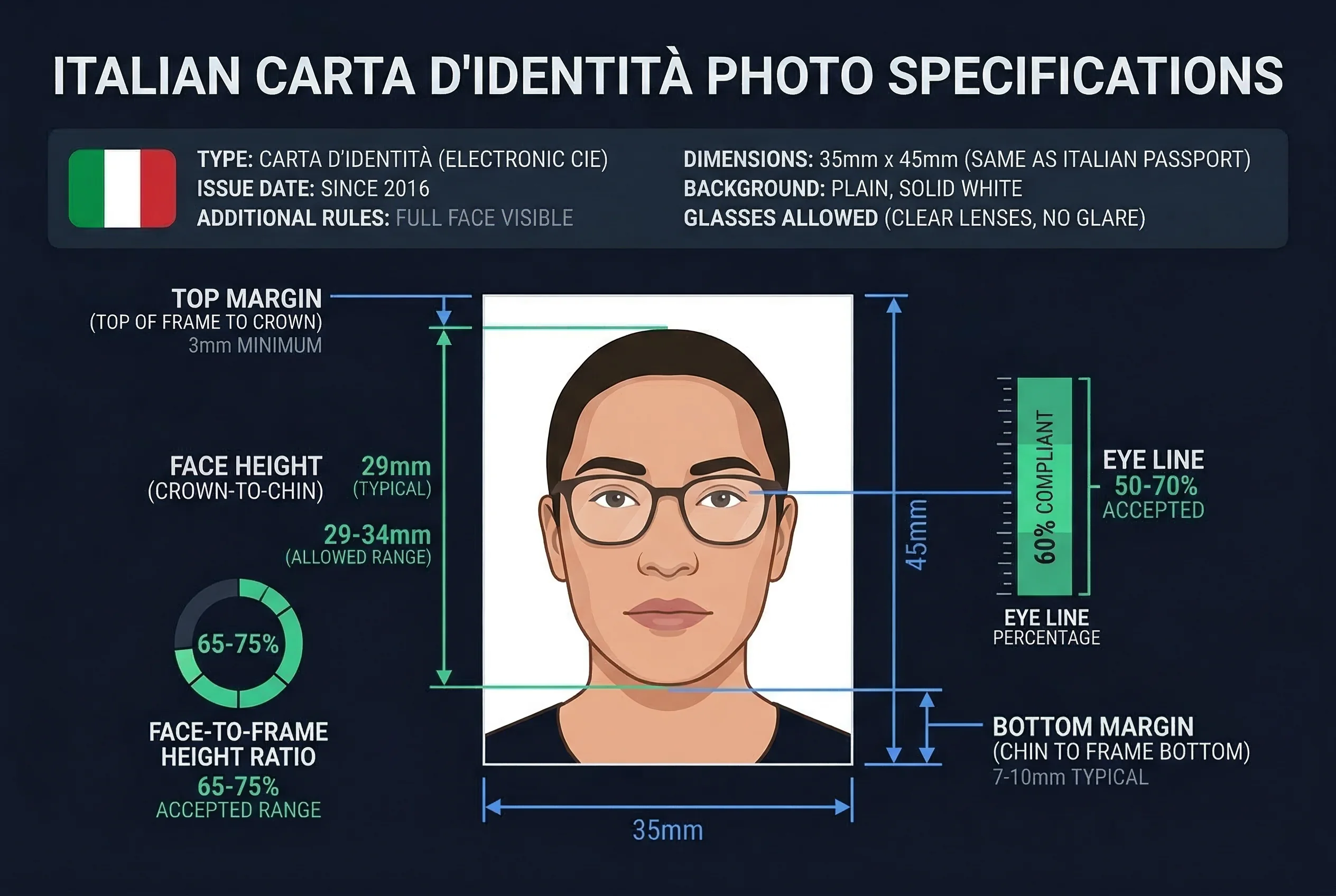
The Carta d'Identità photo must be 35×45mm with a plain white background. Glasses are permitted. Expression should be neutral with mouth closed. These are the same requirements as the Italian passport — the two documents use identical photo specifications.
Italy Carta d'Identità Photo Specifications (35×45mm)
| Requirement | Specification |
|---|---|
| Size | 35×45mm (413×531 pixels at 300 dpi) |
| Background | Plain white |
| Head position | Centred, looking directly at camera |
| Expression | Neutral, mouth closed |
| Glasses | Permitted (no tinted lenses, no heavy reflections) |
| Head coverings | Only for religious or medical reasons |
| Photo age | Recent — taken within 6 months |
The Comune (municipality) enforces these specs at the Anagrafe (registry office). Print quality matters. Blurry, creased, or low-contrast prints are rejected before the application is processed.
Get a compliant passport photo online
The CIE: Italy's Electronic Identity Card
Since 2016, Italy has issued only the Carta d'Identità Elettronica — the CIE. It's a polycarbonate card with an embedded NFC chip storing biometric data, including a digital copy of your facial image. The physical photo you submit at the Anagrafe is digitised, stored on the chip, and printed on the card surface.
The old paper Carta d'Identità is no longer issued for standard applications. If you hold one, it remains valid until its expiry date. All new applications and renewals produce the CIE.
The CIE functions as a standalone travel document for Italian citizens across EU and Schengen countries. A passport isn't needed for most European travel if you carry the CIE.
Same Photo as the Italian Passport
Italian passport photos and CIE photos share identical specifications: 35×45mm, white background, glasses permitted, neutral expression. A compliant passport photo from the past six months will work for a CIE application without modification.
This matters when renewing both documents around the same time. One photo session at a fototessera studio produces enough prints for both. Most photographers print four to six copies per session — confirm before booking if you need enough for two documents.
Where to Get a Compliant CIE Photo in Italy
Fototessera studios. Professional photographers throughout Italy produce compliant CIE photos. Ask for foto per la Carta d'Identità or foto biometrica — either will be understood. Cost is typically €8–15 for a set of prints.
Fotoautomat (photo booths). Found in train stations, shopping centres, and post offices. Italian booths output the 35×45mm format as standard. Look for machines labelled foto formato tessera or foto biometrica. Cost is €5–8.
Digital upload option. Several large municipalities — including Rome — now accept digital photos submitted through the CIEOnline portal before your appointment. File requirements: white background, 35×45mm proportions, JPEG at sufficient resolution. This option isn't universal. Confirm with your specific Comune before booking.
Applying for a CIE at the Anagrafe: What to Bring
Book a prenotazione (appointment). Most Comuni require appointments for CIE applications. Book through your municipality's website or through the national Agenda CIE portal at agendacie.interno.gov.it. Availability varies significantly — Rome and Milan have longer waits than smaller towns.
Bring to your appointment
- Current Carta d'Identità or CIE (or passport for first-time applicants)
- One recent 35×45mm compliant photo (if not using digital upload)
- Codice fiscale (Italian tax code)
- Payment of €22.21 (by card at the office, or via bank transfer beforehand in some Comuni)
What happens at the Anagrafe. An officer reviews your documents and photo, scans your fingerprints, and in some offices captures your digital image directly. The physical CIE card is not issued at the counter. It's mailed to your address by the Istituto Poligrafico e Zecca dello Stato (IPZS) within 6–10 working days.
CIE Fees and Validity by Age Group
The CIE costs €22.21. There is no express service for standard applications.
| Age Group | Validity |
|---|---|
| Adults (18+) | 10 years |
| Children (3–17) | 5 years |
| Infants (under 3) | 3 years |
Shorter validity for younger applicants reflects the faster rate of physical change — a 2-year-old's face looks quite different at age 7. The renewal cycle is set accordingly.
Common Carta d'Identità Photo Rejection Reasons
Wrong background colour. Some applicants bring photos with off-white, cream, or lightly tinted backgrounds. The Anagrafe needs pure white. If the booth you used runs warm, get the photo retaken.
Glasses with reflections. Glasses are permitted, but glare on the lenses can trigger a rejection both at the Anagrafe counter and in the IPZS automated processing check. Reposition or remove glasses if reflections appear.
Photo too old. Six months is the cutoff. Don't use leftover prints from a passport session last year — the Anagrafe will check.
Poor print quality. The CIE chip stores a high-resolution facial scan. The IPZS processing system requires clear, sharp prints. Faded or creased photos fail. Use photographic paper, not inkjet.
Wrong dimensions. Photos from Spanish documents are 26×32mm. Photos from some other European countries may be a slightly different variant of the 35×45mm format. Confirm Italy-standard dimensions specifically.
For a compliant CIE photo before your Anagrafe appointment, passportsize-photo.online checks your image against Italy's 35×45mm standard — background white-point, face proportion, and print quality — before you commit to printing.
Expression and Appearance Rules for Italian CIE Photos
The CIE applies the same biometric standard as the Italian passport:
- Neutral expression — mouth closed, no smile, no frown
- Eyes open — both eyes fully visible, looking directly at the camera
- Glasses permitted — prescription frames are allowed, but no tinted lenses and no reflections on the glass. If reflections are unavoidable, remove the glasses for the photo
- Hair away from face — forehead and both ears should be visible
- Head coverings — only for religious or medical reasons; face from chin to forehead must remain visible
- No heavy makeup — the photo should represent your everyday appearance
- Face centred — head straight, not tilted
Italy's glasses policy is more lenient than most countries. Germany, France, the Netherlands, and the UK have all banned glasses in identity photos. Italy still permits them for both the passport and the CIE.
Italian Documents Compared: CIE vs Passport vs Patente
| Document | Size | Background | Glasses | Smile |
|---|---|---|---|---|
| Carta d'Identità (CIE) | 35×45mm | White | Permitted | Not allowed |
| Italian Passport | 35×45mm | White | Permitted | Not allowed |
| Patente di Guida | 35×45mm | White | Permitted | Not allowed |
| Italian Visa | 35×45mm | White | Not permitted | Not allowed |
The CIE, passport, and patente (driving licence) share identical specifications — one photo session covers all three. The Italian visa is the exception: glasses are not permitted for visa photos, even though they are allowed for domestic Italian documents.
CIE for Italians Abroad: Consular Application Process
Italian citizens registered with AIRE (Anagrafe degli Italiani Residenti all'Estero) can apply for a CIE at their local Italian Consulate. The photo requirements are the same as at a domestic Anagrafe: 35×45mm, white background, glasses permitted.
Processing at consulates typically takes longer than domestic applications — allow 2–4 weeks for delivery. Book a consular appointment early, as availability at popular consulates (London, New York, Buenos Aires) can be limited.
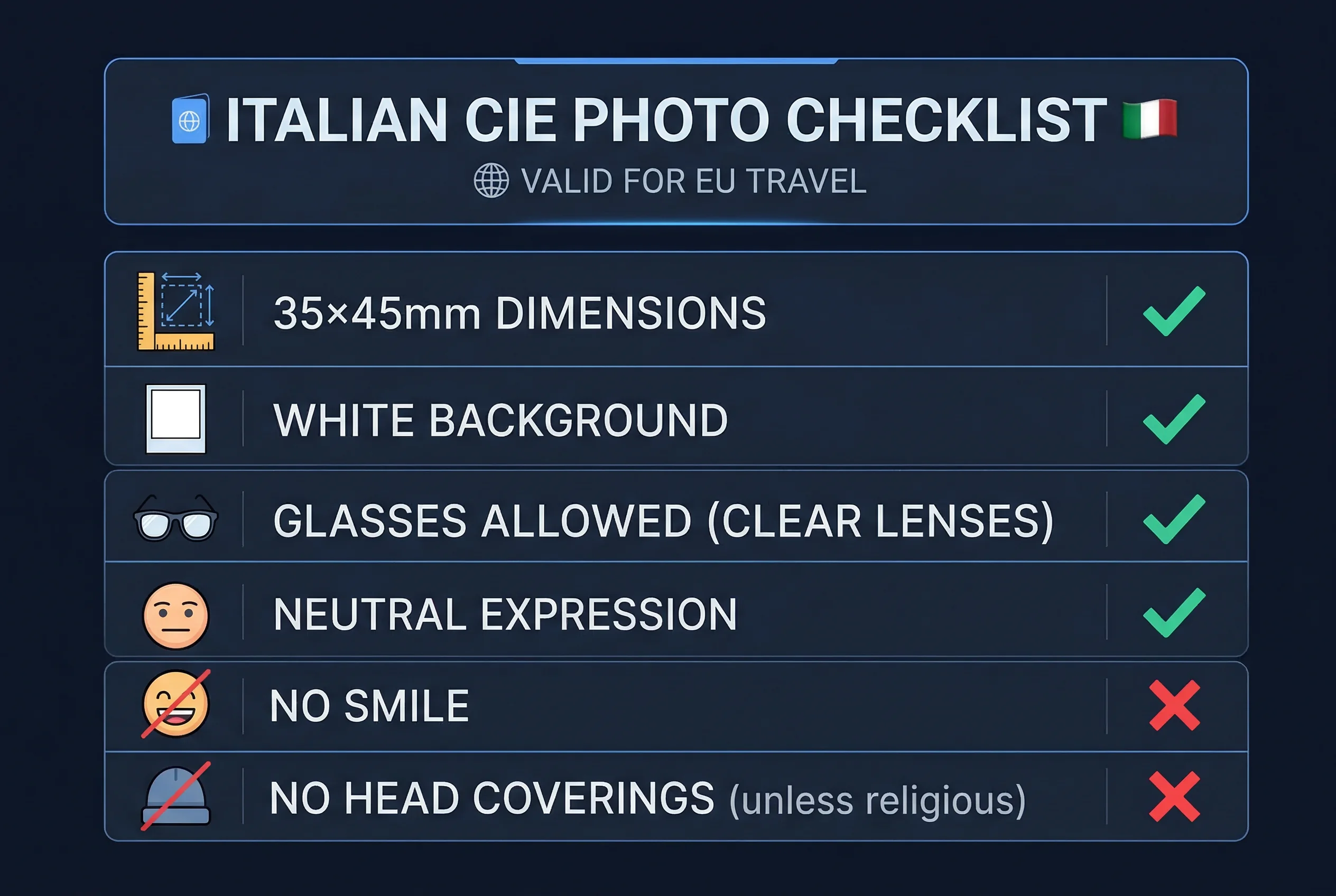
Quick Checklist for Italy Carta d'Identità Photos
- Size: 35×45mm (413×531px at 300 DPI)
- Background: white
- Expression: neutral, mouth closed
- Glasses: permitted (no tinted lenses, no reflections)
- Photo taken within 6 months
- Prenotazione (appointment) booked
- Codice fiscale ready
- Fee: €22.21
For a compliant CIE photo before your Anagrafe appointment, passportsize-photo.online checks your image against Italy's 35×45mm standard — background white-point, face proportion, and print quality — before you commit to printing. See the full Italy guide for all Italian document photo requirements.