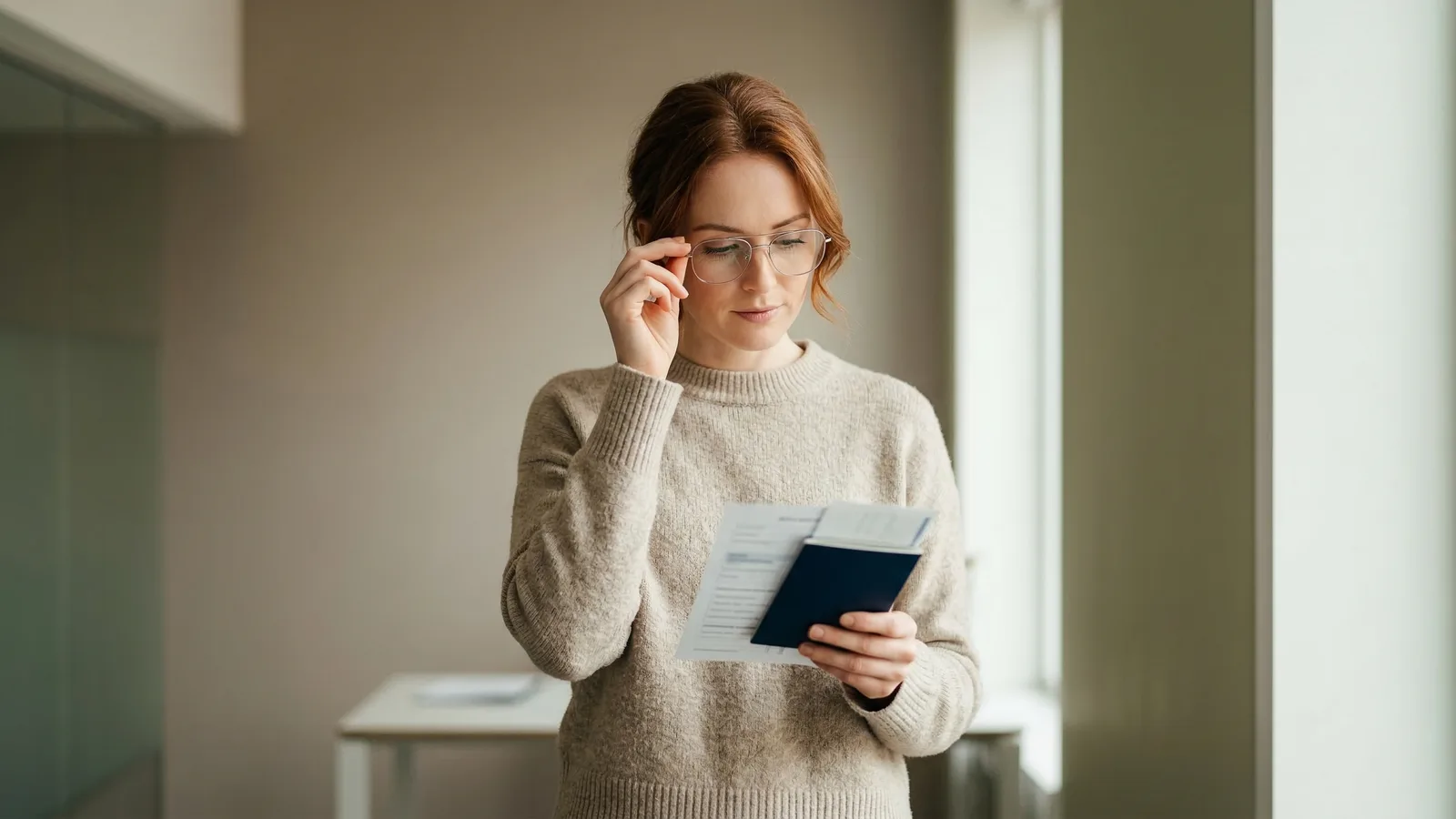
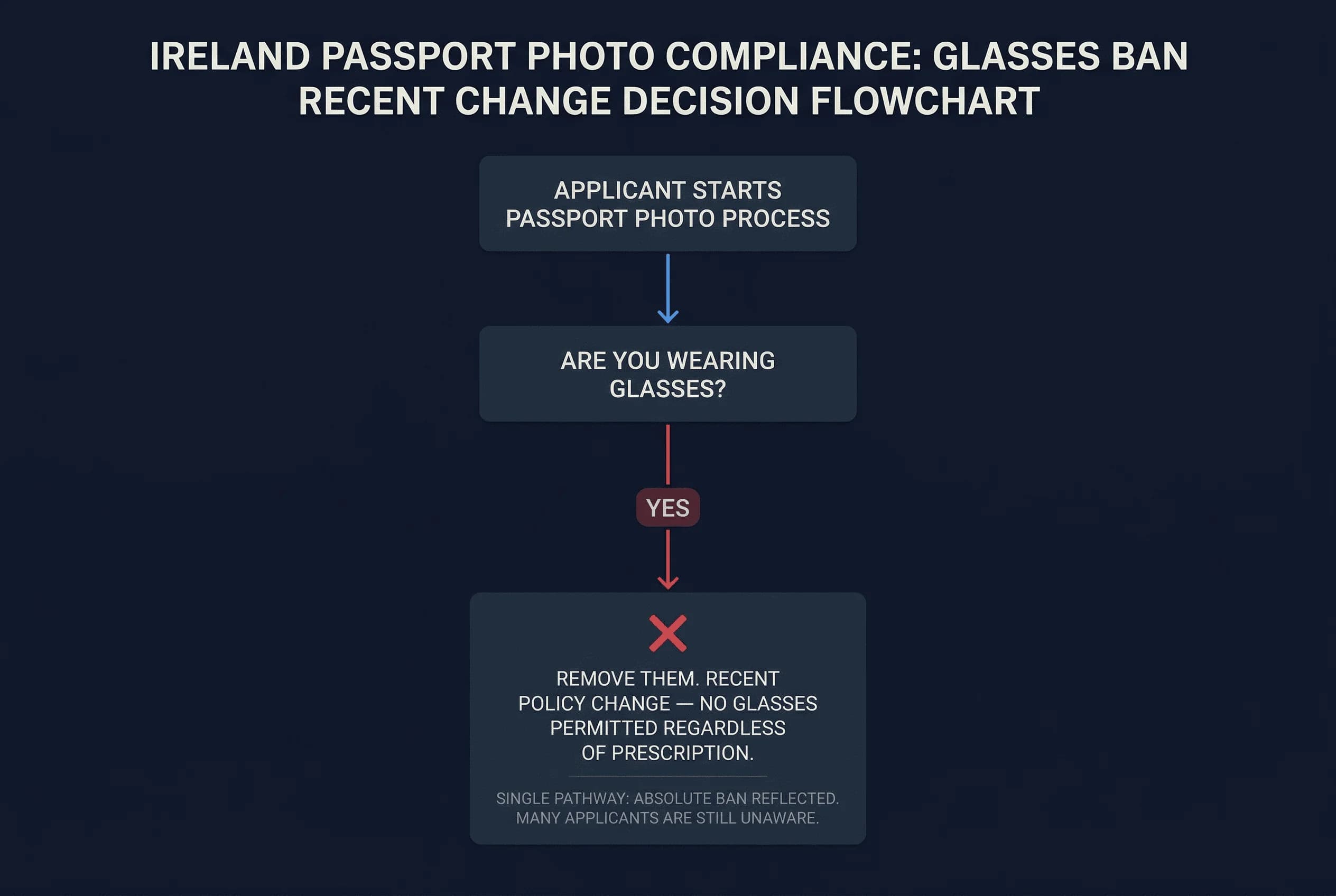
If you're applying for an Irish passport, you cannot wear glasses in your passport photo. This is a recent change from previous policy, and many applicants are still unaware of it. The Irish Passport Office now requires all applicants to remove their glasses for passport photographs, regardless of whether they have a prescription.
This represents a significant shift from the previous policy that allowed prescription glasses. Understanding this change — and how to ensure your photo is accepted — is essential for a smooth application process.
Current Irish Passport Photo Glasses Policy Explained
The Irish Passport Service now states explicitly:
- No glasses of any kind permitted. This includes prescription glasses, sunglasses, tinted lenses, and fashion frames.
- Both eyes must be clearly visible. Frames or lenses must not obstruct any part of the eyes.
- No reflection on lenses. Even if prescription glasses were technically permitted, reflections would cause rejection.
- Recent change. This policy was updated in recent years to align with ICAO standards for automated facial recognition.
The change was implemented to improve the accuracy of facial recognition systems used at Irish borders and to ensure consistency with other EU member states that have similar restrictions.
Get a compliant passport photo online
Why Did Ireland Ban Glasses in Passport Photos?
The primary reasons for the glasses restriction are:
Facial recognition accuracy. Glasses — even prescription glasses — can interfere with facial recognition algorithms. The system needs to map the eyes and surrounding area precisely. Frames covering part of the face or lens reflections can reduce matching accuracy.
Standardization across the EU. Many EU countries restrict or prohibit glasses in passport photos. Ireland's alignment with these standards simplifies border control procedures across the union.
Eliminating rejection variability. Previously, some glasses-wearers had photos accepted while others were rejected based on frame style, reflection levels, or subjective reviewer interpretation. A blanket ban eliminates this inconsistency.
What If You Can't See Without Glasses for Irish Photos?
This is a common concern, and the Passport Office has addressed it. The requirement is clear: glasses must be removed for the passport photo, regardless of visual impairment. The photo will still be acceptable as long as:
- Your eyes are open and visible
- Your face is clearly recognizable
- The photo otherwise meets all requirements
The system is designed to identify you based on facial features other than your eyes. Most people are recognizable without their glasses, and the Passport Office has confirmed this approach works.
Prescription Glasses vs Sunglasses in Irish Passport Photos
Both prescription glasses and sunglasses are prohibited in Irish passport photos. There's no exception for:
- Prescription eyeglasses worn daily
- Prescription sunglasses
- Photochromatic lenses (that darken in sunlight)
- Any tinted or colored lenses
If you wear glasses for vision correction, plan to remove them specifically for your passport photo. Keep a pair of contact lenses handy for the photo session if possible.
Tips for Taking Irish Passport Photos Without Glasses
If you normally wear glasses, these tips help ensure your passport photo is still accepted:
Blink naturally. Without the weight of frames on your nose, you may blink more. Take several photos and choose one where your eyes are open and natural-looking.
Look directly at the camera. Without glasses, you may have trouble seeing the camera clearly. This is fine — look toward the lens anyway and trust that your photo will work.
Clean your eyes. If your eyes are dry or irritated from wearing contacts or from screen time, use lubricating eye drops before your photo session. Red or irritated eyes can sometimes cause concerns.
Practice in advance. Look at photos of yourself without glasses before the actual photo. You'll want to ensure you're easily recognizable.
Are Sunglasses or Tinted Lenses Allowed in Irish Photos?
Sunglasses and any tinted lenses are absolutely not permitted. This has always been the case and hasn't changed. Even non-prescription fashion glasses with dark or colored lenses will cause immediate rejection.
If you're concerned about brightness or squinting without your regular glasses, the solution is simple: open your eyes naturally. The photo should be taken in even, soft lighting that doesn't cause anyone to squint.
Irish Baby and Children's Passport Photo Glasses Rules
Children wearing glasses must also have their glasses removed for passport photos. This can be challenging for parents of children who are accustomed to wearing glasses.
Tips for photographing children without glasses
- Explain the situation in advance if the child is old enough to understand
- Have the photo taken shortly after the child wakes up when they're most cooperative
- Use a favorite toy or song to get their attention
- Take multiple photos — children blink and move frequently
- Consider a professional photographer experienced with children's passport photos
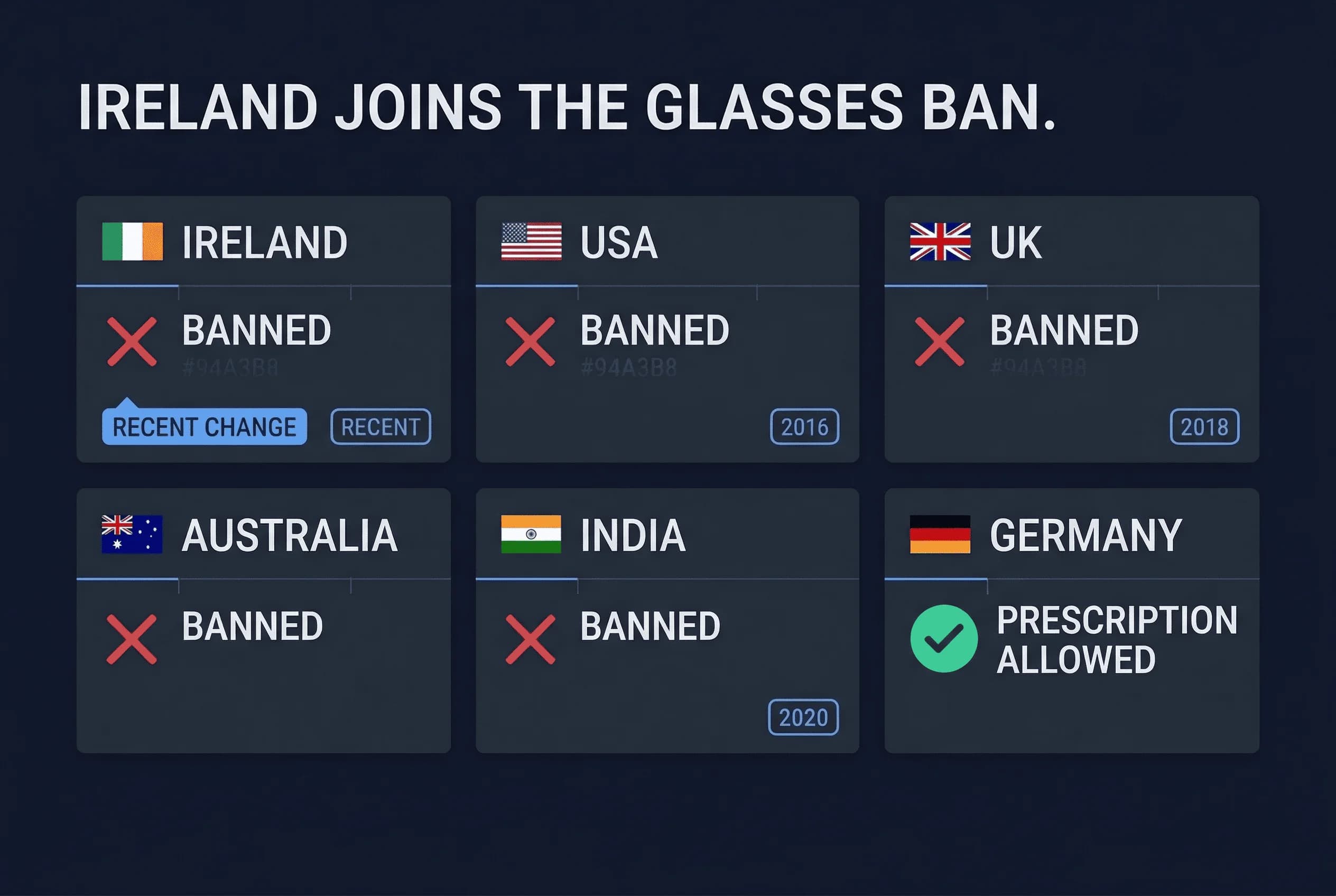
Glasses Rules: Ireland vs Other Countries
| Country | Glasses | Notes |
|---|---|---|
| Ireland | ❌ Banned | |
| United States | ❌ Banned | Since 2016 |
| France | ❌ Banned | |
| Australia | ❌ Banned | Since 2018 |
| Japan | ❌ Banned | |
| India | ❌ Banned | Since 2020 |
| Netherlands | ❌ Banned | |
| United Kingdom | ✅ Conditional | Prescription only, no glare |
| Germany | ✅ Conditional | Prescription only, no glare |
| Canada | ✅ Conditional | Prescription only, no glare |
| South Korea | ✅ Conditional | Prescription only, no glare |
Ireland follows the global majority. If you hold dual citizenship (Irish-British, Irish-American), check each country's rules separately.
What If Your Irish Passport Photo Is Rejected for Glasses?
If you submit a photo with glasses, it will be rejected. The rejection notification will typically indicate "glasses not permitted" or "eyes obscured by eyewear."
When this happens, you'll need to:
- Remove the glasses
- Take a new photo without glasses
- Upload it through your passport application portal
The Irish system allows you to replace the photo without restarting your application. However, this adds time to your processing, so it's best to get it right the first time.
Quick Checklist for Irish Passport Photo Glasses Rules
Before submitting your Irish passport photo, verify:
- No glasses worn in the photo
- No sunglasses, tinted lenses, or fashion frames
- Both eyes are clearly visible and open
- No reflections or glare on lenses (because there are no lenses)
- Face is centered and facing forward
- Background is white or light grey
- Photo meets 35×45mm size requirements
- Expression is neutral
Where to Get Irish Passport Photos Without Glasses
An Post (Post Office). Many An Post offices offer passport photo services. Available throughout Ireland. Cost: €8–12.
Boots Ireland. Photo booths in many Boots stores. Cost: €6–10.
Professional photography studios. Studios in Dublin, Cork, Galway, Limerick, and other cities. Cost: €10–20.
Photo booths. Automated booths in shopping centres. Cost: €5–8. Remove glasses before entering.
Passport Express and Irish Glasses Photo Checks
Ireland's Passport Express service is available at selected An Post offices. Your photo is checked during submission. If staff notice glasses, they'll ask for a retake before accepting. This is a helpful quality check.
Glasses Rules for Irish Citizens Renewing Passports Abroad
If you're renewing your Irish passport from abroad, the same no-glasses rule applies. Irish embassies and consulates in London, Washington DC, Canberra, and Ottawa all enforce the ban.
Irish-British Dual Citizens and Glasses Photo Rules
Many Irish citizens also hold British citizenship. Both countries have different glasses rules:
- Ireland: glasses banned
- United Kingdom: glasses allowed (prescription only, no glare)
A glasses-free photo works for both passports. But if you prefer wearing glasses, it'll only work for the British passport.
Do Not Digitally Remove Glasses from Irish Passport Photos
Do not digitally remove glasses from a photo. Always take the photo without glasses from the start.
Verify your photo meets all Irish passport requirements with the passportsize-photo.online checker. For size requirements, see Irish passport photo size guide. View all Irish passport photo rules on the Ireland hub.