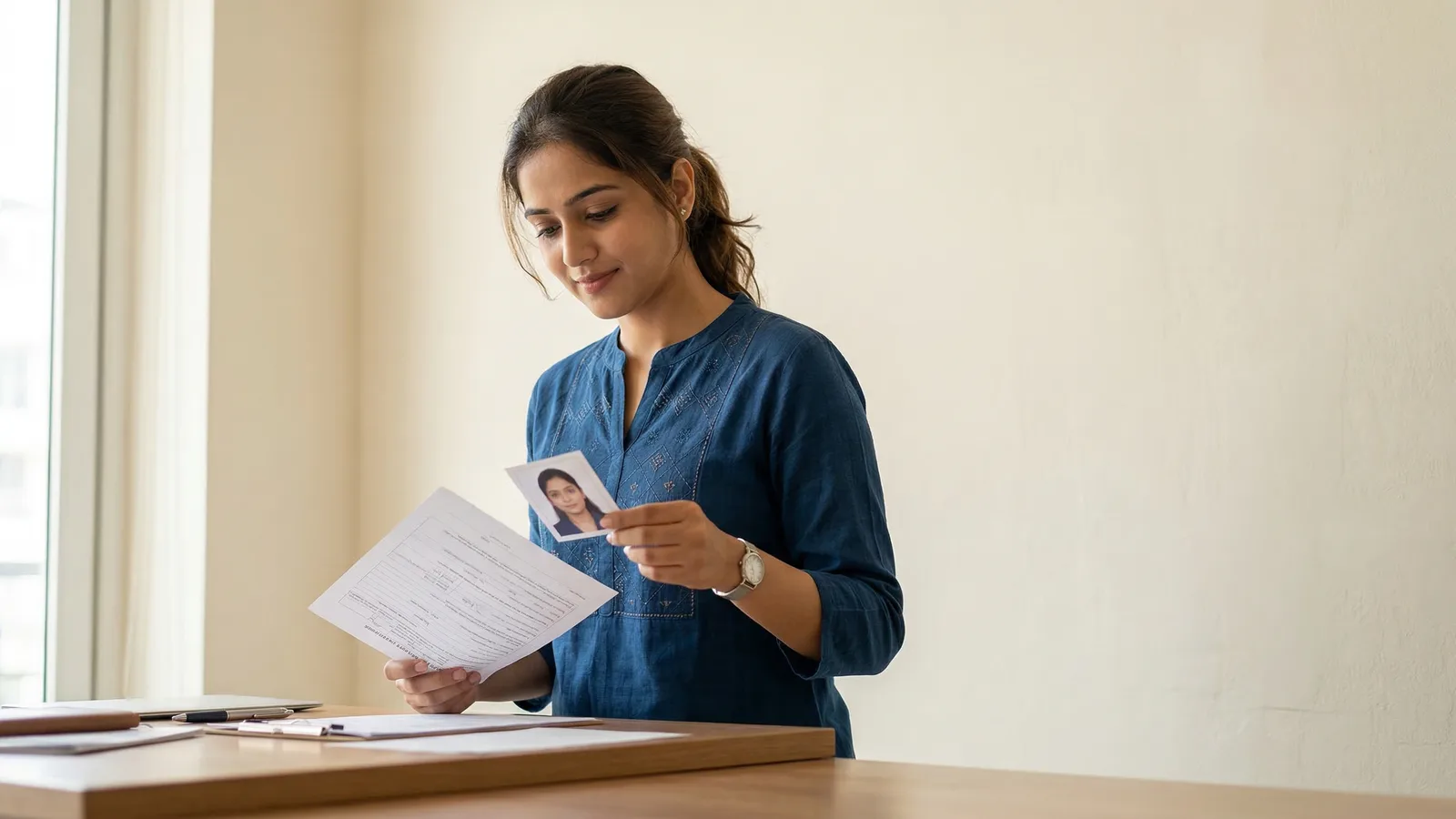
India passport photos require a plain white background (#FFFFFF). The Ministry of External Affairs specifies pure white — not cream, not light grey, not off-white. This aligns India with ICAO standards and with most countries worldwide. The Passport Seva automated screening system rejects non-white backgrounds.
Exact Background Rules for Indian Passport Photos
The background must be:
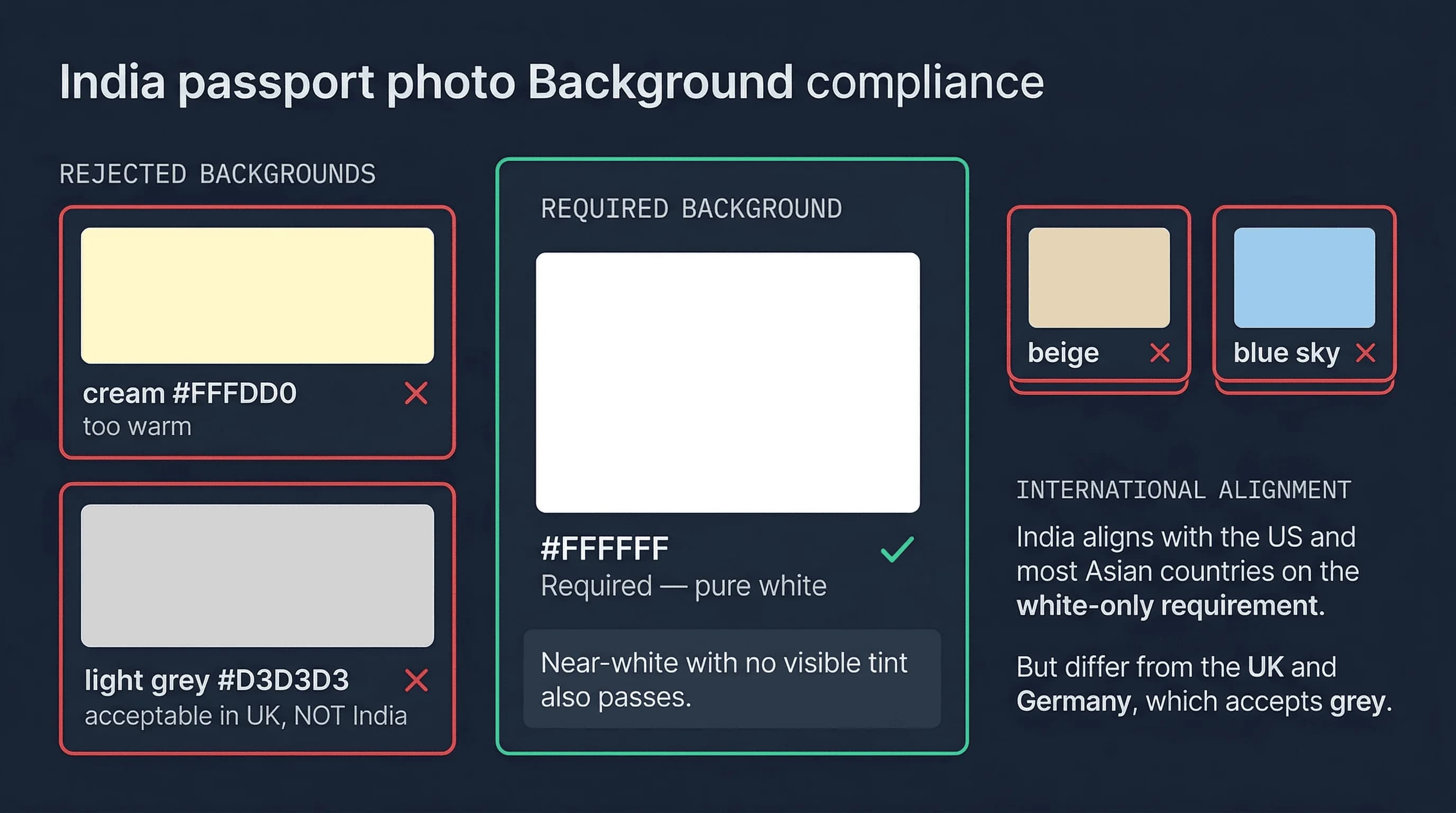
- White (#FFFFFF) — pure white, not off-white, cream, ivory, or grey
- Uniform — the same shade from edge to edge
- Smooth — no visible texture, grain, or pattern
- Shadow-free — no shadows from your head, body, or hair
This requirement applies to both printed photos (submitted at Passport Seva Kendras and Regional Passport Offices) and digital uploads through the Passport Seva portal.
Get a compliant passport photo online
What Background Colors Fail for Indian Passport Photos?
Off-white and cream. Walls that appear white to your eye often photograph as cream or pale yellow under warm indoor lighting. This is the single most common background rejection in India.
Shadows. Standing too close to the wall casts a body shadow behind you. Your head shadow is especially problematic — it creates a dark halo the automated system flags immediately.
Gradients. A single overhead light (tube light or ceiling fan light) makes the background brighter at the top and darker at the bottom. The system expects uniform white everywhere.
Textured walls. Rough plaster, peeling paint, or patterned surfaces create visible texture. Smooth surfaces only.
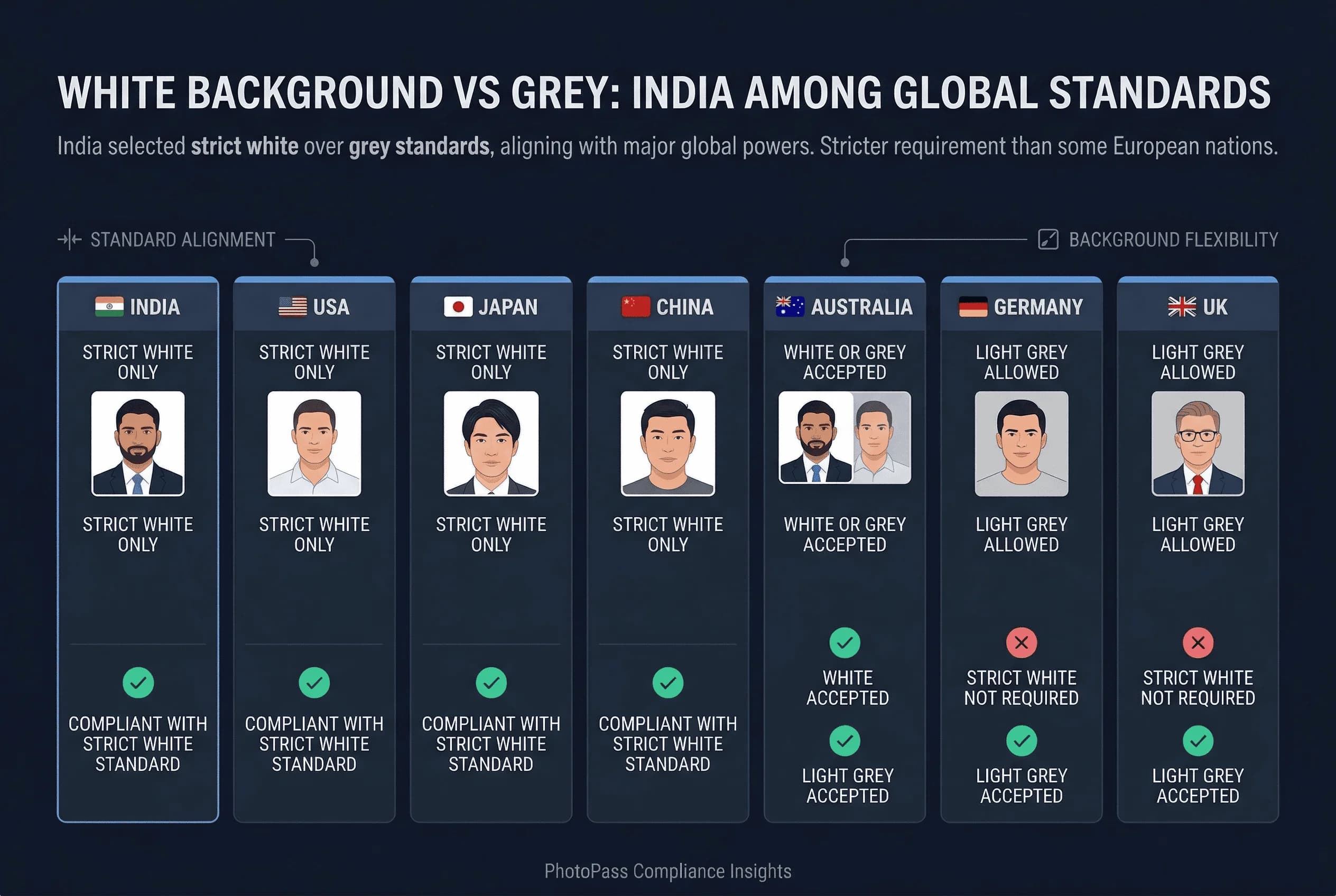
Light grey. What passes in Germany or the UK (light grey at 230,230,230) fails in India. India requires white, not grey.
Outdoor backgrounds. Photos taken outdoors with sky, trees, or buildings visible are immediately rejected. Even a plain outdoor wall may have shadows and colour variation.
Coloured tints. Pale blue, pale green, pale yellow, and other "nearly white" shades fail.
Indian Passport Photo Background vs Other Countries
| Country | Background | Notes |
|---|---|---|
| India | White | Plain white required |
| United States | White | Same as India |
| Japan | White | Same as India |
| China | White | Same as India |
| France | White | Same as India |
| Australia | White | Same as India |
| Canada | White | Same as India |
| Germany | Light grey | Different — will fail in India |
| United Kingdom | Light grey | Different — will fail in India |
India shares its white background requirement with most countries worldwide. A white-background photo taken for the US, Japan, France, or Australia will have the correct background for India — though you must verify size separately, since India uses a unique 35×35mm square format while most of these countries use 35×45mm rectangular. Photos taken for Germany or the UK (light grey backgrounds) will not pass Indian requirements. NRIs (Non-Resident Indians) applying in London, Berlin, or other European cities should be particularly careful about this distinction.
How to Create a White Background at Home for Indian Photos
The White Wall Method for Indian Passport Photos
- Find a smooth white wall. Interior walls with fresh white distemper or emulsion paint work best. Avoid walls with cracks, stains, or peeling paint.
- Stand 40–60cm away from the wall. This gap eliminates your body shadow.
- Use two light sources at 45 degrees. Place one lamp on each side. This cross-lighting cancels shadows on both sides. Table lamps, tube lights, or even phone flashlights held by a helper can work.
- Use daylight bulbs (5000K+). Standard warm yellow bulbs cast yellow tones that make white walls appear cream. Use "cool daylight" CFL or LED bulbs.
- Check the result carefully. Open the photo on a computer or laptop screen and zoom into the background. It should look uniformly white with no grey patches or cream tones.
The Chart Paper Method for Indian Passport Photos
White chart paper or poster board from any stationery shop (₹10–30 per sheet) works well. Use multiple sheets taped together for coverage. Position them behind you and light evenly. This is the cheapest reliable option.
The Bedsheet Method for Indian Passport Photos
A clean white bedsheet stretched taut against a wall can work. However, fabric wrinkles create shadows and texture. Iron the sheet completely flat and clamp it tight to minimise folds. Not the best option, but workable in a pinch.
Where to Get Indian Passport Photos with White Background
Passport Seva Kendra (PSK) on-site studios. Most PSKs have photo services inside or immediately outside the building. They know the exact requirements. Tell the operator: "35×35mm, white background, Indian passport." Verify on their screen before accepting.
Professional studios near PSKs. Studios in the street around Passport Seva Kendras and Regional Passport Offices handle the highest volume and know what passes. Prices: ₹50–200 for a set of prints plus digital file.
Neighbourhood photo studios. Found in every market area. Quality varies. Specify white background and Indian passport format. Check the result before leaving.
Photo kiosks in malls. Self-service booths in shopping centres produce passport photos. Backgrounds are usually compliant. Prices: ₹30–100. Check the preview carefully.
Indians abroad. Indian embassies and consulates accept photos taken locally. In cities with large Indian communities — London Southall, New York Jackson Heights, Toronto Brampton, Singapore Little India, Dubai Karama — studios near the consulate know the 35×35mm format. Specify "white background, Indian passport" and verify.
The Shadow Problem in Indian Passport Photo Backgrounds
Shadows are the most common background issue in DIY photos. When you stand against a wall, your body casts a shadow directly on the background.
The fix: distance. Stand 40–60cm from the wall. The gap gives the shadow space to fall below the frame or diffuse.
Phone flash makes it worse. The built-in flash casts a sharp shadow directly behind your head. Disable the flash and use room lighting or natural light.
Natural light trick. Stand facing a large window during the day. Position the white background behind you. Overcast daylight produces soft, even illumination naturally — better than most artificial lighting setups.
Common Indian Passport Photo Background Mistakes
Yellow lighting. Most Indian homes use warm-tone bulbs that make white walls look cream. Switch to "cool daylight" CFL or LED bulbs, or shoot near a window during the day.
Using a bedsheet without ironing. Wrinkles create shadows and texture. Iron completely flat.
Outdoor photos. Even a plain white outdoor wall has shadows and colour variation from sunlight. Shoot indoors.
Digital background replacement. Some applicants try to digitally replace backgrounds. The Passport Seva system can detect artefacts from background editing. Minor brightness adjustments are fine; full replacement is risky.
Wrong size assumption. India uses 35×35mm (square), not the 35×45mm used by most other countries. A background that's compliant is only useful if the photo is also correctly sized.
Verifying Your Indian Passport Photo Background
Before submitting, check:
- Background is white across the entire frame (no cream, no grey, no tint)
- No visible shadows anywhere behind you
- No texture, pattern, or seam visible
- Background extends beyond all edges of the photo
- Lighting is even from top to bottom, left to right
Use our passport photo checker to validate your background before submitting. For Indian passport photo size requirements, see the India passport photo size guide. View the complete requirements on the India hub page.