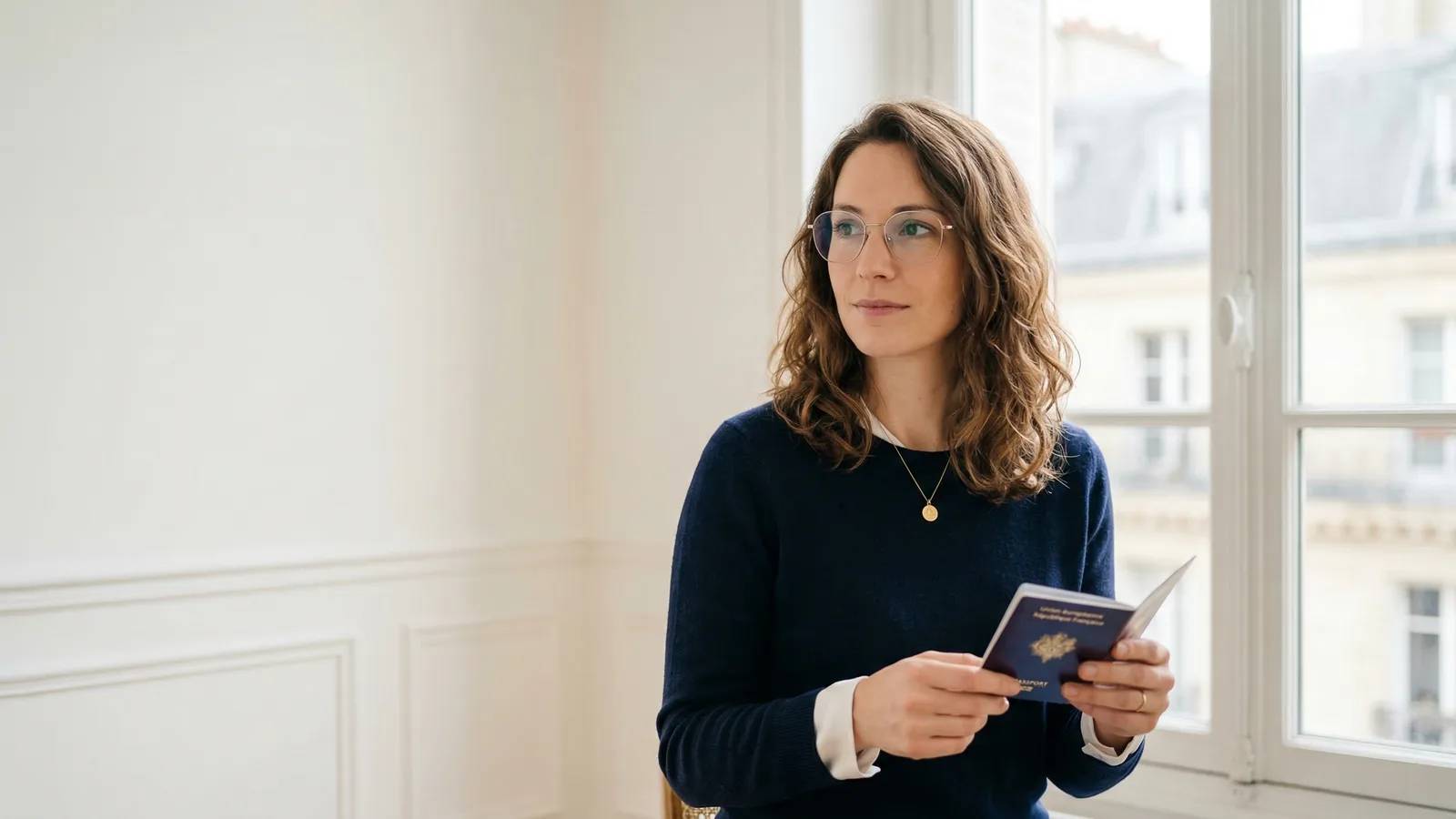
No — glasses of any kind are not permitted in France passport photos. Remove all eyewear before taking your photo. This applies to passports, carte nationale d'identité (CNI), and Schengen visa applications processed through French consulates.
Exact Glasses Rules for French Passport Photos
All glasses are banned:
- Prescription glasses — not allowed, regardless of medical need
- Sunglasses — not allowed
- Tinted lenses — not allowed
- Reading glasses — not allowed
- Blue-light blocking glasses — not allowed
- Photochromic (transition) lenses — not allowed, even if clear indoors
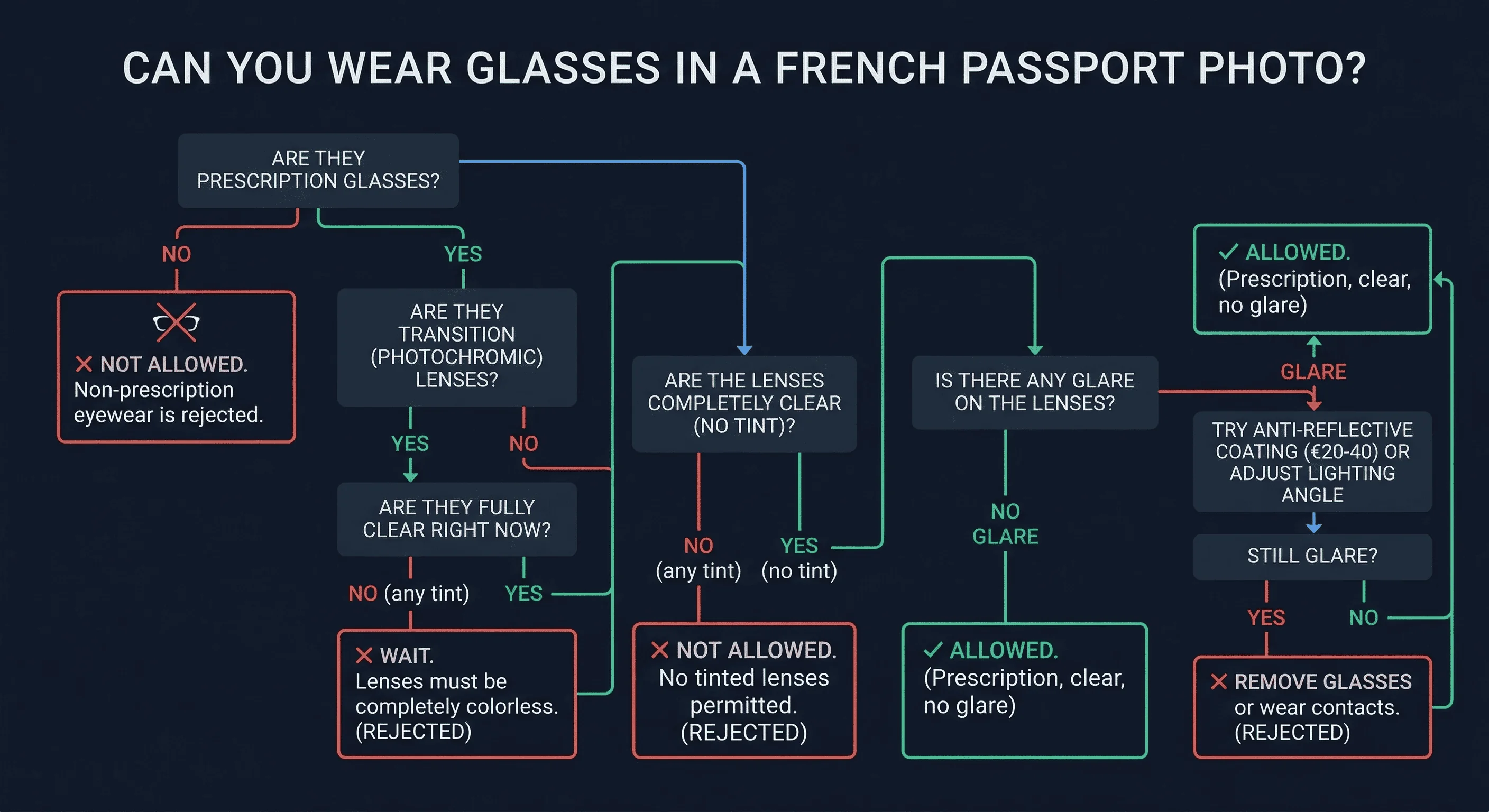
The only item permitted near your eyes is clear prescription contact lenses.
Get a compliant passport photo online
Why Does France Ban All Glasses in Passport Photos?
France's ANTS (Agence Nationale des Titres Sécurisés) processes passport applications digitally. The system uses facial recognition to match applicants against their biometric database. Glasses interfere because:
- Frames obscure facial geometry. The bridge area between the eyes is a critical measurement point.
- Lenses create reflections. Even anti-glare coatings don't eliminate all reflections under studio lighting.
- Shadows from frames fall on the cheeks and under the eyes.
- Different glasses change your appearance. Wearing different frames than your previous photo confuses matching algorithms.
France follows the same strict approach as the US, Australia, Japan, and India.
Are There Medical Exemptions for Glasses in France?
Medical exemptions are extremely rare. You would need documentation from a specialist ophthalmologist and prior approval from the préfecture. The process is slow and cumbersome. For the vast majority of applicants, removing glasses for the 30 seconds of the photo session is far simpler.
Can You Wear Contact Lenses in French Passport Photos?
Clear prescription contact lenses are fine. The rule targets glasses and tinted lenses, not vision correction that doesn't obscure your eyes.
What might get flagged: Coloured or cosmetic contact lenses that noticeably change your eye colour. The ANTS system compares your photo to previous records. Dramatically different eye colour can trigger additional verification.
Practical Tips for Glasses Wearers at French Photo Sessions
Before the photo
- Remove glasses 5–10 minutes early. This gives the red marks on the bridge of your nose time to fade. These marks show up clearly in close-up passport photos.
- If you normally squint without glasses, practise keeping your eyes naturally open. The photo requires a neutral expression (bouche fermée, expression neutre) with both eyes clearly visible.
- If you use contact lenses, insert them before arriving.
During the photo
- Keep your eyes relaxed and open. Don't squint.
- If you can't see the camera clearly without glasses, ask the photographer to guide you.
After the photo
- Check the photo on screen before printing. Verify no red marks are visible from your frames.
Where to Get Glasses-Free Passport Photos in France
Photomaton agréé (approved photo booths). These are the most common option in France. Located in mairies (town halls), supermarchés (supermarkets), gares (train stations), and centres commerciaux. Cost: €5–8 for 4 photos. The machine guides you through the process. Remove glasses before entering the booth.
Photographes professionnels. Studios in every French city. Cost: €8–15. Ask for "photo d'identité, sans lunettes, fond blanc" (ID photo, no glasses, white background). Studios near préfectures and mairies are experienced with passport photo requirements.
Ephoto system. France's digital photo submission system (ephoto agréé) generates a code you enter on the ANTS website. Many photo studios and some Photomaton machines offer this service. The system validates the photo against ANTS requirements before issuing the code — including checking that no glasses are present. If the photo passes, you receive a 22-digit ephoto code.
How the ANTS System Enforces the Glasses Ban
France's Agence Nationale des Titres Sécurisés handles all passport applications digitally. When you submit a photo (either via ephoto code or direct upload), the system checks:
- Background colour (white required)
- Face positioning and head height
- Eye visibility — glasses trigger an automatic rejection
- Expression (neutral, mouth closed)
If your photo is rejected, you receive an error message and must resubmit. This delays your application.
Glasses Rules: French Passport vs CNI vs Schengen Visa
The same no-glasses rule applies to all three:
- Passeport — no glasses
- Carte nationale d'identité (CNI) — no glasses
- Schengen visa (processed by French consulate) — no glasses
A single photo works for all three documents if it meets the 35×45mm size requirement.
Glasses Rules: France vs Other Countries
| Country | Glasses | Notes |
|---|---|---|
| France | ❌ Banned | |
| United States | ❌ Banned | Since 2016 |
| India | ❌ Banned | Since 2020 |
| Australia | ❌ Banned | |
| Japan | ❌ Banned | |
| Netherlands | ❌ Banned | |
| United Kingdom | ✅ Conditional | Prescription only, no glare |
| Canada | ✅ Conditional | Prescription only, no glare |
| Germany | ✅ Conditional | Prescription only, no glare |
| Italy | ✅ Conditional | Prescription only, no glare |
| South Korea | ✅ Conditional | Prescription only, no glare |
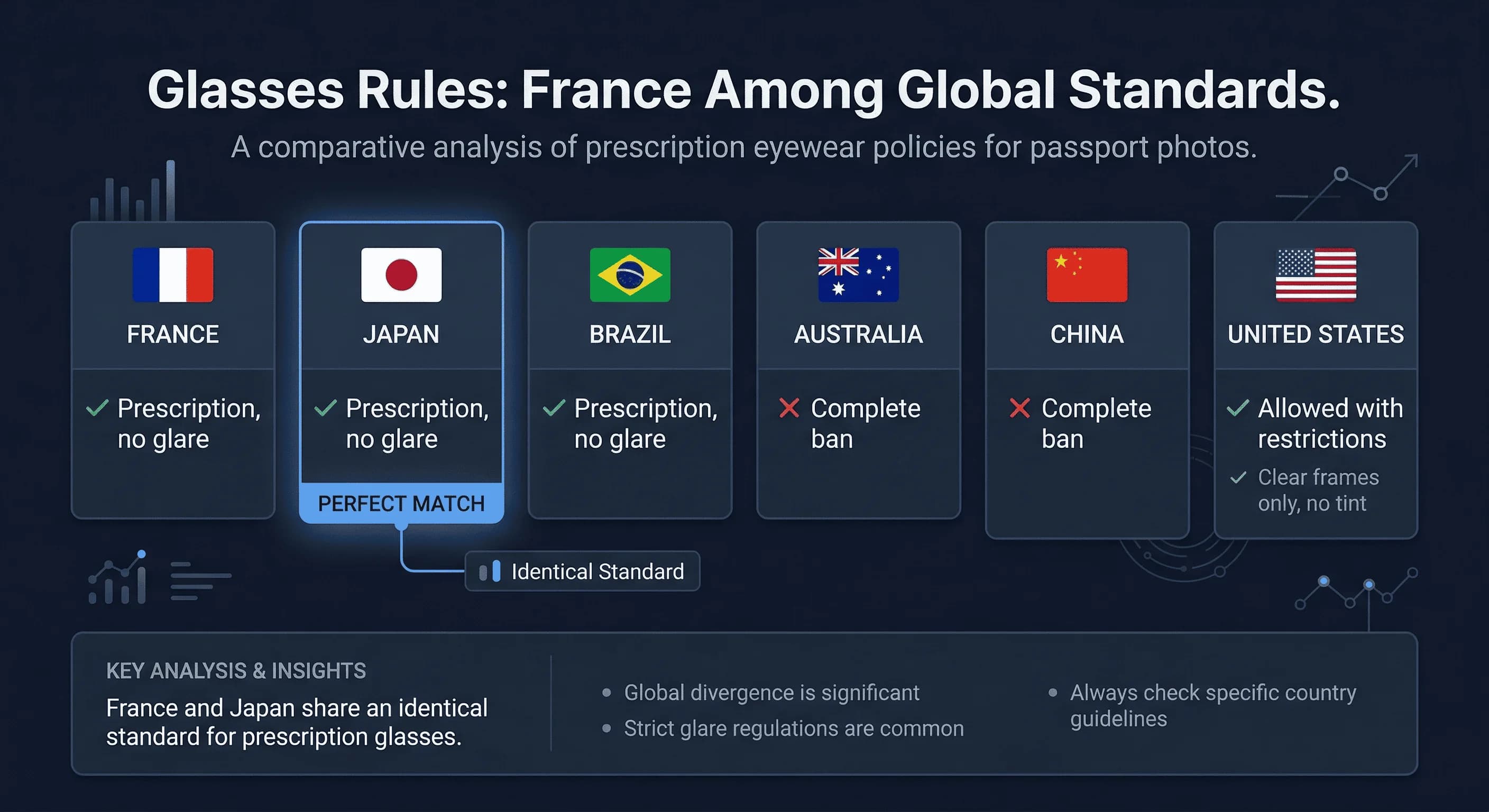
France follows the stricter approach. Among major European countries, only Germany, Italy, and the UK still permit prescription glasses conditionally.
Glasses Rules for French Citizens Renewing Abroad
If you're renewing your French passport from abroad, the same no-glasses rule applies. French consulates in London, Brussels, Montreal, New York, Berlin, and Geneva all enforce the ban.
In countries where glasses are allowed for their own passports (UK, Canada, Germany), photo studios may assume glasses are fine for all passports. Specify clearly: "photo de passeport français, sans lunettes, fond blanc, 35×45mm" (French passport photo, no glasses, white background, 35×45mm).
Do Not Digitally Remove Glasses from Your Photo
Do not digitally remove glasses from a photo. Apps and editing tools can erase glasses, but:
- Facial recognition compares your submitted photo to the in-person biometric scan
- Digitally altered photos may fail the ANTS automated quality check
- If manipulation is detected, it delays your application
Take the photo without glasses from the start.
French Baby and Children's Passport Photos: No Glasses
The same no-glasses rule applies to children's passport photos. If your child wears prescription glasses, remove them for the photo. Children's passports in France are valid for 5 years. A new compliant photo is needed at each renewal.
Common Glasses Mistakes in French Passport Photos
Keeping glasses on "because they're clear." Even perfectly clear prescription glasses are banned. The rule is absolute.
Digitally removing glasses. Photo manipulation is detectable and can delay your application.
Wearing transition lenses that haven't fully cleared. Any residual tint will be flagged.
Wearing coloured contacts. Clear prescription contacts are fine; coloured lenses that change your eye colour may trigger verification issues.
Ignoring nose-bridge marks. Red marks from frames are visible in close-up photos. Remove glasses 5–10 minutes before the photo.
Using an old photo where you wore glasses. If your previous passport photo showed glasses, you need a completely new photo.
Can You Wear Glasses in Other French Documents?
The glasses ban applies to identity documents only. You can wear glasses:
- At the préfecture or mairie during your appointment
- During the in-person biometric data capture
- In your supporting documents (carte vitale, permis de conduire, etc.)
Verify your photo meets all French passport requirements with the passportsize-photo.online checker. For size requirements, see French passport photo size guide. View all French passport photo rules on the France hub.