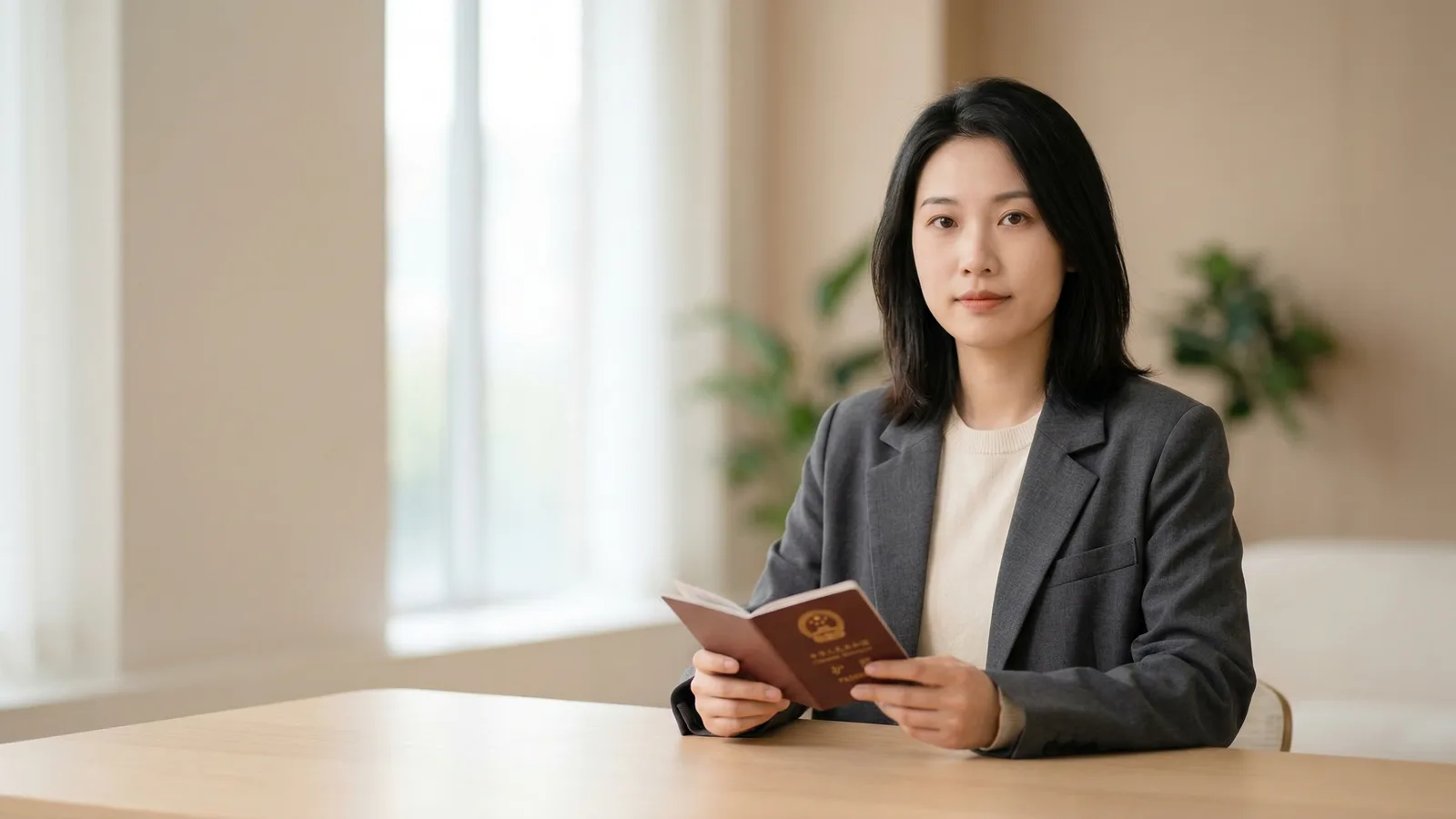
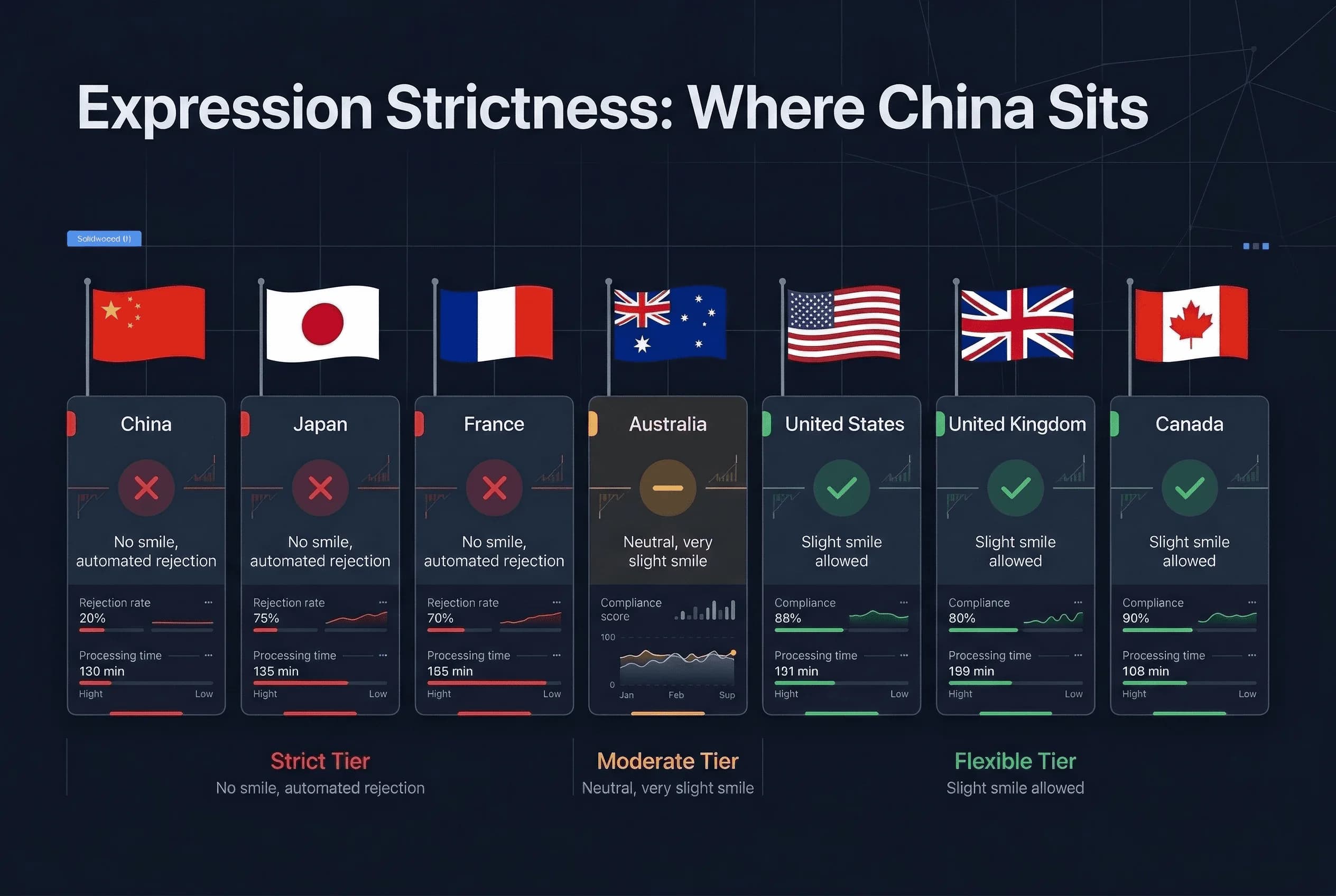
China does NOT allow smiling in passport photos. Like Japan, France, and most other countries, China requires neutral expression with mouth closed.
This is one of the most consistently enforced rules globally. Attempting to submit a photo with any smile leads to automatic rejection.
What Does Neutral Expression Mean for Chinese Photos?
Chinese passport photo requirements specify:
- Mouth closed, lips touching lightly
- No teeth visible
- No corners of mouth raised
- Relaxed facial expression
- Eyes open and focused
This is identical to requirements in Japan, France, and most countries. The rule is straightforward.
Get a compliant passport photo online
Why Does China Require Neutral Expression in Passport Photos?
China's facial recognition system requires a consistent baseline. When you present your passport at automated gates or border control, the system compares your live face to the photo.
A smiling face creates a mismatch with the neutral baseline the system expects. This causes verification failures at border crossings and other identity checkpoints.
Beyond border issues, smile rejection is automatic. The system flags non-neutral expressions before a human ever sees your photo.
Chinese Passport Photo Smile Rules vs Other Countries
Most countries require neutral expression — China is not unusual in this regard:
Neutral expression required
- China: No smile allowed
- Japan: No smile allowed
- France: No smile allowed
- Australia: No smile allowed
- United Kingdom: No smile allowed
- Canada: No smile allowed
- Germany: No smile allowed
- India: No smile allowed
- Brazil: No smile allowed
Slight smile permitted
- United States: Slight natural smile allowed (mouth closed)
The US is the rare exception, not the rule. China joins virtually every major country in requiring neutral expression. The country's large population (1.4 billion) and extensive use of automated verification at borders, train stations, and identity checkpoints make strict standards essential.
Tips for Achieving Natural Neutral in Chinese Photos
Getting a genuinely neutral expression is harder than it sounds. Most people either over-correct (creating a tense, unhappy look) or under-correct (leaving a subtle smile).
Relax your face completely. Don't force a neutral expression. Think "resting face" — how your face looks when you're reading something or waiting for a bus. Not bored, not engaged. Just neutral.
Press lips together lightly. Not hard. Just enough to close your mouth. Pressing too hard creates a dimpled chin or visible jaw tension.
Look at the camera lens. This creates more natural eye contact than looking at a screen or viewfinder. Focus on a single point.
Take 15–20 photos. Your face changes constantly. Use burst mode if available. Review each on a larger screen — phone screens are too small to spot subtle mouth corner raises.
Breathe out before the shot. Exhaling relaxes the facial muscles. Inhaling creates tension. Time the shutter release to the end of an exhale.
Practice in a mirror first. Spend 2–3 minutes finding your natural neutral. It's the expression you'd have while listening to someone speak in a meeting — alert but not emotional.
Common Chinese Passport Photo Expression Mistakes
Polite smile — When asked to pose, people instinctively smile. Remind yourself: neutral only.
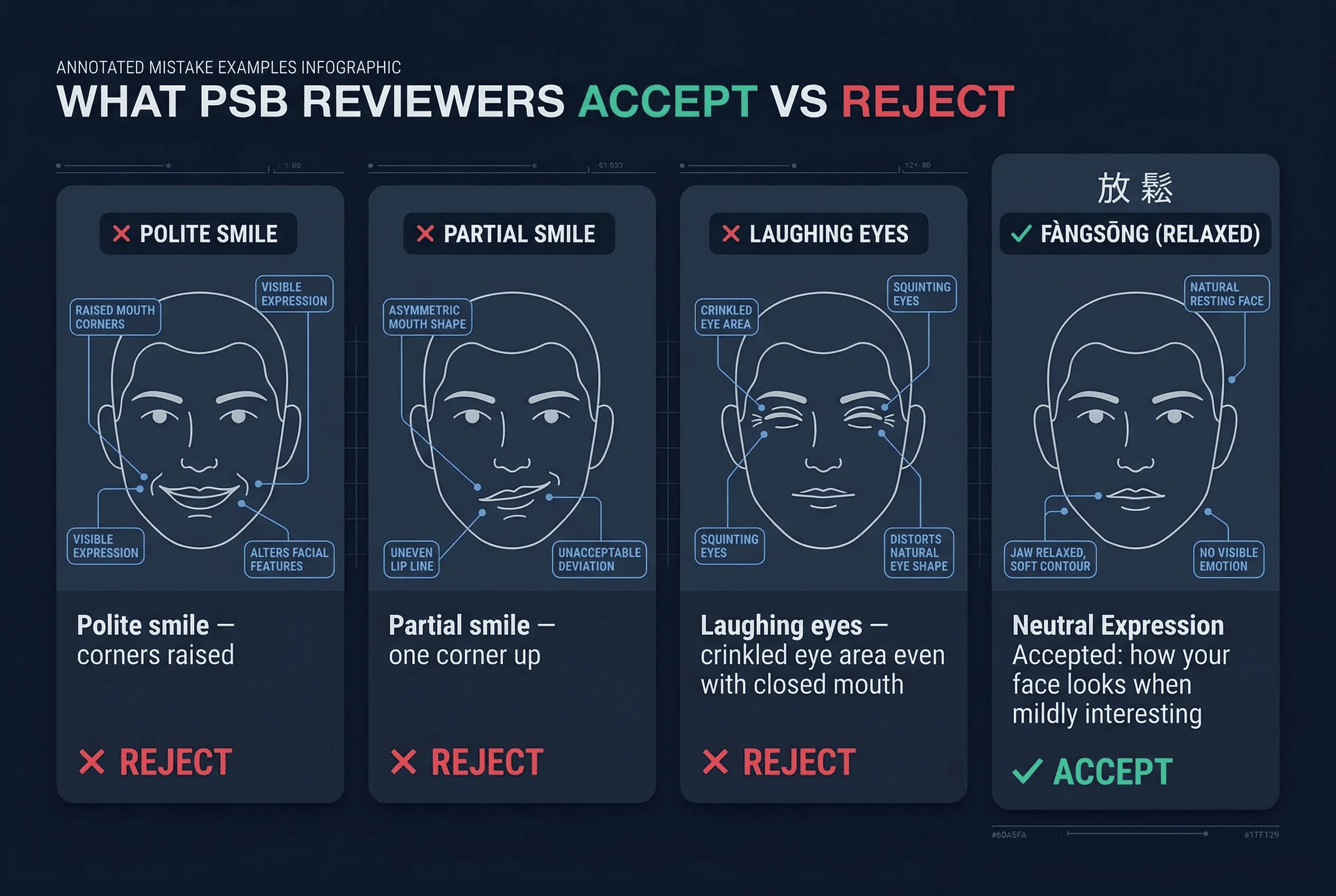
Partial smile — One corner raised slightly. Check both sides of your mouth in the mirror.
Laughing eyes — Crinkled eyes suggest happiness even with closed mouth. Keep your eye area relaxed.
Forced neutrality — Trying too hard to look neutral creates tension around the jaw, chin, and forehead. Aim for relaxed, not rigid.
Chin tension — Pressing your mouth closed too firmly creates a dimpled chin. The muscles around your chin should be soft.
Asymmetric mouth — One corner higher than the other reads as a partial smirk. Check both sides in your mirror practice.
What Does Neutral Look Like in Practice for PSB Photos?
The Public Security Bureau (PSB) defines neutral as "no visible emotional expression." Your lips should be together, not pressed tight. Your jaw relaxed, not clenched. Eyes open normally, not widened or squinted.
Think of how your face looks when you're reading something mildly interesting. Not bored, not excited. That's the expression they want.
Chinese photo studios coach this well. The photographer will say "fàngsōng" (relax) repeatedly. They know exactly what PSB reviewers accept. If you're taking your photo outside China, practice in a mirror until you find that resting middle ground.
The Practical Impact of Smiling in Your Chinese Passport Photo
A rejected photo means delay. Chinese passport processing already takes 7–15 working days domestically. A rejection for expression adds another cycle — another visit to the PSB office, another set of photos, another wait. For urgent travel, this can mean missing flights or rescheduling trips.
More importantly, once your passport is issued, you'll use it for years (Chinese passports are valid for 10 years for adults). Every time you pass through automated e-gates at Beijing Capital, Shanghai Pudong, Guangzhou Baiyun, Shenzhen Bao'an, or any other Chinese airport, the system compares your live face to your passport photo. A non-neutral expression distorts facial geometry enough to trigger manual checks. That means stepping out of the fast lane and waiting for an officer — every single time you travel, for up to 10 years.
What Happens If China Rejects Your Photo for Smiling?
If your photo is rejected for expression at a PSB (公安局) office, you'll need to retake it. Some PSB offices have on-site photo booths that produce compliant photos. If you're applying at a police station in a smaller city, the rejection may require a return visit after getting new photos taken at a nearby studio.
The rejection notice may not always specify "smile" as the reason — it may simply indicate the photo doesn't meet standards (照片不合格). Common expression-related rejection triggers include:
- Any visible teeth
- One or both mouth corners raised
- Crinkled "smiling eyes"
- Visible tension from over-correcting
- Asymmetric mouth positioning
Chinese Passport Photo Expression Specifications Summary
For the complete picture, China's passport photo requires:
- Size: 33×48mm (390×567 pixels at 300 DPI)
- Background: White (#FFFFFF)
- Expression: Strictly neutral — no smile
- Glasses: Not allowed
- Head height: 28–33mm in print
- Recency: Taken within 6 months
Note that China uses a unique 33×48mm size — different from the 35×45mm standard used by most countries. This matters if you're getting photos taken at a studio outside China. Always specify "Chinese passport photo, 33×48mm" when visiting overseas studios.
Smile Rules for Chinese Dual Citizens and Frequent Travellers
If you hold dual citizenship (for example, US and Chinese), remember that the expression rules differ. Your US passport photo can have a slight smile. Your Chinese passport photo must be strictly neutral.
The safest approach is to take all passport photos with neutral expression. A neutral photo satisfies every country's requirements. A smiling photo only works for the US and a handful of others.
Quick Checklist for Chinese Passport Photo Expression
- Mouth closed, lips touching lightly
- No teeth visible
- Mouth corners level (not raised)
- Eyes open and relaxed
- No "laughing eyes" or crinkled corners
- Face relaxed, not tense
- No glasses
Verify your expression with the passportsize-photo.online checker. For complete China passport details, see the China requirements hub. For size details, see the China passport photo size guide.