China permits baby passport photos with more flexibility than adult photos, but the country's unique sizing (33×48mm) creates challenges. Parents must understand both the general baby photo rules and China's specific requirements.
This guide covers everything needed to successfully photograph an infant for a Chinese passport application.
Chinese Baby Passport Photo Size (33×48mm)
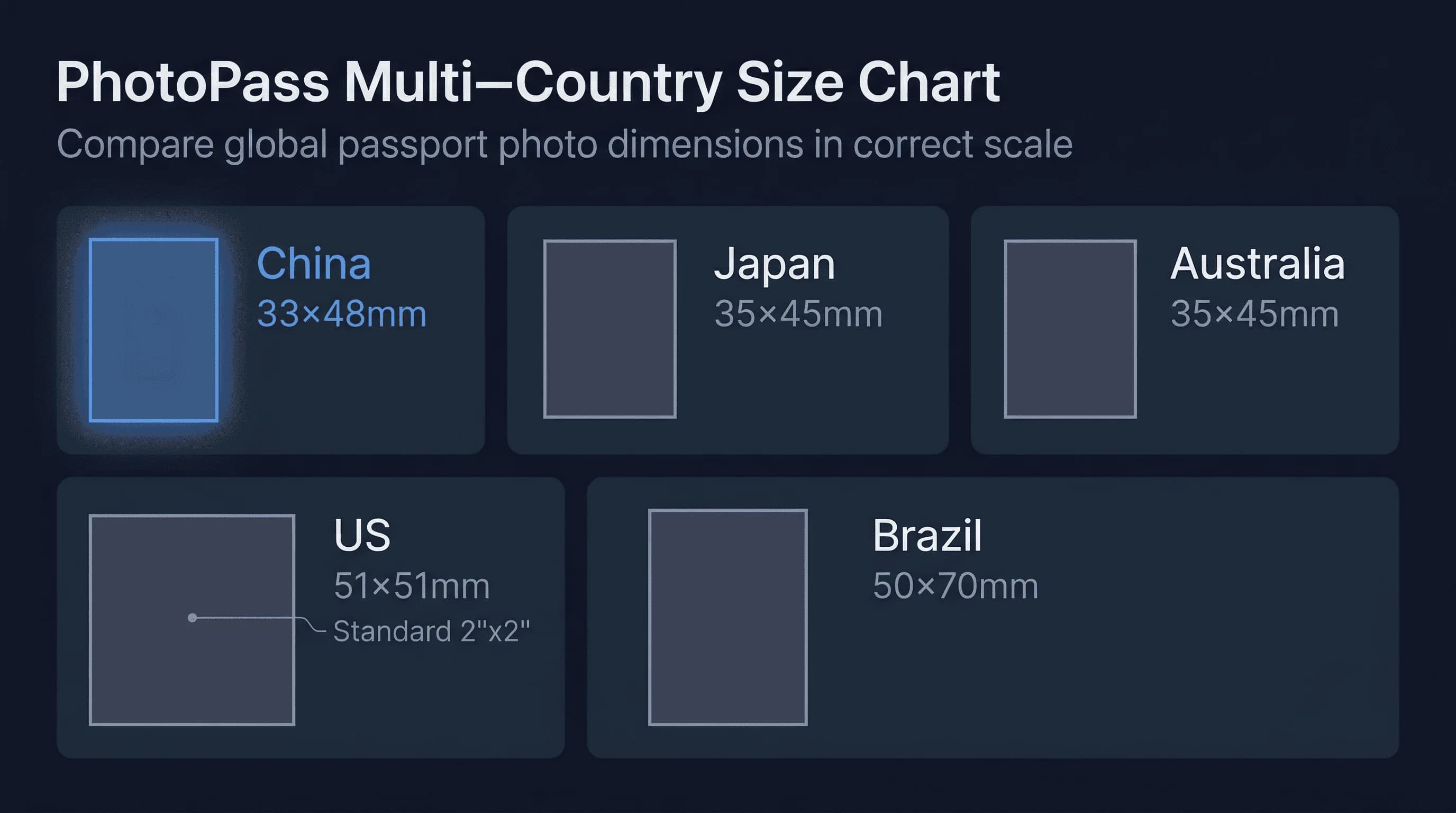
China uses non-standard passport photo dimensions: 33×48mm. This applies to babies too.
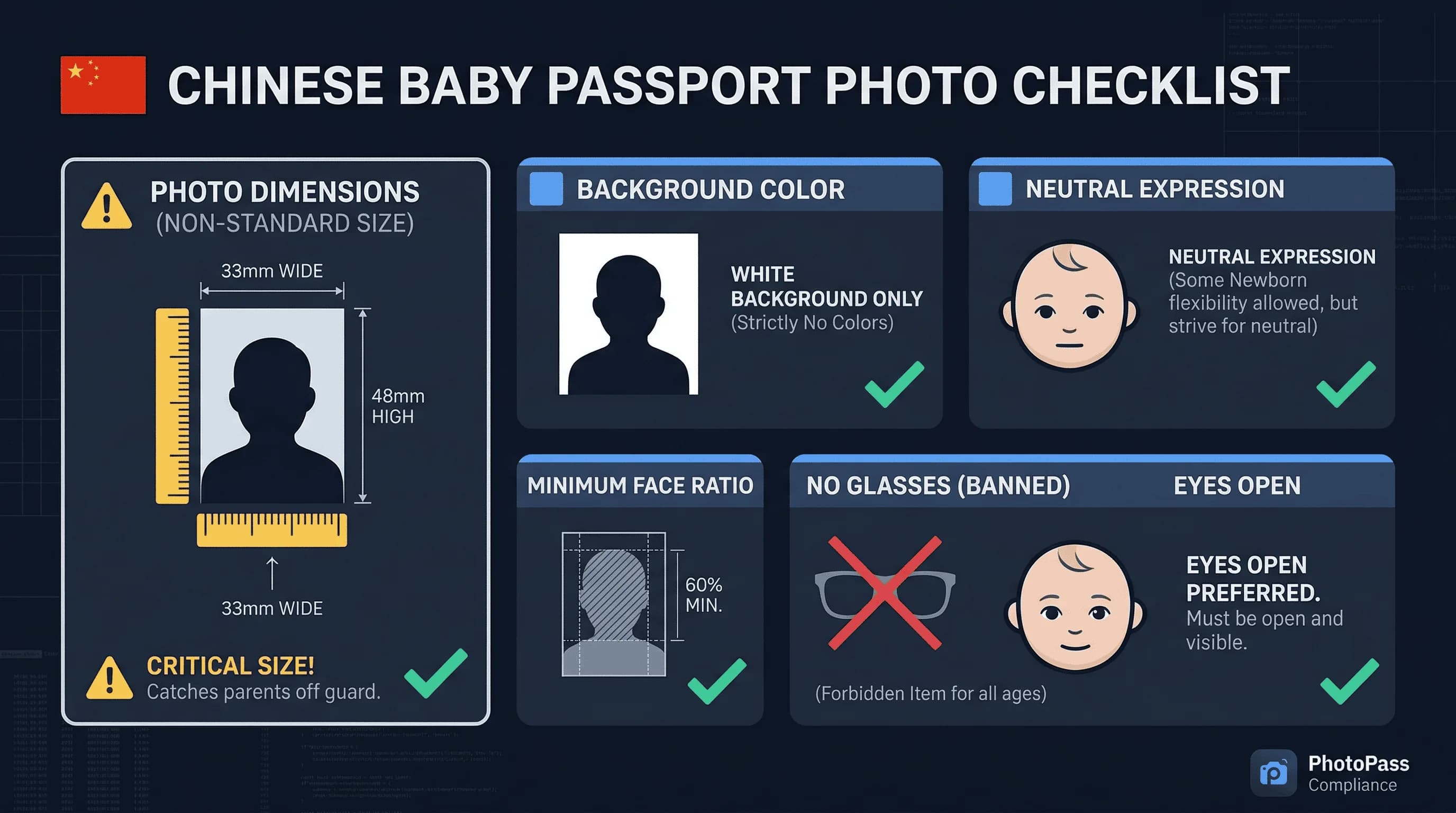
The width is narrower than most countries. Standard 35×45mm photos will be rejected. You must create photos specifically sized for Chinese passports.
At 300 DPI, this translates to 390×567 pixels.
Get a compliant passport photo online
White Background Required for Chinese Baby Photos
Like adults, babies need a pure white background (#FFFFFF). This is non-negotiable.
Use a white blanket, foam board, or continuous paper. Ensure the white is pure, not off-white. Test with a color picker if unsure.
Lighting must be even. Shadows on the background or baby's face cause rejection.
What Expression Is Allowed in Chinese Baby Passport Photos?
China requires neutral expression for adults. For babies, authorities show some flexibility, but not much.
What typically passes:
- Eyes open (preferred but not always required for newborns)
- Neutral or slightly relaxed expression
- Mouth closed or slightly open
What typically fails:
- Crying with distorted features
- Wide open screaming mouths
- Eyes tightly closed in older infants
The key is natural relaxation. A sleeping baby with closed eyes may pass. A baby mid-tantrum will not.
Face-to-Frame Ratio for Chinese Baby Photos
China requires face height to be 60-70% of the frame. This gives more flexibility than Japan's 71-80% requirement but less than Brazil or Australia's 60-80%.
For babies, this ratio is challenging. Infants have smaller heads. Achieving 60% face coverage requires tight framing.
Position the baby close to the camera. Use a vertical crop. The goal is maximum face visibility while maintaining the correct aspect ratio.
Does China's No Glasses Rule Apply to Babies?
China bans all glasses — including for babies who don't wear them. This rule is straightforward for infants.
If your baby wears infant glasses for vision correction, they'll need to remove them for the passport photo. This might require a separate pediatrician consultation if removing glasses distresses the baby.
Photography Tips for Chinese Baby Photos
Timing Your Baby's Photo Session
Photograph during a calm window. After feeding, before nap time. Have all equipment ready before waking the baby.
Setting Up the Background and Lighting
Lay baby on a white surface. White blanket or foam board works. Ensure no wrinkles that create shadows.
Position lighting to eliminate shadows. Soft, even light from directly in front works best.
Capture Rapidly with Burst Mode
Take many photos quickly. Babies move and change expressions constantly. Review each shot. Delete failures immediately.
Plan for 20-30 attempts minimum.
Clothing for Baby Passport Photos
Dress baby in contrasting colors to white. Dark reds, blues, and browns photograph well.
Avoid white or light clothing that blends into the background.
Common Chinese Baby Passport Photo Rejection Reasons
Wrong size. The 33×48mm requirement catches many parents. Studios outside China often default to 35×45mm. Always specify "中国护照照片, 33×48毫米" (Chinese passport photo, 33×48mm).
Non-white background. Off-white or grey backgrounds are rejected. Pure white is required.
Face too small. The 60% minimum applies to babies. Get closer. Crop tighter. Babies have smaller heads, so you need to fill more of the frame.
Shadows. Poor lighting creates shadows on the face or background. Use two light sources to eliminate shadows.
Blurriness. Baby movement causes motion blur. Use a fast shutter speed (1/200 or faster).
Glasses. Glasses of any kind cause rejection. Remove all eyewear before the photo.
Where to Get Baby Photos in China
Photo studios near PSB offices (公安局出入境管理处). Every city's Public Security Bureau has nearby photo studios (照相馆). Staff are experienced with passport photo requirements. Cost: ¥20–50.
Large chain studios. Hainan Airlines Photo (海马体照相馆) and other chains in shopping malls offer passport photo services with professional lighting. Cost: ¥30–80.
DIY at home. The most practical option for babies:
- Lay baby on white blanket or white foam board
- Use natural window light supplemented with a desk lamp
- Position camera directly above, pointing down at baby's face
- Take 20–30 rapid shots in burst mode
- Select the best one with eyes open and neutral expression
Photo booths (自助照相机). Available in some metro stations and government buildings. Not recommended for babies — the enclosed space and fixed timing make it impossible to capture a calm infant.
Age-Specific Tips for Chinese Baby Passport Photos
Newborns (0–3 months). Easiest to photograph because they move less. Lay them on a white surface. A sleeping newborn with closed eyes may pass, but eyes open is preferred. Chinese authorities are somewhat lenient at this age.
Infants (3–12 months). More alert and wiggly. Have a helper hold the baby's attention with a colourful toy above the camera. Use burst mode. Plan for the session to take 10–15 minutes.
Toddlers (1–3 years). Most challenging. They resist sitting still. Use favourite toys, songs, or animated videos on a phone held above the camera to get a brief moment of calm. Take as many shots as needed.
Hukou and Chinese Baby Passport Applications
In China, a baby's household registration (户口本 / hukou) must be completed before applying for a passport. Both parents' ID cards (身份证) are typically required. The passport application is submitted at the local Exit-Entry Administration (出入境管理局) office. The same 33×48mm white-background photo is required.
Chinese Baby Passport Photos at Embassies Abroad
If your baby was born outside China and you're applying for a Chinese passport (or Chinese travel document), the same photo rules apply. Specify 33×48mm — studios abroad often don't stock Chinese dimensions.
Chinese embassies and consulates in major cities (New York, Los Angeles, San Francisco, London, Sydney, Tokyo, Singapore, Vancouver) process baby passport applications. Some offer photo services on-site, but availability varies. Call ahead to confirm.
Note: some overseas Chinese missions may accept standard 35×45mm photos. Check with your specific embassy before your appointment. The safest approach is to bring 33×48mm photos regardless.
Chinese Travel Document vs Passport Photo Requirements
Babies born abroad to Chinese citizens may receive either a Chinese passport or a Chinese travel document (旅行证), depending on whether the child has foreign nationality. Both documents require the same 33×48mm white-background photo specifications.
Chinese Baby Passport Renewal and Photo Updates
Chinese passports for children under 16 are valid for 5 years. Each renewal requires a new photo meeting the same 33×48mm white-background requirements. Babies' faces change dramatically — budget for multiple photo sessions over the early years.
Camera Settings for DIY Chinese Baby Passport Photos
Use burst mode (continuous shooting). A shutter speed of 1/200 or faster prevents motion blur. ISO 400–800 is acceptable in indoor lighting. Focus on the baby's eyes — autofocus on the nearest eye produces the sharpest result. Shoot in RAW if possible, so you can adjust white balance to ensure the background reads as pure white.
Quick Checklist for Chinese Baby Passport Photos
Before submitting your baby's Chinese passport photo:
- Photo is 33×48mm (not 35×45mm)
- Background is pure white
- No glasses or eyewear
- Baby's face is visible and centred
- Face height is 60–70% of frame
- Eyes preferably open
- No extreme expression (crying, screaming)
- No shadows on face or background
- Photo is sharp and not blurry
- 300 DPI minimum resolution
Verify your baby's photo meets all Chinese passport requirements with the passportsize-photo.online checker. For size details, see Chinese passport photo size guide. View all Chinese passport photo rules on the China hub.