
No — you cannot smile in a Canada passport photo. IRCC requires a neutral facial expression with your mouth closed.
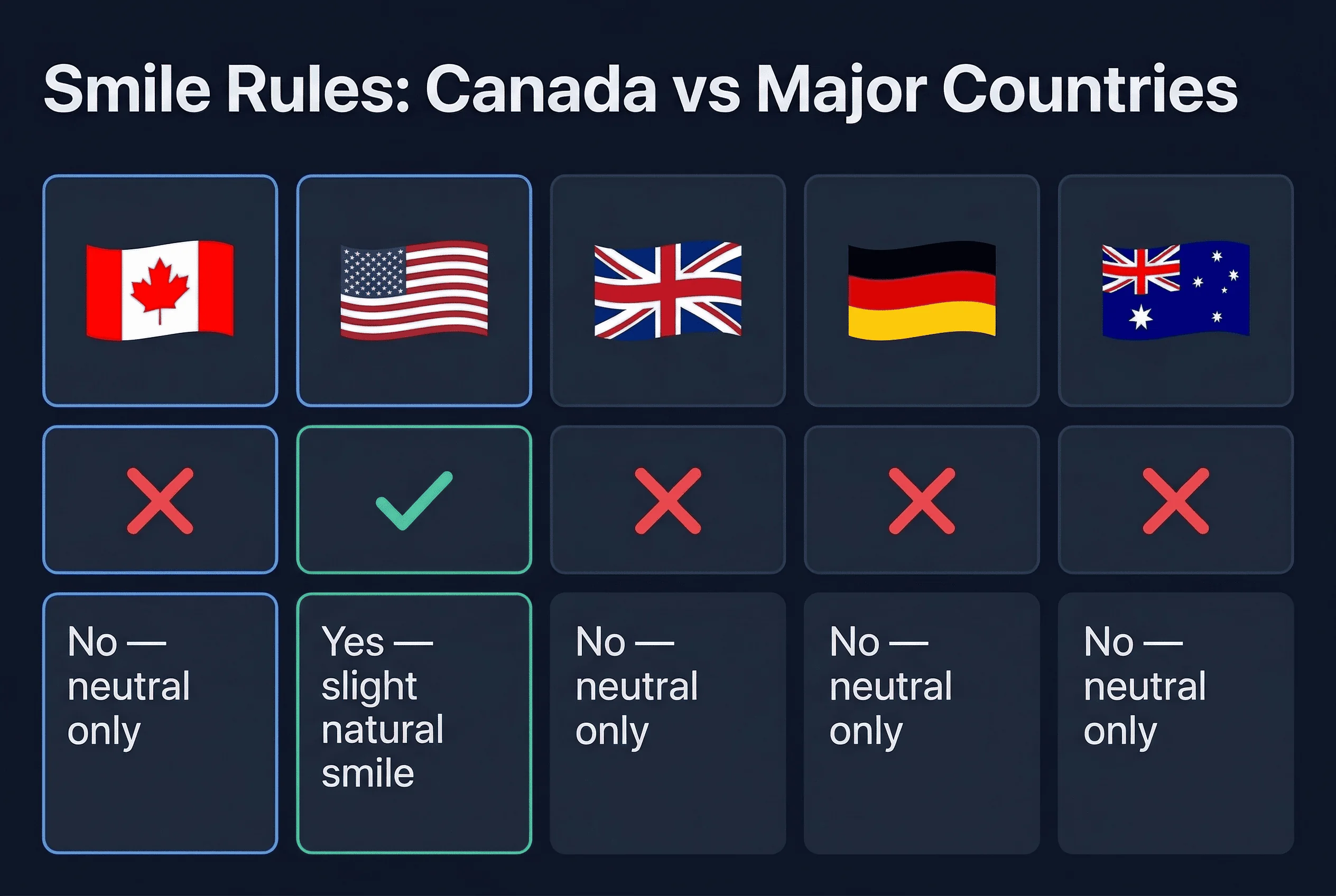
This rule aligns Canada with most countries worldwide. The United States is the notable exception, allowing slight natural smiles. But for Canadian passports, leave the smile at home.
What Does Neutral Expression Mean for Canadian Photos?
IRCC specifies:
- Mouth closed — no teeth visible, no open mouth
- Neutral expression — no smiling, no frowning, no exaggerated expressions
- Eyes open and visible — looking directly at the camera
- Natural face — no puckered lips, no raised eyebrows
"Neutral" means your face at rest. Think of how you look when someone asks you a simple question and you respond without particular emotion. That's the expression you want.
Get a compliant passport photo online
What Happens If You Smile in a Canadian Passport Photo?
Your photo will be rejected.
The automated system flags expressions that deviate from neutral. You'll receive an error indicating "Expression does not meet requirements" and need to upload a new photo.
Each rejection adds days to your application. Getting it right the first time saves time.
Why Does Canada Require No Smile in Passport Photos?
Canada adopted stricter rules to align with international standards:
- Facial recognition accuracy — neutral expressions provide consistent biometric data
- ICAO compliance — the international standard specifies neutral expression
- Consistency — matching photos to live faces is easier with neutral expressions
The US is the major exception. Most other countries — Canada, UK, Germany, Australia, France, Japan — all require neutral expression.
Canadian Passport Photo Smile Rules vs Other Countries
| Country | Smile Allowed |
|---|---|
| United States | Yes — slight natural smile |
| Canada | No — neutral only |
| United Kingdom | No — neutral only |
| Germany | No — neutral only |
| Australia | No — neutral only |
If you hold dual US/Canadian citizenship and need photos for both passports, your Canadian photo cannot have a smile — even if your US photo does.
Tips for a Natural Neutral Look in Canadian Photos
Many people overthink this and end up looking stiff or uncomfortable — which ironically draws more attention than a genuine neutral expression.
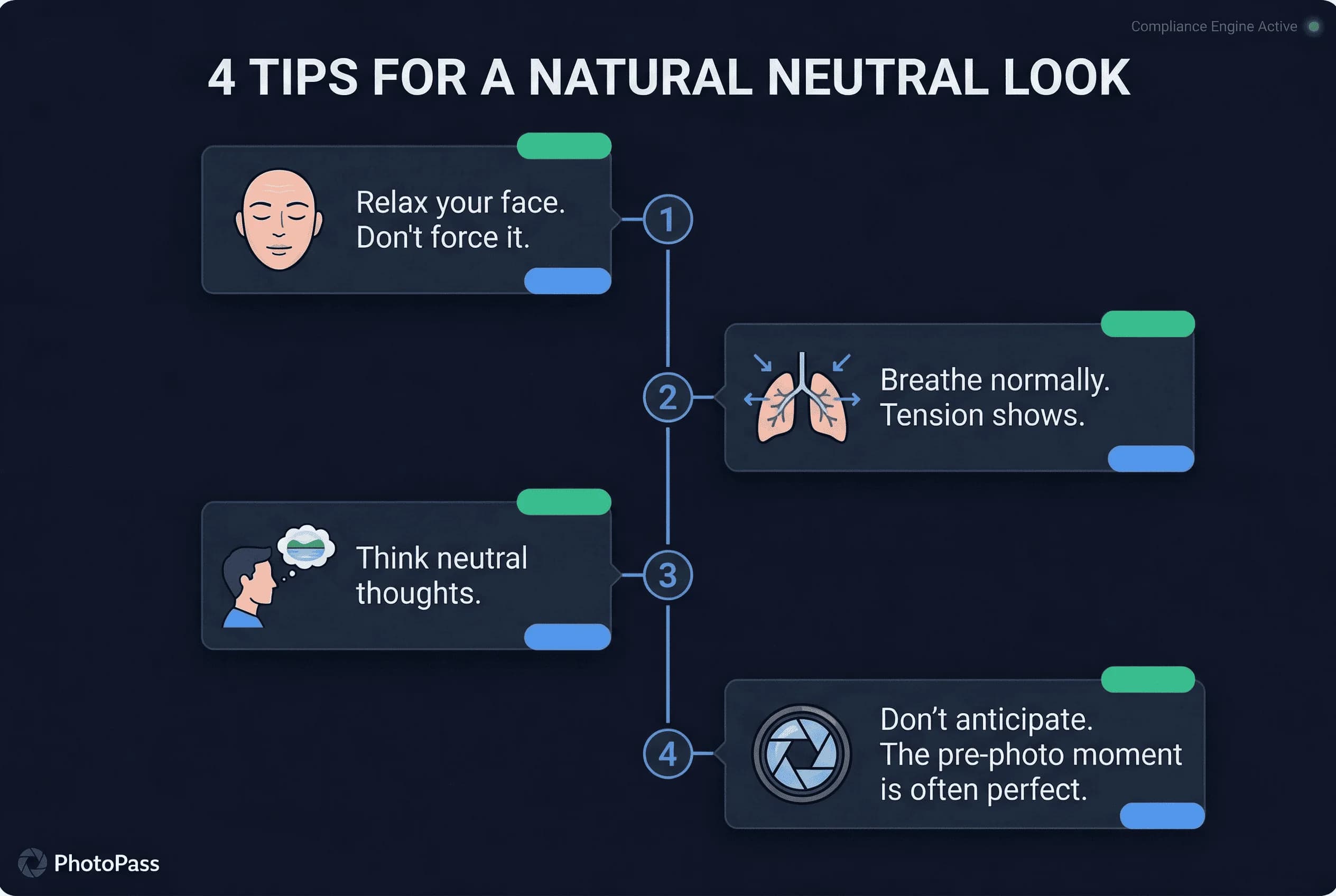
Relax your face completely. Don't force a neutral expression. Think "resting face" — how your face looks when you're reading something or waiting for the bus. Not bored, not engaged. Just neutral.
Breathe out before the shot. Exhaling relaxes the facial muscles. Inhaling creates tension. Time the shutter release to the end of an exhale.
Think boring thoughts. Don't think about the photo, the photographer, or "not smiling." Think about your grocery list, your commute, or what you need to do next week. Your mind drives your expression.
Practice in a mirror for 2–3 minutes. Find the expression you have when listening to someone explain something routine — alert but not emotional.
Say "mmm" and hold it. Your lips meet naturally in a genuine neutral position. This technique is widely used in Canadian passport studios.
Take 15–20 photos. Your face changes with every breath. Use burst mode if available. Review each on a larger screen and delete anything showing lip corner elevation immediately.
Don't think "don't smile." Thinking about not smiling makes you hyper-aware of your mouth, which often triggers the very expression you're trying to avoid. Focus instead on the camera lens as a physical object.
The goal is looking like yourself on an average day. Not a mannequin. Not a model. Just you.
What About Babies in Canadian Passport Photos?
Canada is somewhat lenient with babies.
The guidelines expect eyes open, neutral expression — same as adults. But in practice, the system cuts more slack for infants who can't maintain neutral expression.
If your baby smiles slightly, retake if possible. If your baby has a neutral or grumpy expression, that's more likely to pass.
Common Questions About Canadian Passport Photo Smiling
Can I show my teeth?
No. Teeth are not allowed. Mouth must be closed.
What if I have a naturally pleasant face?
Some faces look friendly at rest. That's fine. The software detects actual smiles, not resting face structure.
Can I purse my lips?
No. Pursed lips are an expression. Keep lips relaxed and together.
Do children have different rules?
No. Children must also have neutral expression, though some leniency exists for young children.
What if I'm smiling and don't realize it?
This happens. Before submitting, look at your photo critically. Would a stranger say you're smiling? If yes, retake.
What If You're Accidentally Smiling in Your Photo?
Check your photo before submitting:
- Look at your mouth — are corners slightly upturned?
- Look at your eyes — are they crinkled (indicating a genuine smile)?
- Imagine it's a stranger's photo — would you say they're smiling?
If uncertain, retake. It's better to spend five minutes than deal with rejection.
How Facial Recognition Uses Your Canadian Passport Photo
Your Canadian passport photo will be used for up to 10 years (adults) or 5 years (children under 16). Every time you pass through automated kiosks at Toronto Pearson, Vancouver, Montreal Trudeau, Calgary, or other Canadian airports, the system compares your live face to your passport photo.
A smiling passport photo creates a geometric mismatch with your neutral face at the kiosk. Your cheek positions, eye aperture, and mouth shape all shift when you smile. This mismatch triggers manual checks — pulling you into a queue for a CBSA officer instead of passing through the automated lane.
What Happens If Canada Rejects Your Photo for Smiling?
If IRCC rejects your photo for expression, you'll need to submit a new one. The rejection notice may not always specify "smile" — it may reference "photo does not meet specifications." Common expression-related rejection triggers include:
- Any visible teeth
- One or both mouth corners raised
- Crinkled "smiling eyes"
- Visible facial tension from over-correcting
- Asymmetric mouth positioning
Standard Canadian passport processing takes 10 business days (in-person) or 20 business days (by mail). A rejection adds another cycle to that timeline.
Canadian Passport Photo Expression Specifications Summary
For the complete picture, Canada's passport photo requires:
- Size: 50×70mm (591×827 pixels at 300 DPI)
- Background: White (#FFFFFF)
- Expression: Strictly neutral — no smile
- Glasses: Allowed (prescription only, no glare)
- Head height: 31–36mm in print
- Recency: Taken within 12 months
Note that Canada uses 50×70mm — one of the largest passport photo formats. The larger format makes expression deviations more visible than in smaller formats like Japan's 35×45mm.
Smile Rules for Canadian Dual Citizens
If you hold dual US/Canadian citizenship, remember:
- Canadian passport: Strictly neutral, no smile
- US passport: Slight natural smile permitted
The safest approach is to take all passport photos with neutral expression. A neutral photo satisfies every country's requirements, including the US.
Quick Checklist for Canadian Passport Photo Expression
- Mouth closed, lips together gently
- No teeth visible
- Mouth corners level (not raised)
- Eyes open and looking at camera
- No "laughing eyes" or crinkled corners
- Face relaxed, not tense or forced
- No raised eyebrows
Verify your expression with the passportsize-photo.online checker. For size specifications, see the Canada passport photo size guide. For full Canadian passport rules, visit the Canada hub.