
Canada requires a plain white background for passport photos. IRCC (Immigration, Refugees and Citizenship Canada) specifies a uniform white background with no patterns, gradients, textures, or shadows. Unlike some countries, Canada also requires that passport photos be taken by a commercial photographer — not at home.
The Exact Background Rule for Canadian Passport Photos
The background must be:
- White (#FFFFFF) — pure white, not off-white, cream, ivory, or grey
- Uniform — the same shade from edge to edge
- Smooth — no visible texture, grain, or pattern
- Shadow-free — no shadows from your head, body, or hair
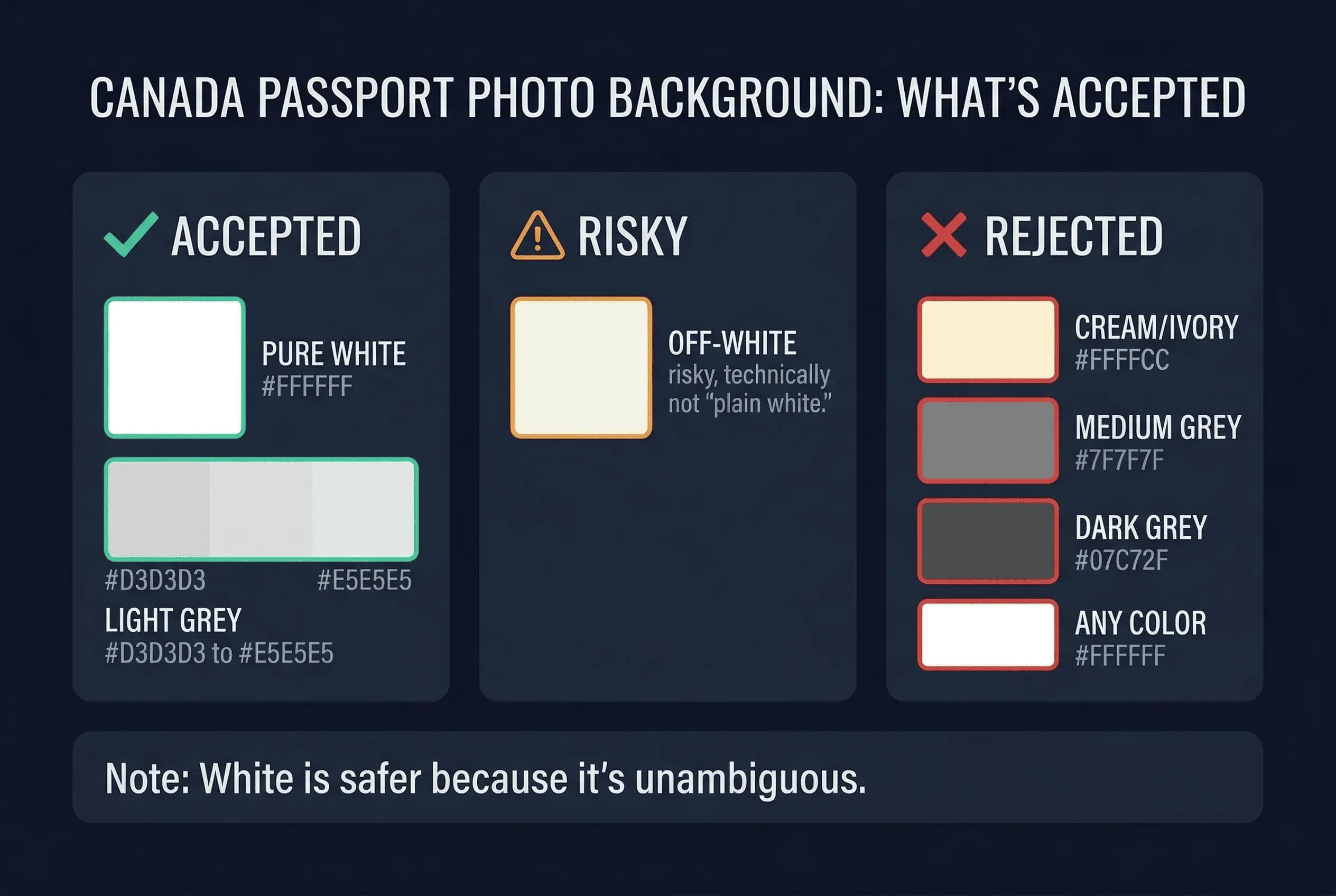
The background requirement applies to both the printed photo (submitted with a paper application or at a passport office) and any digital submission.
Get a compliant passport photo online
Canada's Commercial Photographer Requirement for Photos
Canada is one of the few countries that requires a commercial photographer for passport photos. You cannot take your own passport photo at home and submit it. The photographer must stamp, sign, and date the back of the print.
This means background compliance is primarily the photographer's responsibility. However, understanding the rules helps you verify the output and catch problems before you submit.
What Backgrounds Fail and Why for Canadian Photos
Off-white and cream. Studio walls or backdrops that have yellowed over time photograph as cream rather than white. Professional studios replace their backgrounds regularly — cheaper studios may not.
Shadows. Poor studio lighting casts shadows on the background. Even a professional studio can produce shadows if the lighting is poorly set up. Check the photo carefully before accepting.
Gradients. Uneven illumination makes the background brighter in one area than another. The background should be uniform from edge to edge.
Textured backdrops. Fabric backdrops with visible weave or texture create patterns. Professional studios use smooth paper or vinyl backgrounds.
Light grey. What passes in Germany or the UK (light grey at 230,230,230) fails in Canada. Canada requires white, not grey.
Coloured tints. Pale blue, pale green, or warm-toned backgrounds fail even if they appear white in the studio.
Canadian Passport Photo Background vs Other Countries
| Country | Background | Notes |
|---|---|---|
| Canada | White | Plain white required |
| United States | White | Same as Canada |
| France | White | Same as Canada |
| Australia | White | Same as Canada |
| Japan | White | Same as Canada |
| India | White | Same as Canada |
| Germany | Light grey | Different — will fail in Canada |
| United Kingdom | Light grey | Different — will fail in Canada |
| Brazil | White | Same as Canada |
Canada shares its white background requirement with most countries. A white-background photo taken for the US, France, or Japan will have the correct background for Canada — though the size differs (Canada uses a unique 50×70mm format). Photos taken for Germany or the UK (light grey) will not pass Canadian requirements.
For Canadian-British dual citizens, this matters: a UK passport photo (grey background) cannot be reused for a Canadian passport (white background).
Where to Get Your Photo in Canada
Since photos must be taken by a commercial photographer, your options are:
Shoppers Drug Mart / Pharmaprix. The most common option across Canada. Background is standardised white. Cost: approximately $15–20. The pharmacist or photo technician stamps and signs the back. Available in most locations nationwide.
Costco. Photo centres at Costco locations offer passport photos with white backgrounds. Cost: approximately $7–10 (often the cheapest option). Quality is reliable.
Canada Post. Many Canada Post locations offer passport photo services. Cost: approximately $15–20. Convenient if you are also mailing your application.
Walmart. Photo centres in Walmart stores offer passport photos. Cost: approximately $10–15. White backgrounds are standard.
Professional photography studios. Independent studios in all major cities offer passport photos. Cost varies ($15–40). Useful if you need specific accommodations or need photos for multiple countries simultaneously.
Canadians abroad. Canadian embassies and consulates can direct you to approved local photographers. In cities with Canadian communities, studios near the consulate may know the 50×70mm format. Specify white background and verify the result.
What to Check at the Studio for Background Compliance
When the photographer shows you the photo, verify:
- Background is pure white. Not cream, not grey, not any other colour. If it looks even slightly off-white, ask them to retake.
- No shadows. Look behind your head and shoulders. Any dark areas mean the lighting needs adjustment.
- Uniform from edge to edge. The background should be the same brightness everywhere — top, bottom, left, right.
- No visible texture. The background should look perfectly smooth.
- Photo is 50×70mm. Canadian passport photos are larger than most countries' formats.
If anything looks wrong, ask the photographer to retake before you leave. It is much easier to fix in the studio than to resubmit an application.
The Shadow Problem in Canadian Passport Photo Studios
Even professional studios sometimes produce shadow issues. The most common cause is a single overhead light that creates shadows below the subject's head and on the lower background.
Good studios use multiple lights. Two front lights at 45 degrees eliminate facial shadows, plus one dedicated background light to keep the white backdrop uniformly lit.
Bad studios use one light. A single flash or continuous light creates uneven illumination and background shadows.
If you notice shadows in the preview, politely ask the photographer to adjust the lighting. Most will comply — they want a passing photo too.
Why Lighting Matters More Than the Wall Color
A white wall or backdrop does not guarantee a white background in the final photo. Lighting determines how the camera captures the background colour.
Warm lighting (2700K–3000K) casts yellow tones that make white surfaces photograph as cream. Professional studios should use daylight-balanced lighting (5000K–5500K) to maintain true colour.
Uneven lighting creates gradients — brighter at the top, darker at the bottom. The background should be lit uniformly across the entire frame.
Underlit backgrounds appear grey in photos even when the physical surface is white. If the background receives less light than your face, it will photograph darker than it actually is. A dedicated background light solves this.
Common Canadian Passport Photo Background Mistakes
Accepting a grey-toned background. Some studios have aging backdrops that photograph as pale grey rather than white. Check the photo on their screen. If it looks grey, ask for a retake.
Not checking the back of the print. Canadian passport photos must have the photographer's stamp, signature, and date on the back. Without this, the photo is invalid regardless of background colour.
Using DIY photos. Canada requires a commercial photographer. Home photos — even perfectly white-background ones — will be rejected if they lack the photographer's certification.
Confusing with US requirements. Both countries require white, but US photos are 51×51mm (square) while Canadian photos are 50×70mm (tall rectangle). The background colour matches, but the size does not.
Accepting without verifying. Always check the photo on screen before the photographer prints. Once printed, retakes may cost extra.
Verifying Your Canadian Passport Photo Background
Before submitting your application, check the printed photo:
- Background is white across the entire frame
- No visible shadows behind you
- No texture, pattern, or seam visible
- Photo is 50×70mm (the Canadian format)
- Photographer's stamp, signature, and date are on the back
Use our passport photo checker to validate the background digitally before printing. For Canadian passport photo size requirements, see the Canada passport photo size guide. View the complete requirements on the Canada hub page.