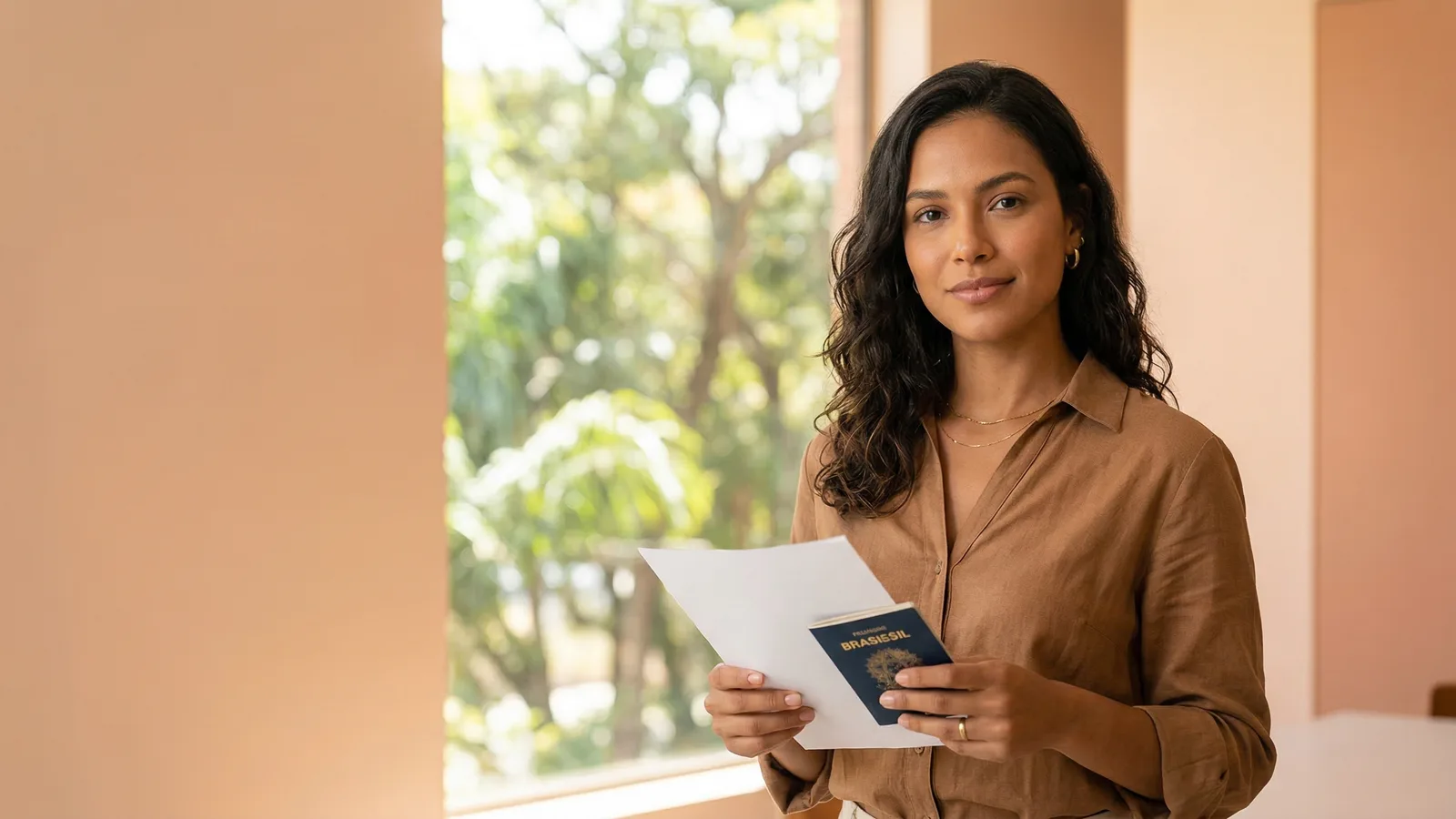
Brazil does NOT allow smiling in passport photos. Your expression must be neutral, with mouth closed. This rule aligns Brazil with most countries globally.
Attempting to submit a photo with any smile leads to automatic rejection. The Brazilian Federal Police uses automated facial recognition that flags non-neutral expressions.
What Does Expressão Neutra Mean for Brazilian Passport Photos?
In Portuguese, "expressão neutra" (neutral expression) has specific requirements:
- Boca fechada (mouth closed) - lips touching gently
- Sem sorriso (without smile) - no teeth visible
- Sem elevação dos cantos (without corner elevation) - no lip corner lift
- Expressão relaxada (relaxed expression) - face at rest
- Olhos abertos e focados (eyes open and focused) - normal open eyes
This is not optional. The Federal Police's automated system scans every photo before human review. Any smile triggers automatic rejection.
Get a compliant passport photo online
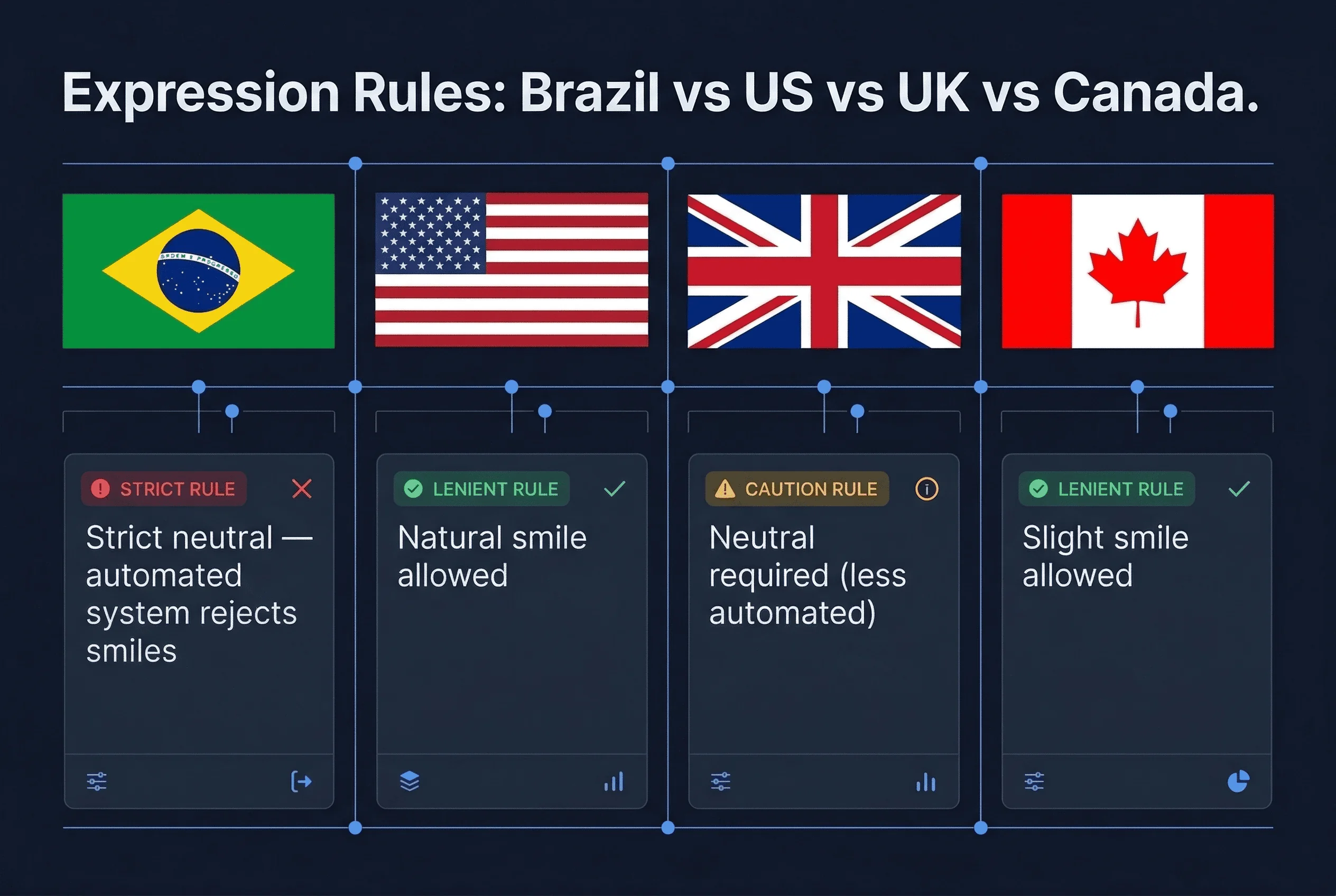
Brazilian Passport Photo Smile Rules vs Other Countries
Brazil's neutral expression rule matches the global standard:
- Brazil: No smile allowed — automated system rejects non-compliant photos
- United Kingdom: No smile allowed — neutral expression required
- Canada: No smile allowed — neutral expression required
- Germany: No smile allowed — neutral expression required
- Australia: No smile allowed — neutral expression required
- Japan: No smile allowed — among the strictest enforcement
- United States: Slight natural smile permitted — the rare exception
The US is the notable global outlier. If you have a US-compliant photo with a smile, it will fail in Brazil. You need a separate neutral photo for your Brazilian passport.
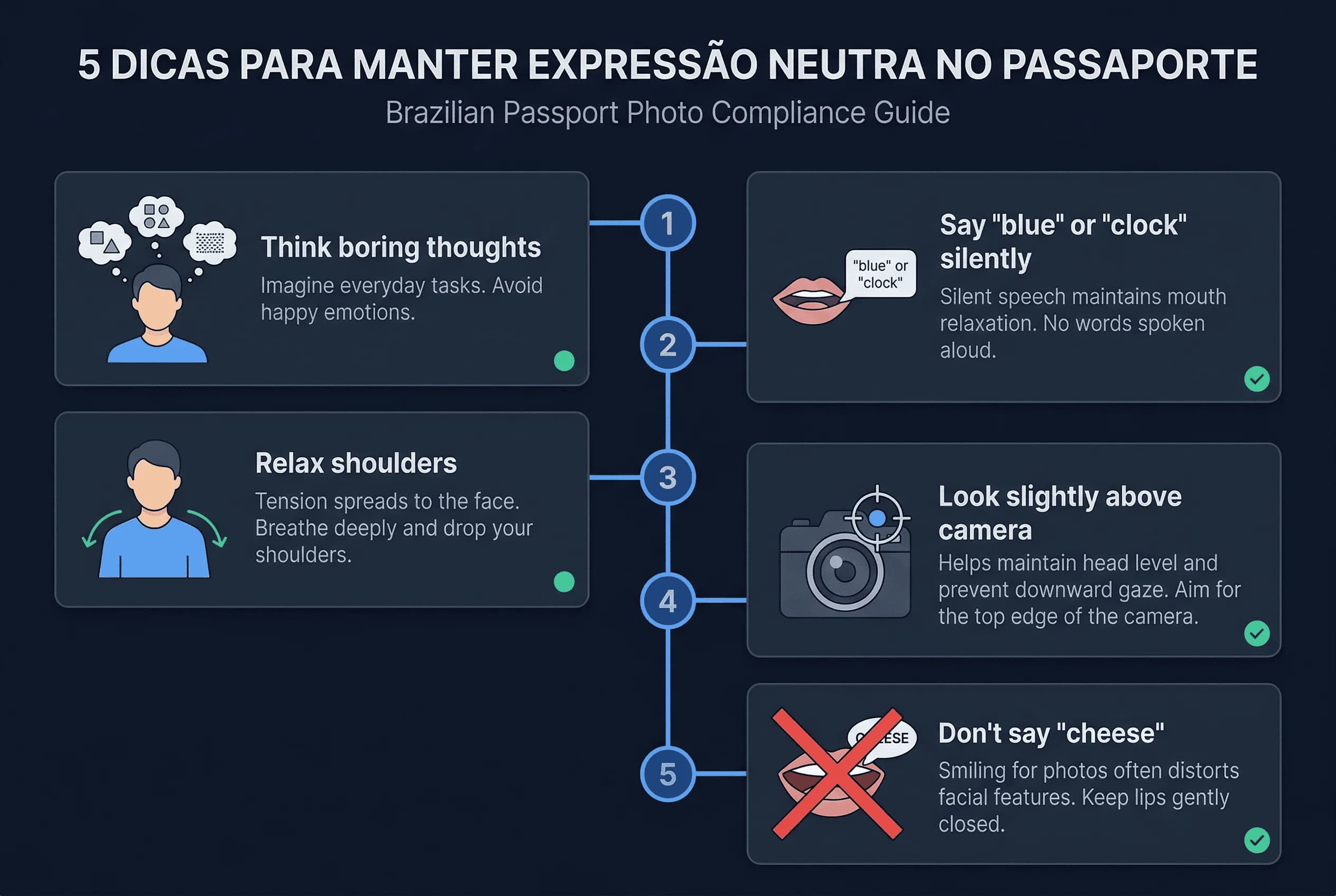
Tips for Achieving a Neutral Expression in Brazilian Photos
Getting a genuinely neutral expression is harder than it sounds. Most people either over-correct (creating a tense, unhappy look) or under-correct (leaving a subtle smile).
Think boring thoughts. Your face follows your mind. Think about routine tasks — what you need from the grocery store, your commute route. Not exciting things.
Say a neutral word silently. Words like "blue," "clock," or "paper" keep lips together without engaging smile muscles.
Relax your shoulders first. Tension travels upward from shoulders to jaw to face. Drop your shoulders, unclench your jaw, then breathe out slowly.
Look at the camera lens. Focus on the physical lens itself, not the screen or viewfinder. This creates a natural, centred gaze.
Breathe out before the shot. Exhaling relaxes the facial muscles. Inhaling creates tension. Time the shutter release to the end of an exhale.
Don't say "queijo" (cheese). Brazilian photographers may say this out of habit. It creates forced smiles. Instead, breathe naturally and maintain your neutral face.
Practice in a mirror for 2–3 minutes before the actual photo session. Find the expression you have when you're listening to someone explain something routine — alert but not emotional. That's your target.
How Nervous Expressions Affect Brazilian Passport Photos
Nervous expressions can mimic smiles or create other problems:
Tight lips — Clenched teeth or pressed lips appear strained. This isn't neutral — it's tense. Let your jaw relax before pressing lips together lightly.
Raised eyebrows — Nervousness often raises eyebrows, creating a "surprised" look. Keep your forehead smooth and eyebrows in their natural position.
Fixed stare — Staring intensely at the camera creates visible tension in the eye area. Blink naturally and maintain a soft gaze.
Shifty eyes — Looking around suggests discomfort and prevents a clean photo. Pick one point (the camera lens) and hold your gaze there.
Jaw clenching — Stress often manifests as jaw clenching, which creates visible tension lines. Consciously unclench and let the lower jaw relax.
A neutral expression isn't tense. It's relaxed. If you're nervous, take several deep breaths before the photo. Breathe out slowly through your mouth, then close it lightly. The camera captures everything — including tension you don't feel.
How Facial Recognition Uses Your Brazilian Passport Photo
Your passport photo will be used for years. Brazilian passports are valid for 10 years for adults. Every time you pass through automated e-gates at Guarulhos (São Paulo), Galeão (Rio de Janeiro), Brasília, Confins (Belo Horizonte), or other Brazilian airports, the system compares your live face to your passport photo.
A smiling passport photo creates a persistent mismatch when you're standing at border control with a neutral face. This triggers manual checks — pulling you out of the automated lane into a queue for a federal police officer. For frequent international travellers, this means cumulative delays over a decade.
Brazil also uses facial recognition at various government services and identification checkpoints. A non-compliant passport photo can cause friction beyond just airport immigration.
Common Expression Mistakes in Brazilian Passport Photos
Polite smile — Brazilians are culturally warm and expressive. The instinct to smile for the camera is strong. Consciously override it: no sorriso.
Partial smile — One mouth corner raised slightly. This asymmetry is easily caught by automated scanning.
Laughing eyes — Crinkled eyes suggest happiness even with a closed mouth. Keep your eye area relaxed.
Forced neutrality — Trying too hard creates tension around the jaw, chin, and forehead. Aim for relaxed, not rigid.
Over-corrected frown — Looking angry or sad because you're trying not to smile. This also draws attention.
Chin tension — Pressing your mouth closed too hard creates a dimpled chin. The jaw muscles should be soft.
What Happens If Brazil Rejects Your Photo for Smiling?
If your photo is rejected for expression, you'll need to retake it. This delays your application. Brazilian passport processing through the Polícia Federal typically takes 6–15 business days. A rejection for expression adds another cycle — another set of photos and another submission.
The rejection notice may not always specify "smile" — it may say the photo doesn't meet federal specifications. Common expression-related rejection triggers include:
- Any visible teeth
- One or both mouth corners raised
- Crinkled "smiling eyes"
- Visible facial tension from over-correcting
- Asymmetric mouth positioning
How Brazil's 50×70mm Size Shows Expression Details
Brazil uses 50×70mm (591×827 pixels at 300 DPI) — one of the largest passport photo formats. This larger format means your face is more detailed in print. Expression deviations that might be invisible in a smaller format (like Japan's 35×45mm) are more visible in Brazil's 50×70mm photo.
Smile Rules for Dual Citizens and Brazilian Americans
If you hold both US and Brazilian citizenship, you need two different photos:
- US passport: Slight smile is fine
- Brazilian passport: Strictly neutral, no smile
The safest approach is to take all photos with neutral expression. A neutral photo satisfies every country's requirements, including the US.
Brazilian Passport Photo Expression Specifications Summary
For the complete picture, Brazil's passport photo requires:
- Size: 50×70mm (591×827 pixels at 300 DPI)
- Background: White (#FFFFFF)
- Expression: Strictly neutral — no smile (boca fechada)
- Glasses: Not allowed
- Recency: Taken within 6 months
Quick Checklist for Brazilian Passport Photo Expression
- Boca fechada (mouth closed)
- No teeth visible
- Mouth corners level (not raised)
- Eyes open and relaxed
- No "laughing eyes"
- Face relaxed, not tense
- No glasses
Verify your expression with the passportsize-photo.online checker. For complete Brazil passport details, see the Brazil requirements hub. For size specifications, see the Brazil passport photo size guide.