Australia does NOT allow smiling in passport photos — and the enforcement is among the strictest globally. Even slight smiles trigger automatic rejection.
This is critical: your expression must be completely neutral.
The Strict Expression Requirement for Australian Photos
Australian passport photos require:
- Mouth closed, lips touching lightly
- No teeth visible
- No corners of mouth raised
- Completely neutral expression
- Eyes open and focused
Any deviation — even a trace of a smile — causes rejection.
Get a compliant passport photo online
Why Are Australian Passport Photo Smile Rules So Strict?
Australia implemented strict expression rules to improve biometric matching accuracy. Their automated gates at airports need consistent baseline expressions for reliable verification.
The 2018 changes (including glasses ban) were part of a broader modernization. The goal: reduce verification failures and speed up border processing.
Australian Passport Photo Smile Rules vs Other Countries
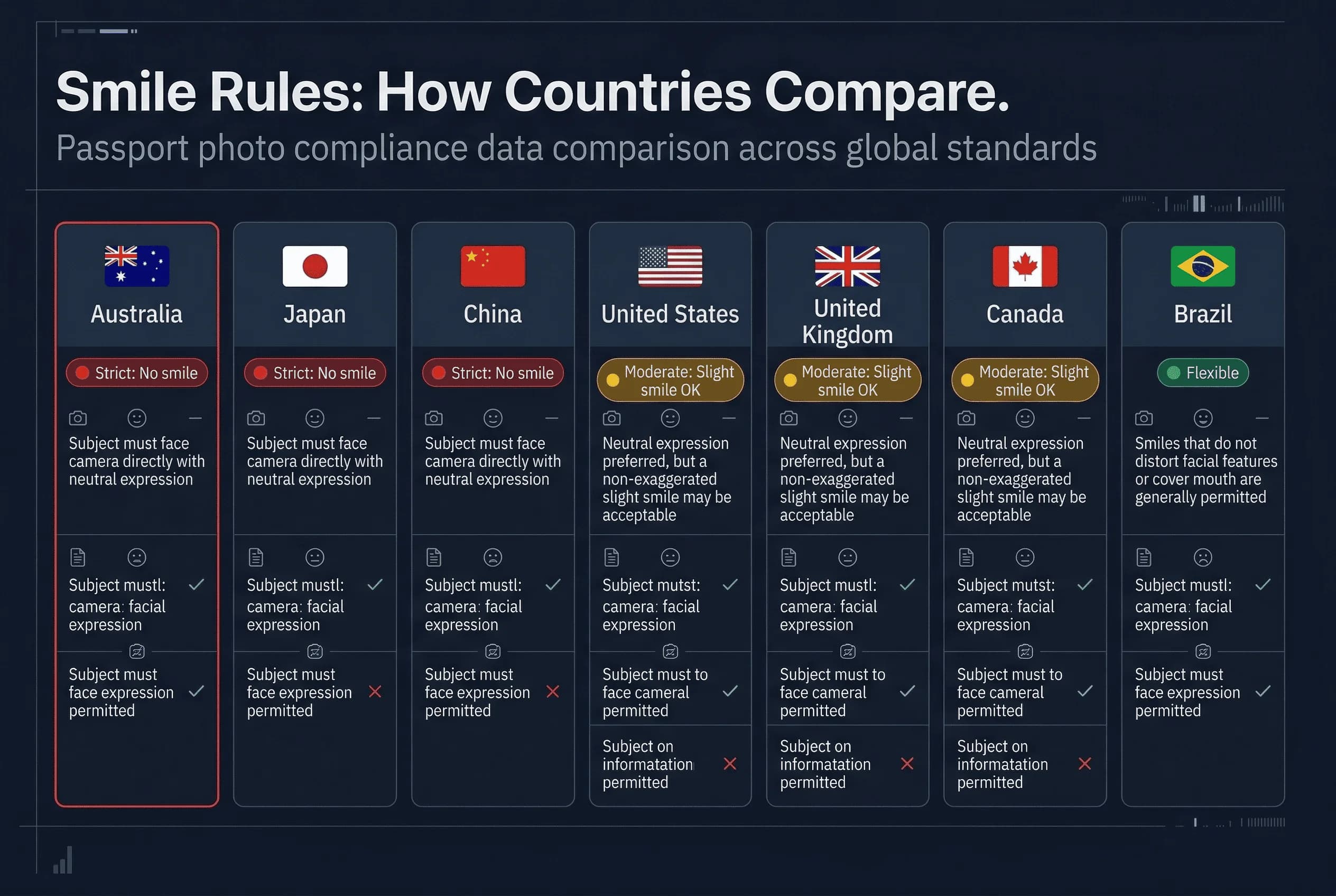
Neutral expression is the global standard. Australia is not unusual in requiring it — but enforcement is among the strictest:
Neutral expression required (no smile)
- Australia — among the strictest enforcement
- Japan — similarly strict
- China — automated system rejects non-neutral
- United Kingdom — neutral required
- Canada — neutral required
- France — neutral required
- Germany — neutral required
- India — neutral required
- Brazil — neutral required
Slight smile permitted
- United States — the rare global exception
The US is the only major country that allows a slight smile. Australia sits at the strict enforcement end of a rule that virtually every country now shares. If you hold dual citizenship, keep neutral expression for all passport photos — it satisfies every country's requirements.
What Does Neutral Expression Mean for Australian Photos?
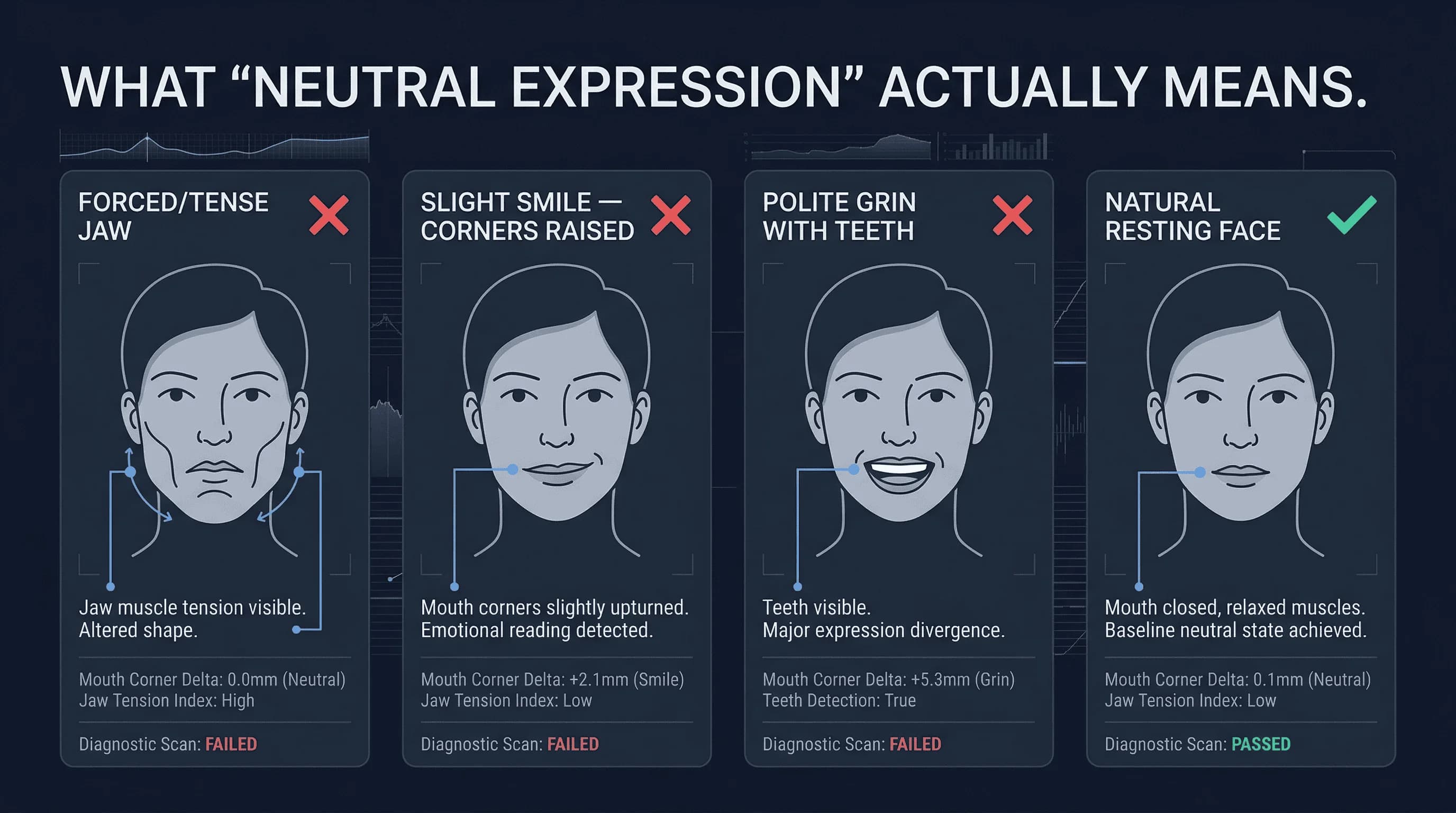
Neutral means:
- Your lips touch without pressing together
- Your jaw is relaxed, not clenched
- Your eye area shows no crinkling
- Your face rests naturally
Don't try to look "neutral" — you'll overdo it. Instead, find your natural resting face.
Neutral vs Natural Expression in Australian Passport Photos
These terms sound similar but differ in practice:
Neutral - A technical term meaning no smile, no expression. The face appears blank to a computer.
Natural - Your actual resting face. This includes tiny muscle tensions unique to you.
Australia's requirement is neutral, but your photo should look natural. The goal is appearing as yourself, not as a robot.
A natural neutral expression shows:
- Slight lip seal (not pressed tight)
- Eyes in their normal open position
- No tension in forehead or jaw
- Your personal, unique resting face
Avoid the "deer in headlights" look. That suggests stress, not neutrality.
What Does Mouth Closed Mean in Australian Passport Photos?
Mouth closed is literal in Australia:
- Both lips touch along their entire length
- No gap between lips
- Teeth must not show
- Corners of mouth not lifted or lowered
Think "closed" not "sealed." Your lips should rest together gently. Pressing them together hard creates visible tension.
A good test: say "mmm" and hold it. Your lips meet naturally. That's the position for your passport photo.
Australian vs US Passport Photo Smile Rules
The United States is one of the few countries that allows slight smiles in passport photos. This is a key difference:
Australia — No smile permitted. Strictly enforced. Even a polite grin triggers automatic rejection.
United States — "Natural" smile allowed. Eyes must be open. Teeth optional (not showing is fine).
If you have a US-compliant photo with a slight smile, it will fail Australian requirements. The automated system catches smiles automatically. You need a separate, neutral photo for your Australian passport.
Tips for People Who Naturally Smile in Photos
Some people naturally look like they're smiling even when neutral. This is common and doesn't mean your photos will fail — the system detects actual smile muscle engagement, not facial structure.
Practice in a mirror for 2–3 minutes. Find your true resting face. If your mouth corners naturally sit high, you may need to consciously relax the muscles around your cheeks. Let gravity do the work.
Think boring thoughts. Don't think about the photo or the photographer. Think about laundry, your commute, or what you need from the shops. Your mind drives your expression.
Say "mmm" and hold it. Your lips meet naturally in a genuine neutral position. This is the technique recommended by many Australian passport photo studios.
Breathe out before each shot. Exhaling relaxes the facial muscles. Inhaling creates tension. Time the shutter to the end of an exhale.
Take 15–20 photos. People who smile easily often need many attempts. Review each on a larger screen — phone screens are too small to spot subtle mouth corner raises. Delete anything showing lip corner elevation immediately.
Don't think "don't smile." Thinking about not smiling makes you hyper-aware of your mouth, which often triggers the very smile you're trying to avoid. Instead, think about nothing. Focus on the camera lens as a physical object.
Common Expression Mistakes in Australian Passport Photos
The polite smile — Australians are culturally friendly and the instinct to smile for the camera is strong. Consciously override it: no smile.
Laughing eyes — Crinkled eyes suggest happiness even with a closed mouth. Keep your eye area relaxed.
Forced neutrality — Trying too hard creates tension around the jaw, chin, and forehead. Aim for relaxed, not rigid.
Partial smile — One corner raised slightly. Check both sides in a mirror.
Over-corrected frown — Looking angry or sad because you're trying not to smile. This also draws scrutiny.
How SmartGate Verifies Your Passport Photo Expression
Australian passport photos must work at automated SmartGates. When you arrive at Sydney, Melbourne, Brisbane, Perth, or other international airports, the system compares your live face to your passport photo.
A smiling passport photo creates a geometric mismatch with your neutral live face. Your cheek positions, eye aperture, and mouth shape all shift when you smile. This mismatch triggers manual checks — pulling you out of the SmartGate into a queue for a border officer. Australian passports are valid for 10 years — a bad photo means 10 years of friction at every international trip.
What Happens If Australia Rejects Your Photo for Smiling?
If your photo is rejected for expression, you'll need to retake it. The Australian Passport Office rejection notice may not always specify "smile" — it may reference "photo does not meet specifications."
Rejection adds processing time to your application. Standard processing is 6–8 weeks; a rejection adds another cycle to that timeline.
Australian Passport Photo Expression Specifications Summary
For the complete picture, Australia's passport photo requires:
- Size: 35×45mm (413×531 pixels at 300 DPI)
- Background: White (#FFFFFF)
- Expression: Strictly neutral — no smile
- Glasses: Not allowed (banned since 2018)
- Head height: 32–36mm in print
- Recency: Taken within 6 months
Quick Checklist for Australian Passport Photo Expression
- Mouth closed, lips touching lightly
- No teeth visible
- Mouth corners level (not raised)
- Eyes open and relaxed (no crinkling)
- Face muscles relaxed (no visible tension)
- No glasses
- White background
Verify your expression with the passportsize-photo.online checker. For complete Australia passport details, see the Australia requirements hub. For size specifications, see the Australia passport photo size guide.